


Congratulations to Alexia Fürnkranz-Prskawetz on receiving the prestigious EAPS Award for Population Studies!
08.06.2026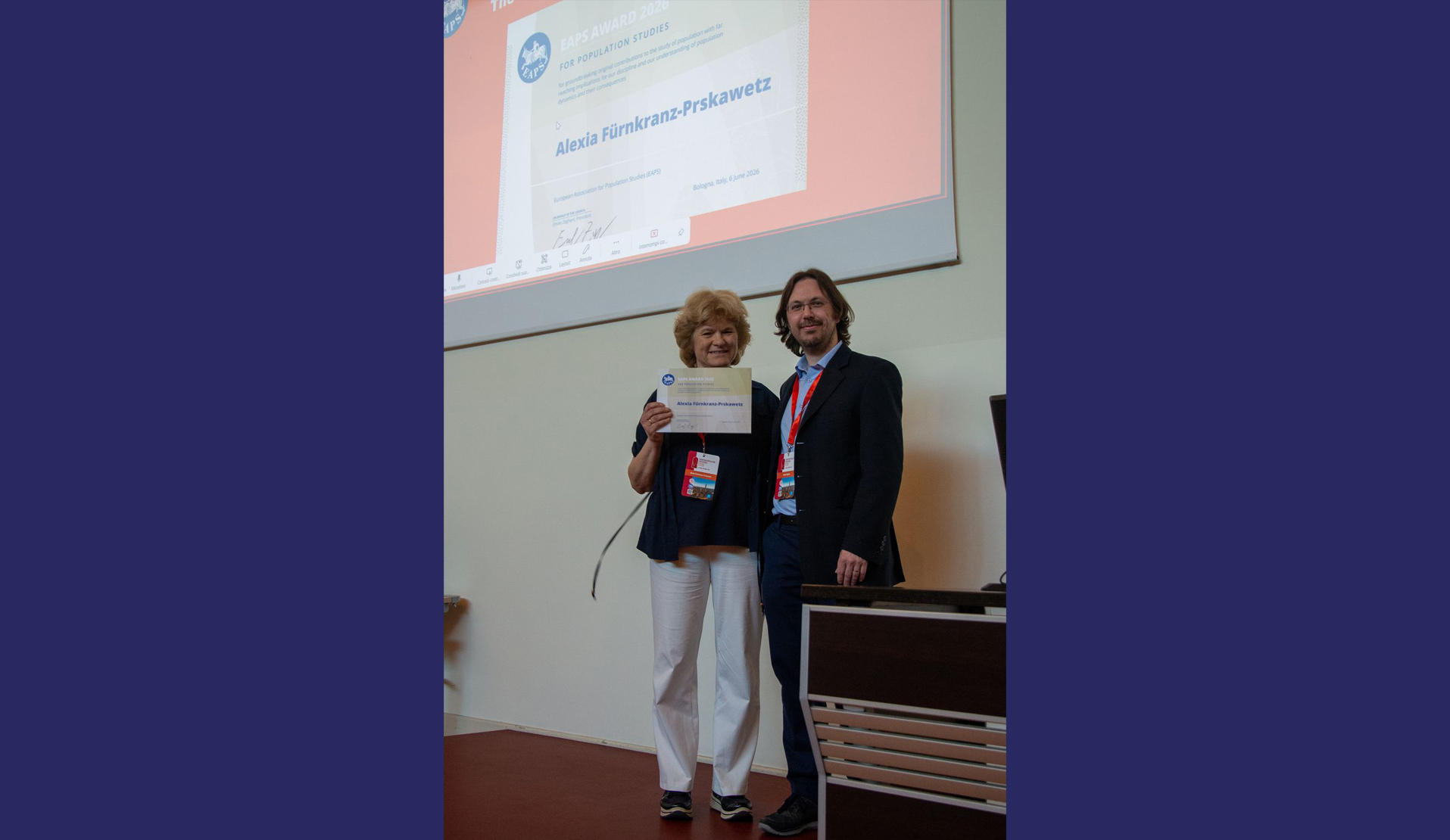
Huge congratulations to Alexia on receiving the prestigious EAPS Award for Population Studies!
This highest award of the EAPS honors groundbreaking original contributions to the study of population with far reaching implications for our discipline and our understanding of population dynamics and their consequences.
Alexia on receiving the award
“I am deeply honored and grateful to receive this award from the European Association for Population Studies. EAPS gives me a home for already more than three decades. My sincere thanks go to the selection committee, to the colleagues who nominated me and to my mentors, collaborators, students and co-authors. This award belongs to all of them. The award is also a recognition of the bridges our field has built. Bridges between disciplines and bridges across methods. We need to continue on this way and reach out to other disciplines. This not only allows for a better understanding of demographic processes but also allows us to show the role of demographic processes for our societies.”
About Alexia Fürnkranz-Prskawetz
Alexia Fürnkranz-Prskawetz is Professor of Mathematical Economics at the Institute of Statistics and Mathematical Methods in Economics at TU Wien (since 2008). Currently she is also deputy group leader of the research group “Economic Demography” at the Vienna Institute of Demography, Austrian Academy of Sciences and senior guest research scholar at the International Institute of Applied Systems Analysis, Laxenburg, Austria. Her main areas of research are in the economic consequences of population and individual ageing, long run economic growth, and models on the interlinkage between the economy, environment and demography.
Notably, Alexia has contributed to the integration of population science and economics across all areas of demography (fertility, health and longevity, population ageing, migration, and economic-demographic projections), connecting them with counterparts in economics (family, labour, health, social security, education). Her work spans micro-, meso-, and macro-analysis and comprises theoretical, empirical and policy-oriented research.