



An exotic atom is where one or more of the normal subatomic particles (protons, neutrons, and electrons) in an atom have been replaced with an ‘alternative’. For example, if we replace the proton in hydrogen with a positron we form positronium, the quasi-stable short-lived bound state of the positron and electron. By studying exotic atoms, we can probe matter-antimatter interactions, search for symmetry violation and hence probe physics beyond the standard model at low energies using ‘relatively’ small experiments. Exotic atoms present extreme versions of the everyday, enhancing properties that we cannot easily probe in conventional atoms. Most exotic atoms are hard to make and unstable when you do make them, but these enhancements make them worthwhile and ensure a large community of expotic atom research worldwide of which MBI is a part.
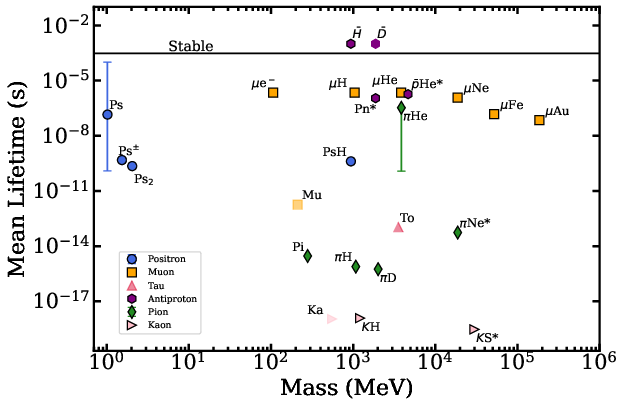
The exotic atoms group works with positrons and antiprotons to make systems including positronium and antihydrogen (a bound positron and antiproton). In Vienna we run Austria's only antimatter beamline to study positronium and how it interacts with its environment, see this page for more information. At CERN, Geneva we make antihydrogen using antiprotons from the AD/ELENA and particle accelerator complex, see this page for more information. On the graph below you can see the mass of these exotic species plotted against their lifetime. Positronium lasts for up to microseconds, and antihydrogen is stable, making these two atoms some of the easiest to study.
Group Members
- Alina Weiser - PhD Student
- Dr. Ross E. Sheldon - PostDoc
Former Members
- Dr. Eric Hunter - PostDoc
- Dr. Andreas Lanz - PhD Student
- Dr. Daniel Murtagh - Group Leader
Available Positions
If you are a motivated undergraduate student in physics interested in a research project, please get in touch with us about possible Internships and BSc/MSc Theses. If you want to collaborate on research, or you would like to pursue a PhD or PostDoc with us, please contact us.
