


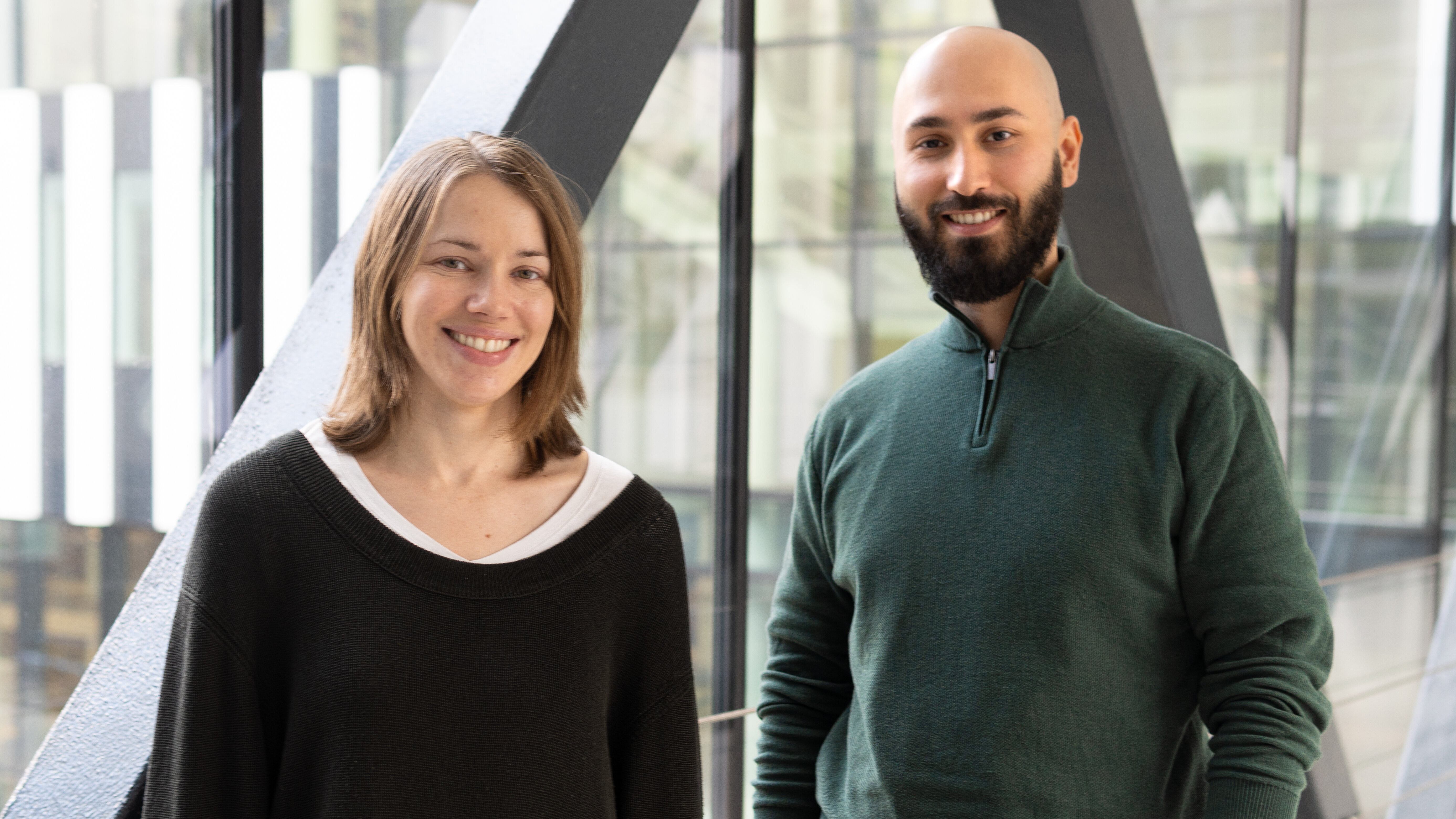
Sara Wighard and Oguzhan Kaya, two postdoctoral researchers at IMBA, were awarded Marie Skłodowska-Curie Postdoctoral Fellowships. The highly competitive fellowships, awarded by the European Comission, support outstanding scientists in EU research institutions to foster excellence in research. Sara Wighard joined Alejandro Burga's research group in 2024. Oguzhan Kaya also recently joined IMBA as part of Jürgen Knoblich's group.

In her project, Sara Wighard aims to investigate how selfish genetic elements contribute to biological innovation. Selfish genetic elements are genetic parasites that ensure their transmission to the next generation by inserting themselves into the genome of germline cells. However, defense systems comprised of small RNAs and proteins defend the genome against such threats, detecting and silencing selfish elements to preserve DNA integrity.
With selfish genetic elements and the host genome pitted against each other, an arms race unfolds in the germline, in which selfish elements and genome defense mechanisms continuously adapt to outcompete one another. This arms race represents an opportunity for biological innovation: selfish elements can reshape genome architecture and provide new genetic material, while adaptations in genome defense can catalyze the development of new molecular mechanisms, such as the evolution of adaptive immunity in prokaryotes and vertebrates.
In her project, Wighard will use nematode models to study how selfish elements influence the host genome. “Using genetic and phylogenetic approaches, I will investigate how newly introduced selfish elements affect genome architecture and gene regulation, and how the genome defense machinery responds,” Wighard explained. Ultimately, Wighard’s project aims to deepen our understanding of the conflict between selfish elements and their hosts, shedding light on the role that selfish elements play in driving evolutionary innovation. Insights into nematode defense mechanisms could inform strategies to combat human and plant-parasitic nematodes.
Oguzhan Kaya aims to understand the bidirectional communication between tumors and healthy neurons in the brain. Brain tumors can severely impair brain function, leading to behavioral changes, loss of motor function and abnormal brain signaling. “Some brain tumors can cause severe seizures, especially in children,” Kaya explained. “I will study how the tumor communicates with the rest of the brain and alters the brain’s electrical signaling to trigger epileptic seizures.”
As part of his project, Kaya will collaborate with the Medical University of Vienna to receive tumor samples from patients with diffuse hemispheric glioma, a rare childhood cancer with a very poor prognosis. Understanding how tumor cells and neurons connect and interact will be crucial to uncovering how diffuse hemispheric glioma and other brain tumors utilize neuronal input to their advantage and cause neurological symptoms including epileptic seizures.
“I will transplant tumor cells into human brain organoids to study the crosstalk between diffuse gliomas and cortical neurons,” Kaya explained. Leveraging technologies pioneered by the Knoblich lab, Kaya will study how cancer cells and neurons interact. “Using viral neural tracing, I will study how tumor cells and neurons connect in brain organoids and analyze how these connections can affect network activity in the brain organoid.”
In his project, Kaya also aims to identify the molecular mechanisms underlying neuron-glioma interactions. “I will use genetic perturbation screenings to identify genetic vulnerabilities in tumor cells that could be targeted to develop novel treatments for diffuse hemispheric glioma.” His findings could inform new therapeutic strategies against other brain tumors.
During her PhD in Evolutionary Biology at the Max Planck Institute for Biology in Tübingen, Wighard studied the evolution of phenotypic plasticity in nematodes. In 2024, Wighard joined the lab of Alejandro Burga at IMBA as a postdoctoral researcher.
“I’m delighted to be selected for such a prestigious fellowship, it is a great achievement,” Wighard says. “The funding and networking opportunities provided will support me in developing as a scientist and following my research goals.”
During his PhD in Molecular Neurobiology at the German Cancer Research Center in Heidelberg, Germany, Kaya studied how stem cells in an adult brain activate in normal and malignant conditions and how their activation can lead to cancer. In 2024, Kaya joined the lab of Jürgen Knoblich at IMBA as a postdoctoral researcher.
“I'm happy to have my ideas get recognized with this fellowship,” Kaya says. “As a non-European citizen, I’m extremely grateful to the European Union and the Marie Skłodowska-Curie Action for their unwavering support for science, which has been essential to my career so far.”
The European Commission’s Marie Skłodowska-Curie Postdoctoral Fellowship Program awards two-year postdoctoral fellowships to outstanding scientists working in research institutions in EU member states to support their careers and foster excellence in research.
The selection process evaluates the applicant's achievements and the scientific quality of the project and the host laboratory. The process is highly competitive, with less than 15 percent of applicants receiving a fellowship. On top of a monthly stipend, the fellowship provides research and travel allowances, and the program organizes a yearly meeting.