



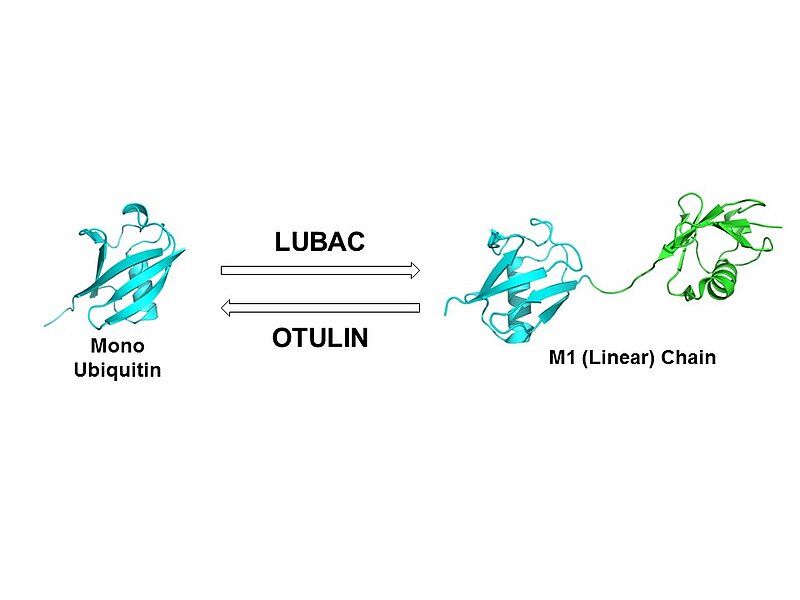
Commonly ubiquitination occurs on lysine (Lys) residues of substrates. Only recently it was shown that not only Lys residues, but also methionine (Met) 1 residue in ubiquitin can be targeted for ubiquitin chain formation. These ubiquitin chains linked via Met1 are called linear ubiquitin chains. “This is the only type we call linear ubiquitin chains. They are characterized by tandem repeats and play an important role in the regulation of cellular signaling including the tumor necrosis factor (TNF) signaling cascade”, explains Fumiyo Ikeda.
Today Fumiyo Ikeda published a review on linear ubiquitination in the journal Immunological Reviews. The key message in this article is that this unique type of ubiquitination plays a critical role in the immune response and is strictly regulated by particular enzymes.
Linear ubiquitin chains are generated by the enzyme complex “linear ubiquitin chain assembly complex” (LUBAC). This complex consists of three components: HOIP, HOIL-1L and Sharpin. Based on the functional analysis of LUBAC at cellular and molecular levels, together with observations in genetically modified mouse models, it is now understood that this ligase complex is important in the regulation of inflammation, apoptosis, development and cancer.
Another important type of enzyme is the deubiquitinase (DUB) which is able to hydrolyze ubiquitin chains. Recently a DUB called OTULIN was found to be the first linear ubiquitin chain-specific DUB. Interestingly, deficiency of OTULIN or dysregulation of OTULIN enzymatic activity leads to improper cellular signal transductions, which depend on the LUBAC. Because the OTULIN mutant mice are embryonic lethal, it is obvious that OTULIN plays a critical role during development in mice, however its biological roles especially in vivo are still elusive.
The concept of ubiquitin as a critical cellular signaling regulator, which can be independent from proteasomal degradation, has been established in the past years. “There are still many open questions, but it seems that there are correlations with patients suffering from autoimmune diseases”, says Fumiyo. It was found that some of the autoimmune deficiency patients have mutations in two of the three component genes that encode LUBAC. The linear ubiquitin chains function as a protein modifier to recruit signaling complexes that adjust and control cellular functions. The LUBAC components are involved in the regulation of pathological conditions, such as inflammation and cancer development. As a result, it is crucial to understand more about molecular regulation of LUBAC, as this could help developing possible therapeutic strategies.
Original Publication
Fumiyo Ikeda (2015): Linear ubiquitination signals in adaptive Responses. Immunological Reviews, Volume 266, Issue 1, pages 222-236
DOI: 10.1111/imr.12300