


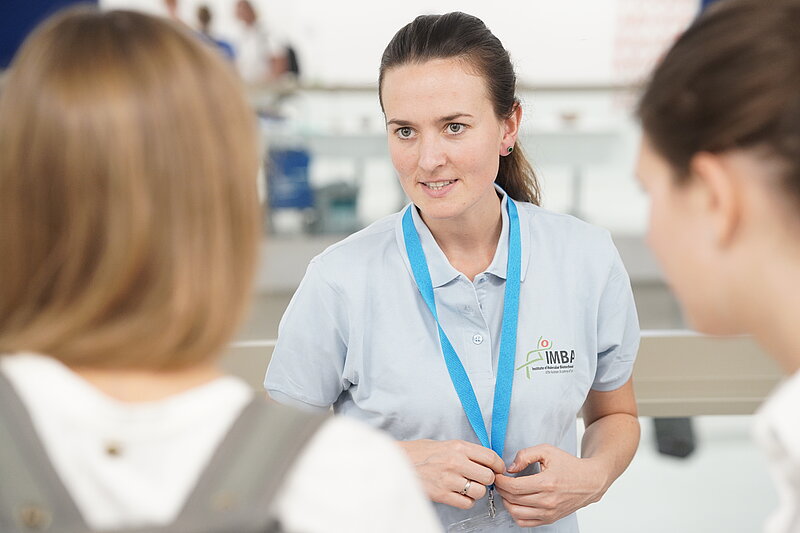
The Disruptive Innovation – Early Career Seed Money funding program of the Austrian Academy of Sciences (ÖAW) and the Austrian Science Fund (FWF) selected the project “Effects of microglial maturation on neuronal function in the context of autism spectrum disorder” by Laura Kracht, a postdoctoral researcher in the lab of Jürgen Knoblich at IMBA, for one of the program’s competitive fellowships.
Laura Kracht did her PhD at the University Medical Center Groningen, in Netherlands, where she studied how microglia, a type of immune cell present in the brain, regulates normal brain development. “Microglial cells have many different functions, especially during brain development. My research showed that developed microglia are present in the early stages of brain formation and are very important in regulating how neuronal connections are formed,” Kracht explains. “Glial cells phagocytose dying neurons and help shape synapses by removing unnecessary neuronal projections and releasing neurotrophic factors, among other functions”.
Kracht joined the Knoblich lab as a postdoctoral fellow in November 2022. In her project, Kracht wants to study how deregulation of microglial maturation and function can compromise neurodevelopment. “I will investigate how mutations in a subset of genes related to autism susceptibility can affect the function of the microglia, and how this impacts the normal formation of neuronal connections.” Kracht will take advantage of the brain organoids developed by the Knoblich group, as well as the CHOOSE system. This CRISPR-based gene editing technology allows the group to scan the functional effects of various specific genetic mutations at the same time in cells of the same organoid. “I will knock out 50 different genes and see what effect each mutation has in the function of the microglia cells,” Kracht explains.
Kracht’s project will be the first to combine genetic perturbations in microglia with brain organoids to analyze gene expression and function. “Normally, microglia are studied in two-dimensional cultures, but microglia cells are highly responsive to their environment. By adding microglia to brain organoids, we can study these cells in an environment that is more similar to our brain,” Kracht points out. The project will use single cell sequencing technologies to study how single mutations in autism susceptibility genes alter gene expression patterns. Her research will provide insights into the function of microglia in neuronal development and, potentially, uncover mechanisms involved in the etiology of autism.
“I’m very grateful for the support by the Disruptive Innovation program. It was a great experience to participate in the selection event, which included poster and oral presentations and scientists from all kinds of different fields. Sharing my science with a different kind of audience was very enriching, broadening my scope and getting me out of my comfort zone,” Kracht says. The funding will cover material and reagent costs of her research project for the next year. “I was very honored and happy to be selected. This funding will help my project but will also be a great step for my future career,” Kracht concludes.