


Jumping genes leap across cells and generations
23.09.2026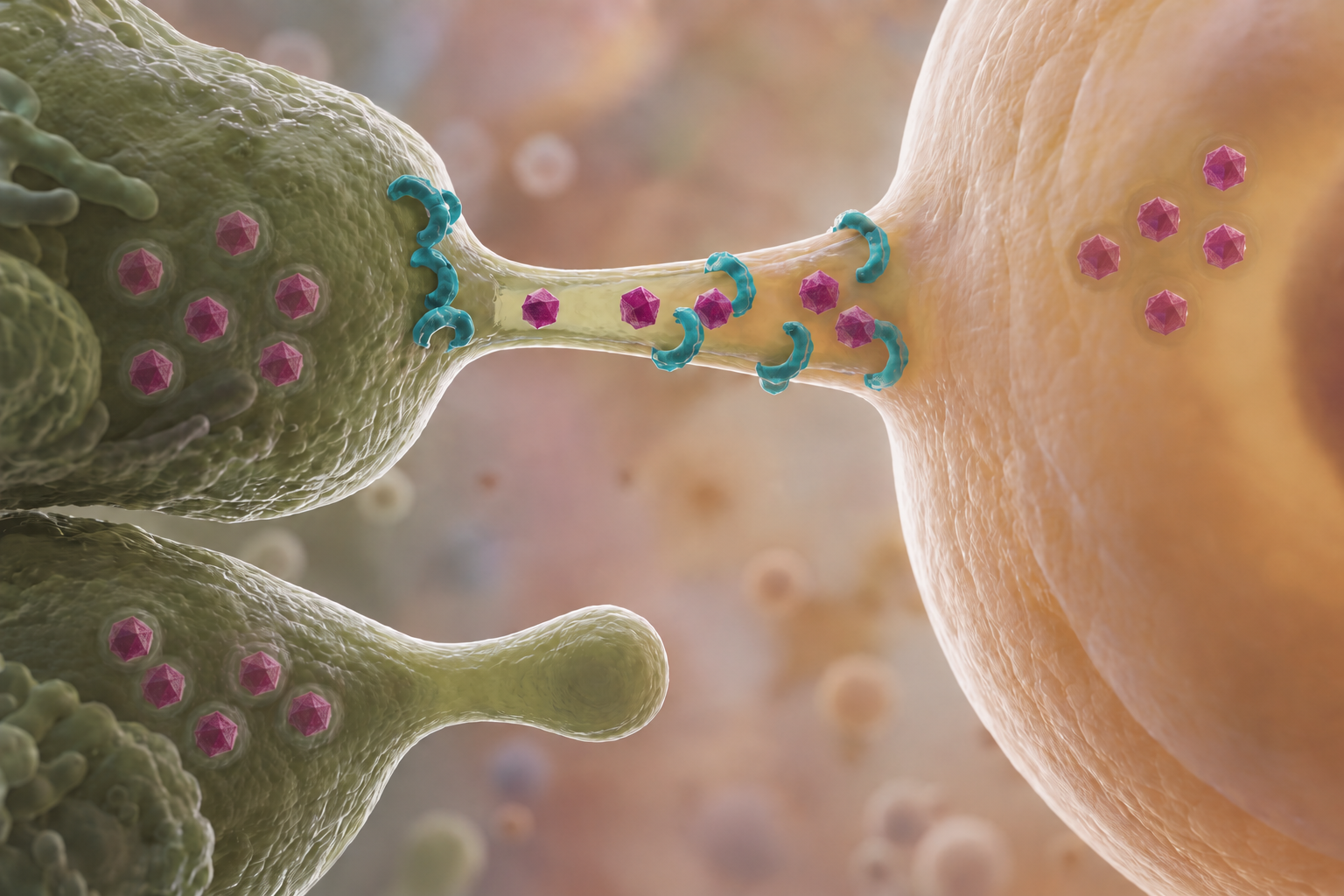
Nearly half of the human genome originates from ‘jumping genes’ or transposable elements. These DNA parasites move within genomes for their own advantage, either cutting themselves out of a chromosome and transferring to a new location or duplicating themselves as RNA that is then reconverted to DNA and inserted elsewhere. Although most transposable element insertions have lost the ability to move, their past activity was a major force in genome evolution.
Retroviruses, a viral family that includes HIV, exploit a very similar mechanism to insert themselves into the host’s own genome. If this insertion is undetected, the host cell treats viral DNA as its own, using it as a template to produce new virus particles that leave the cell in search of a new target. Unlike retroviruses, most transposable elements lack the machinery to move across cells and are typically confined to the one where they are expressed.
Researchers in the lab of Julius Brennecke now show in a fruit fly model that a group of transposable elements manipulate their host cell to break loose and infect nearby cells. These jumping genes are active in the ovary, shipping themselves from neighboring cells to the developing egg, a foothold that guarantees the transposable element’s own survival across generations. The new study, now published in the journal Cell, blurs the established line between transposable elements and viruses.
One-way ticket into the genome
Until now, scientists knew of only one mechanism for a transposable element to cross from one cell to another: by using a virus-like envelope protein. In this study, the team uncovered the second such mechanism ever identified - and even pinpointed the specific molecule driving it.
A small protein encoded by the transposable element itself, sORF2, orchestrates the operation. It manipulates the cells in which the transposable element is located to grow finger-like structures that reach for the egg. Once contact is established, the membranes of these fingers and the egg appear to fuse, allowing the transposable element particle, carrying its genetic material, to slip through.
“Transposable elements are normally kept silenced by the cell's own defense systems,” says Maya Voichek, first author and former postdoc at IMBA. “We developed approaches to switch the defense system off in a controlled way, letting normally dormant transposable elements spring back into action so we could watch the process happen under the microscope.”
By making it into the egg, a transposable element becomes virtually immortal: passed down from parent to offspring for generations to come. However, this invasion comes at a cost. Flies in which these jumping genes were experimentally reactivated laid far fewer viable eggs, with hatching rates dropping from about 70 percent to as low as ten percent.
A widespread strategy with deep evolutionary implications
The team found that sORF2-like proteins are common among insect transposable elements and across species, from fruit flies to disease-spreading mosquitoes and crop-damaging beetles. But these proteins also show up in some viruses of fish and birds. “These viruses weren't known to be able to fuse cells at all, but our investigations in the lab demonstrated that they are,” says Voichek. “It looks like sORF2 is a widespread alternative infection strategy for viruses and transposable elements that need to move between cells but lack an envelope protein.”
“This discovery makes it much harder to say where a selfish piece of DNA ends and a virus begins. sORF2 gives these transposable elements virus-like powers. They can permanently rewrite their host's genome, thereby changing the course of evolution,” says Julius Brennecke, senior group leader at IMBA. “That molecular toolkit could eventually be harnessed to deliver chosen genes into cells, for research or therapeutic purposes.”
These findings speak to several fields at once, adding a new chapter to virology, raising fresh questions in reproductive and developmental biology, and pointing toward new possibilities in gene-delivery research.
Original publication
Maya Voichek, Andreas Bernhard*, Lea Lauterjung*, Maria Novatchkova, Dominik Handler, Paul Möseneder, Liudmila Protsenko, Baptiste Rafanel, Svetlana Iarovenko, Peter Duchek, Kirsten-André Senti**, Julius Brennecke**. Direct cell-to-cell transmission of retrotransposons. Cell, 2026. DOI: 10.1016/j.cell.2026.08.047
*these authors contributed equally to the study
**co-corresponding authors