


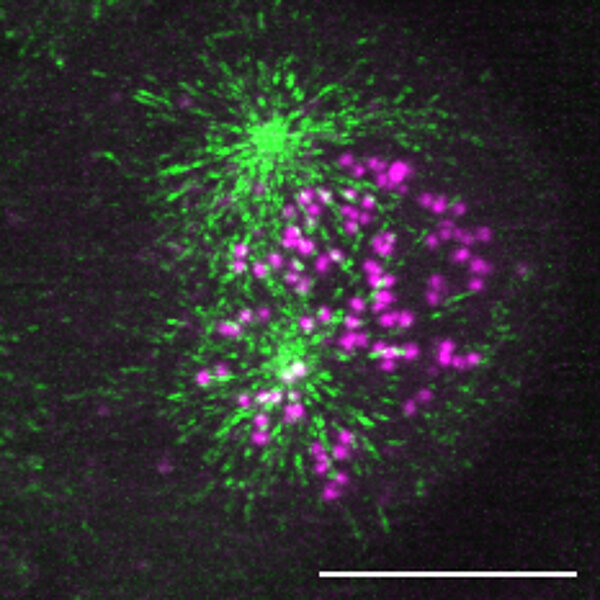
Among the winners is Daniel Gerlich, group leader at the Institute for Molecular Biotechnology (IMBA). Together with Alipasha Vaziri, Group leader at the Institute of molecular pathology and the Max F. Perutz Laboratories, and Kareem Elsayad, leader of the CSF Advanced Microscopy Facility, he aims to visualize the dynamics of individual microtubules in the project „Elucidating mitotic spindle assembly mechanisms by super-resolution fluorescence microscopy“.
As first step, the team will build a Bessel beam light-sheet microscope, following the design of the inventor, Eric Betzig, Nobel Laureate in Chemistry 2014 at Janelia Research Institute (USA). "We want to establish the technology of the Bessel microscope at the Vienna Biocenter and optimize it for our biological applications", says Gerlich. With the new technology individual microtubules can be observed in real time as they build the mitotic spindle of human cells, which reveal unprecedented detail about its assembly mechanisms.
The Bessel beam technology exposes biological samples with much less light and therefore enables ultra-fast imaging without perturbing sensitive biological processes such as cell division. Within a few seconds more than 10,000 images can be recorded without damaging the mitotic spindle. Conventional confocal laser microscopy, in contrast, becomes toxic for dividing cells already at a rate of about one frame per second.
Besides its application to study cell division, the implementation of a Bessel beam microscope will also contribute to develop the Vienna Biocenter as an outstanding center for bioimaging.