


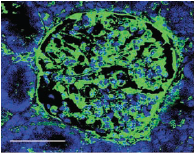
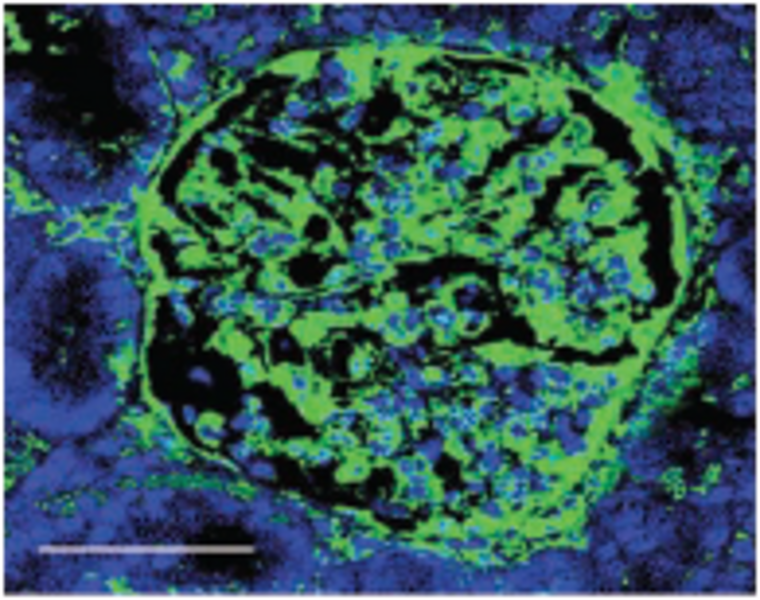
Recently, a team of researchers, amongst them Christoph Gebeshuber, postdoc at IMBA, found out that over-expression of miR-193a in podocytes (the cell type establishing the filtration barrier within the kidney glomerulus) induces FSGS in transgenic mice by down-regulating WT-1, a transcription factor essential for podocyte homeostasis. Their data showed that a huge subgroup of FSGS patients exhibits enhanced miR-193a levels.
Preliminary experiments in mice suggest that functional inhibition of miR-193a might be a therapeutic approach in individuals with miR-193a-driven FSGS.
Original Publication
Gebeshuber, Kornauth, et.al. Focal segmental glomerulosclerosis is induced by microRNA-193a and its downregulation of WT1. Nat Med. 2013 Apr;19(4):481-7. doi: 10.1038/nm.3142. Epub 2013 Mar 17.