


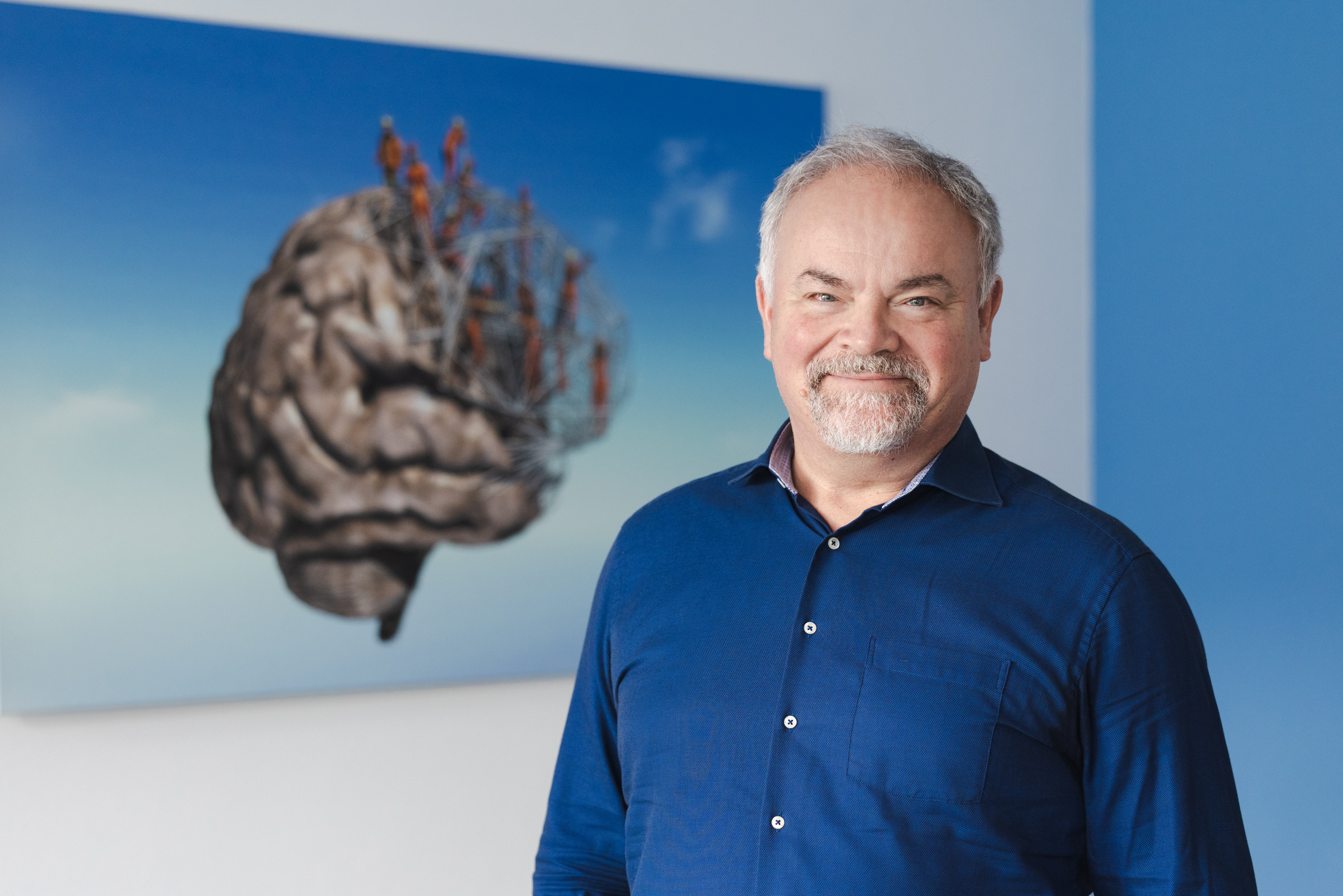
The ERC Advanced Grant is among Europe's most prestigious and competitive funding schemes, supporting established researchers pursuing ambitious, high-risk projects with the potential to drive major advances in their fields. Jürgen Knoblich's project, CASCO – Connectivity and Activity in Self-Organizing Cortical Organoid Networks, is one of the projects selected for funding in the latest ERC Advanced Grant competition.
The human cerebral cortex is responsible for higher cognitive functions including perception, learning, memory, and decision-making. These abilities depend on highly organized networks of excitatory and inhibitory neurons whose activity must remain precisely balanced. Disruptions of this balance are a hallmark of many neurological and neurodevelopmental disorders, yet the mechanisms by which such networks form during human brain development are not known.
Knoblich's research has long focused on understanding human brain development using cerebral organoids—three-dimensional stem-cell-derived tissue models that recapitulate key aspects of the developing human brain. His laboratory pioneered the development of brain organoid technology, opening new opportunities to study uniquely human developmental processes that are difficult or impossible to investigate in animal models.
Building on these advances, the CASCO project will investigate one of the central questions in neuroscience: how diverse neuronal cell types self-organize into functional cortical networks. A particular focus will be on understanding how different types of neurons work together to establish the delicate balance between excitation and inhibition that allows brain networks to function properly—a fundamental feature of brain circuits that is frequently disrupted in neurodevelopmental disorders.
Using cerebral organoids, the researchers will systematically vary the composition of neuronal cell types and examine how these changes affect network activity. The project will explore how cell type composition influences key characteristics of cortical networks, including synaptic connectivity, synaptic strength, and network organization.
To better understand how brain networks emerge, the team will develop predictive machine learning models that connect the types of neurons present in a network with its electrical activity. These models will help researchers understand how changes in cellular diversity influence the function of developing brain circuits.
The project will also explore how genetic alterations associated with neurological disorders affect the formation and function of cortical networks. Using organoid models of Tuberous Sclerosis Complex, a disorder frequently associated with epilepsy, and ARID1B-related Coffin–Siris syndrome, a neurodevelopmental disorder linked to autism, the team will investigate how disease-causing mutations alter cell type composition, neuronal connectivity, and the balance between excitation and inhibition.
Through CASCO, Knoblich's laboratory aims to transform cerebral organoids from systems that recapitulate aspects of human brain development into models that can predict how changes in cellular composition influence network activity and function.
About ERC Advanced Grants
The European Research Council, set up by the European Union in 2007, is the premier European funding mechanism for excellent frontier research. The ERC's mission is to facilitate the highest quality of research across all fields in Europe through competitive funding. The ERC offers four core grant schemes: Starting Grants, Consolidator Grants, Advanced Grants and Synergy Grants.
ERC Advanced Grants provide long-term funding for established leading principal investigators who want to pursue a ground-breaking, high-risk project. ERC Advanced Grants provide funding of up to 2.8 million Euro for a period of five years to support personnel and research costs of the funded project.