


The research group of Kazufumi Mochizuki at the Institute of Molecular Biotechnology (IMBA) is studying a process called DNA Elimination. Eukaryotes like mammals and plants use small RNA directed heterochromatin formation to silence transposable elements (TEs). TEs are DNA sequences that are able to change their positions within the genome . It is essential that they are kept silencing. Otherwise they stop jumping, occupy important parts of the genome and activate unwanted function leading to diseases like cancer.
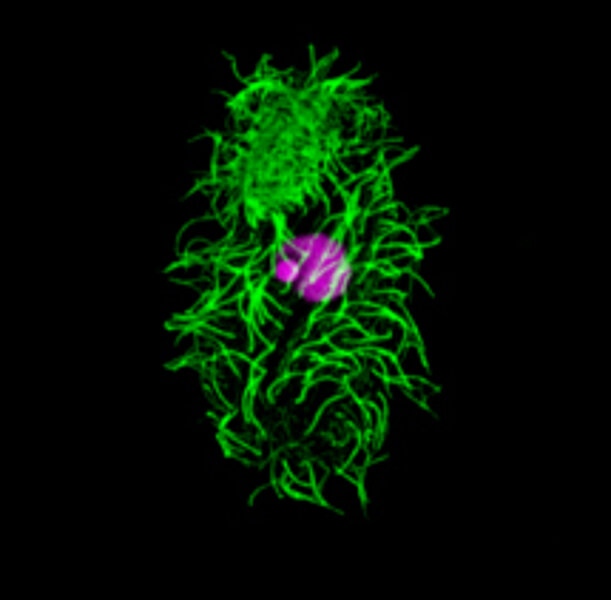
Also in Tetrahymena TEs disperse throughout the genome. “Although there are a number of different TEs, Tetrahymena are able to identify all sets of TEs very precisely. More curiously, they get rid of all TEs - this process is called DNA Elimination”, says Mochizuki. Since several decades Tetrahymena is a classic model species. Already two Nobel Prizes were awarded based on studies using this protozoa. Tetrahymena are famous for the presence of two nuclei in each cell: a larger, somatic macronucleus and a smaller, germline micronucleus. They have different functions with distinct cytological and biological properties.
How do Tetrahymena recognize TEs? “They use small RNA to identify them and compare the whole genome”, explains Mochizuki. Only the germline genome has TEs, but not the somatic one. They compare the germline and the soma genome, to find the TEs.
“But this whole genome comparison is not the only way”, says Mochizuki. In a recent publication the group at IMBA reports about many genomic locations in Terahymena which do not produce small RNAs - obviously only half of the genomic region make RNA. How are TEs in these regions identified? Kazufumi Mochizuki and colleagues could show that a limited set of TE-related sequences (internal eliminated sequences, IESs) first produces small RNAs. These small RNAs then recognize not only the IESs from which they derived, but also other IESs in trans. The trans recognition triggers the expression of yet another class of small RNAs that identify other TE-related sequences. In short: in Tetrahymena TEs are targeted for elimination by a genome-wide trans-recognition network.
Original Publication
Noto T, Kataoka K, Suhren JH, Hayashi A, Woolcock KJ, Gorovsky MA, Mochizuki K. Small-RNA-Mediated Genome-wide trans-Recognition Network in Tetrahymena DNA Elimination. Mol Cell. 2015 Jul 16; 59(2):229-42. doi: 10.1016/j.molcel.2015.05.024.