


Breast cancer: New insights could improve immunotherapy response
27.05.2026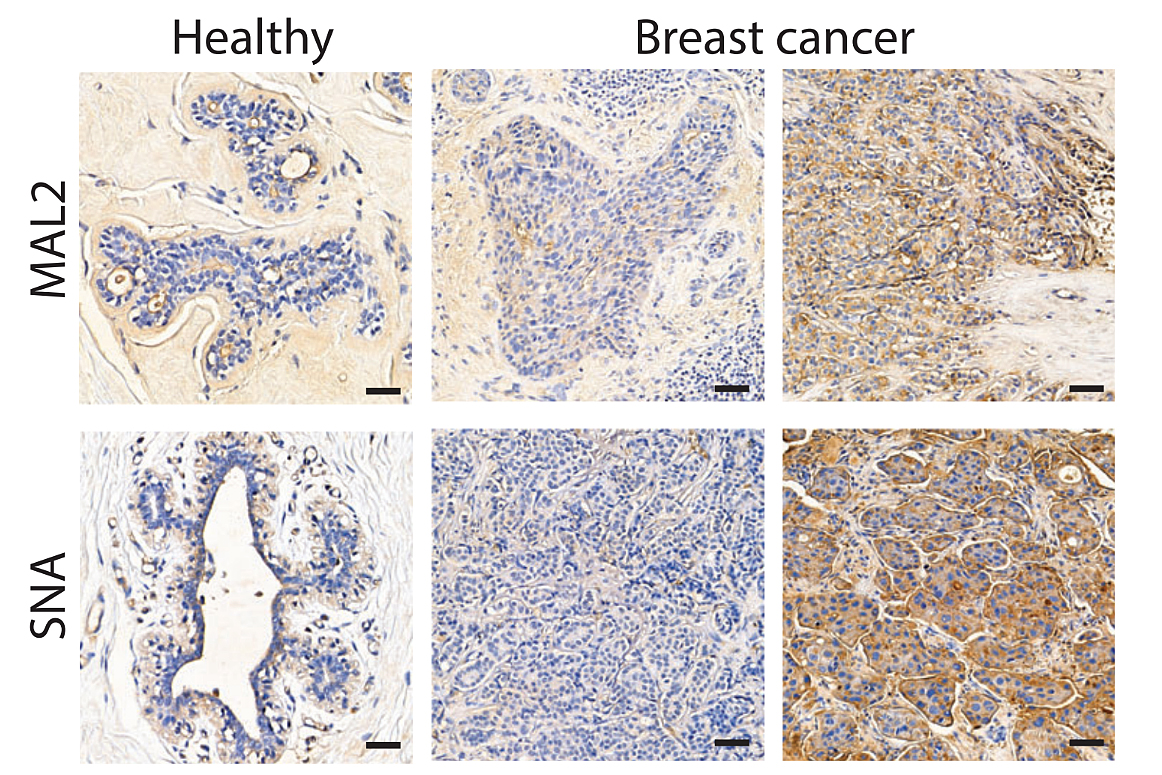
Immunotherapies such as checkpoint inhibitors work by activating the body’s own immune system to recognize and destroy cancer cells. While these therapies have transformed the treatment of several cancers, many breast tumors remain resistant to them. A new study, led by scientists around Josef Penninger at IMBA, identifies “sialylation” as an important contributor to this resistance.
Sialylation is a biochemical modification in which sugar molecules are added to proteins and lipids on the surface of cells. The study that was now published in the journal Nature Communications shows that around two-thirds of breast tumors display elevated levels of sialylation. Analysis of tissue samples from 136 breast cancer patients found that these tumors contained significantly fewer cytotoxic T cells, immune cells that play a key role in killing cancer cells.
The team further demonstrated that sialylation alters the tumor microenvironment in several ways. Among other effects, it enhances the activity of the growth factor G-CSF produced by tumor cells, leading to the recruitment of immune-suppressive cells into the tumor tissue. These suppressive cells prevent cytotoxic T cells from efficiently infiltrating the tumor. At the same time, sialylation appears to reduce the visibility of tumor cells to the immune system, allowing cancer cells to evade immune recognition.
In preclinical models, pharmacological inhibition of sialylation reversed many of these effects. Blocking the process increased the number of activated T cells entering tumors while reducing immune-suppressive neutrophil populations. Tumors that had previously shown poor responses to checkpoint inhibitors became more sensitive to immunotherapy treatment.
“Our study shows that therapeutically blocking sialylation causes even tumor models that were previously resistant to treatment to respond to immunotherapies,” says Stefan Mereiter, lead author, former IMBA postdoc, and now group leader of his own lab at the MedUni Vienna. A substantial part of the research underlying the publication was done at IMBA, while the corresponding authors have multiple affiliations.
Breast cancer is the most common cancer in women worldwide, and only a subset of patients currently benefits from immunotherapy. The researchers believe that targeting tumor sialylation could become a promising strategy to improve immune responses and overcome resistance mechanisms in breast cancer treatment.
Original Paper
Stefan Mereiter, Gustav Jonsson, Tiago Oliveira, Ingrid-Judith Garberis, Johannes Helm, Markus Abeln, Ann-Kristin Jochum, Wolfram Jochum, Max J. Kellner, Marek Feith, Vanessa Tkalec, Karolina Wasilewska, Jie Jiao, David Hoffmann, Lukas Emsenhuber, Felix Holstein, Anna C. Obenauf, Guido Kroemer, Magali Lacroix-Triki, Omar Hasan Ali, Lukas Flatz, Rita Gerardy-Schahn, Anja Münster-Kühnel, Johannes Stadlmann, Laurence Zitvogel, Josef M. Penninger (2026):
“Tumor sialylation regulates G-CSF stability and promotes neutrophil-mediated immunosuppression in breast cancer.”
Nature Communications, https://doi.org/10.1038/s41467-026-73401-9
About IMBA
The Institute of Molecular Biotechnology (IMBA) of the Austrian Academy of Sciences is one of Europe’s leading research institutes in the field of molecular biology. With over 200 scientists from more than 40 countries, IMBA is committed to excellent fundamental research. At IMBA, scientists seek to gain insight into human health, including inborn diseases of the heart and brain, degenerative diseases and regenerative strategies. Research topics pursued at IMBA include chromosome biology, RNA biology, cell and developmental biology, stem cell biology, neuroscience, and organoid research. IMBA is located at the Vienna BioCenter, Austria's vibrant cluster of universities, research institutes, and biotech companies in the life science field. www.oeaw.ac.at/imba, www.viennabiocenter.org