


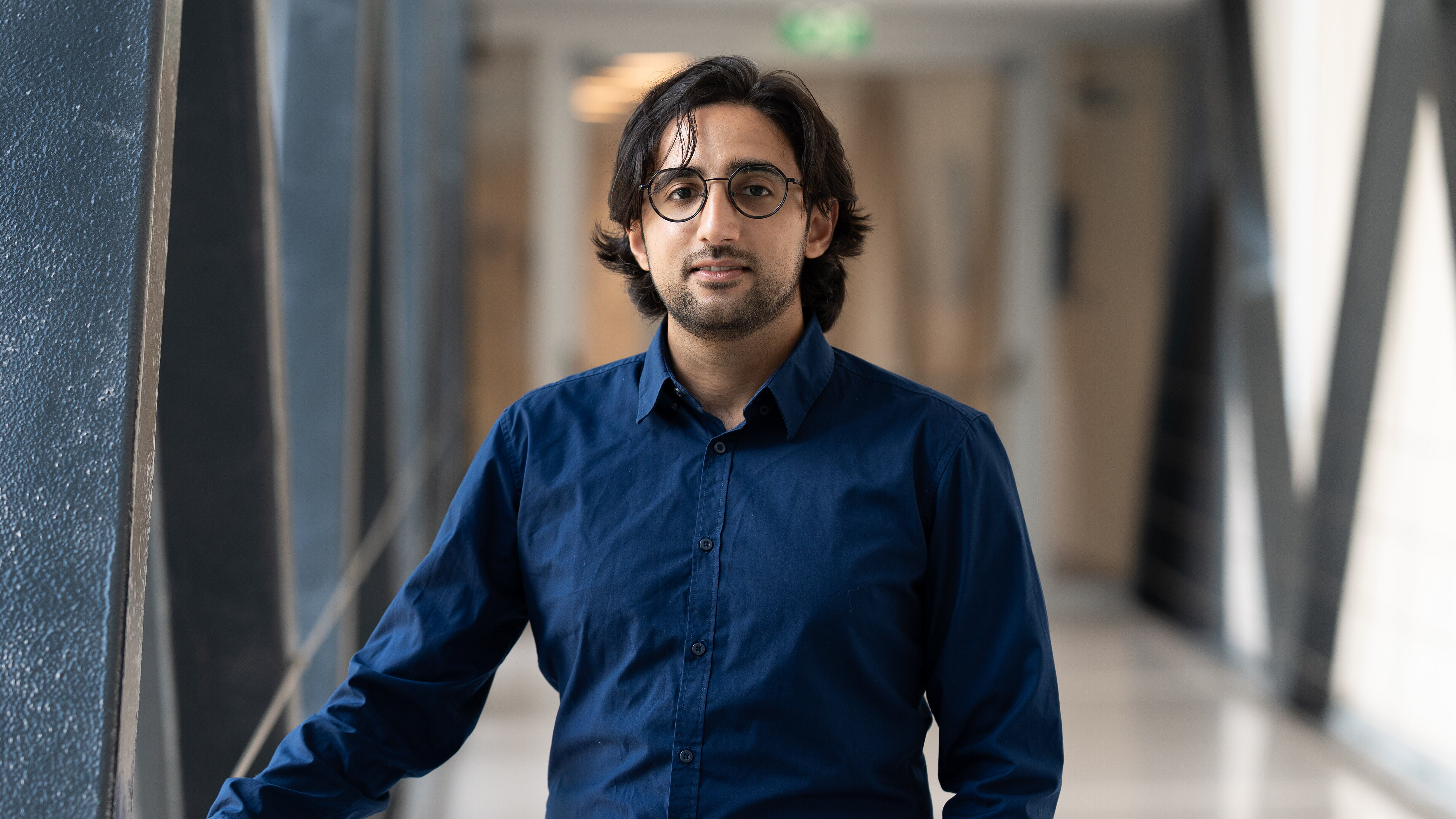
Mustafa Alaabo, a PhD student in Daniel Gerlich’s lab at the Institute of Molecular Biotechnology of the Austrian Academy of Sciences (IMBA), was awarded a prestigious Boehringer Ingelheim Fonds Fellowship. The fellowship will support Alaabo’s doctoral research and connect him to a global network of promising young researchers. In his project, Alaabo aims to investigate the molecular mechanisms behind homologous recombination, the process by which dividing cells repair breaks in their DNA using a homologous template.
When DNA breaks occur, cells must act fast to avoid harmful consequences like genomic instability and cell death. Most cells patch up their DNA using non-homologous end joining —a quick but error-prone method that often introduces mutations. However, in dividing cells, accurate DNA repair is crucial to ensure the correct genetic information is passed on. In this case, cells rely on another DNA repair process known as homologous recombination once a second copy of the chromosome is available.
Homologous recombination depends on the protein Rad51, which binds to the damaged DNA site and forms a dynamic DNA filament that scans the cell’s genome for a matching sequence to use as a repair template. However, inside eukaryotic cells, the DNA is tightly packed around protein structures called nucleosomes. How Rad51 manages to search this tightly packed DNA to find a homologous sequence is still unknown.
To address this knowledge gap, Alaabo will use advanced biochemistry and single-molecule imaging techniques to reconstruct chromatinized DNA structures with precise nucleosome positioning in the lab. “I will test how Rad51 reads the DNA in different chromatin settings to find a homologous sequence for repair,” Alaabo explains.
Using this setup, Alaabo will shed new light on how Rad51 reads the DNA within chromatin and whether Rad51 filaments can remodel nucleosomes to access the genetic information needed for repair.
Understanding the molecular basis of DNA repair mechanisms such as homologous recombination is essential to study how errors in repair can lead to cancer, but also to guide the development of more accurate gene editing technologies.
“I’m very thankful to the Boehringer Ingelheim Fonds for recognizing the potential of my project and for supporting my research journey, and to my mentor Daniel Gerlich for his supervision,” says Alaabo.
About Mustafa Alaabo
Mustafa Alaabo obtained a Bachelor’s Degree in Molecular Biology and a Master’s in Biochemistry at the University of Vienna. In 2024, he joined Daniel Gerlich’s lab at IMBA as part of the Vienna BioCenter PhD Program.
About the BIF PhD Fellowships
The Boehringer Ingelheim Fonds (BIF) awards PhD fellowships of 2 to 3.5 years to outstanding junior scientists worldwide who wish to pursue an ambitious PhD project in basic biomedical research in an internationally leading laboratory. The peer-review selection process evaluates the applicant's achievements and the scientific quality of the project and host laboratory. The process is highly competitive, with less than 10 percent of applicants receiving a fellowship. On top of the monthly stipend, the BIF offers fellows seminars, travel allowances, individual and personal support, and access to a worldwide network of fellows and alumni.