



When an axolotl loses a body part, it can grow it back almost perfectly. A new study on the role of muscle stem cells in regeneration from the labs of Elly Tanaka (IMBA), Ji-Feng Fei (Southern Medical University), Hanbo Li (BGI Research), and Yanmei Liu (South China Normal University), published in the journal Science Advances, now shows that axolotls do in fact not rely on a single, universal “regeneration program”. Instead, they found muscle stem cell strategies that differed fundamentally between the main body axis and appendages.
Muscle stem cells are normally specialists giving rise to muscle only. The present study shows that after tail amputation, muscle stem cells there become much more versatile. They can generate several kinds of tissue that are essential for rebuilding the tail, including connective tissue that supports muscles, and cartilage that contributes to skeletal structures.
This flexibility is not random. It is controlled by a well-known cell communication system called TGF-β signaling. Signaling pathways are ways cells send instructions to one another using molecules as messages. In this case, high levels of TGF-β signaling push muscle stem cells toward connective tissue, while lower levels keep them on the muscle-making path.
Most regeneration research in axolotls has focused on limbs, while the tail has received less attention. As a result, scientists long assumed that regeneration works similarly across different body parts. To scrutinize this assumption, the researchers combined several powerful modern techniques.
First, they used genetic fate mapping and clonal analysis - labeling specific muscle stem cells and tracking all the tissues their descendants end up in. Second, they applied single-cell RNA sequencing. This method reads out which genes are active in individual cells. By doing this, the scientists revealed that tail muscle stem cells temporarily resemble cells from very early embryos, specifically a region called mesoderm. The mesoderm is one of the three main layers in an embryo and gives rise to muscle, bone, and connective tissue. This embryonic-like state explains the cells’ flexibility.
Third, the researchers manipulated TGF-β signaling directly, turning it up or down in muscle stem cells. By doing so, they showed that this signaling pathway acts like a switch, controlling whether the cells become muscle or connective tissue during tail regeneration.
Together, these approaches provided important insights on how the same type of stem cell can contribute to different regeneration programs. Further studies will now aim to find out how different body regions such as the central body axis versus the peripheral body parts influence the selection of these programs.
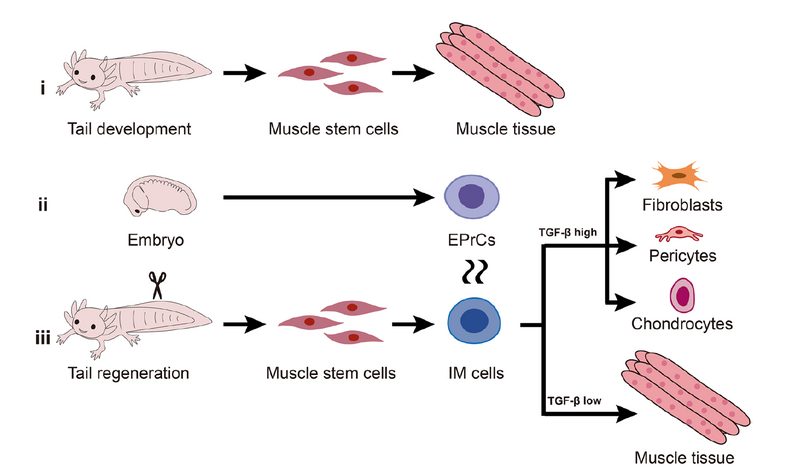
(i) During tail development, Muscle Stem Cells give rise exclusively to muscle tissue.
(ii) During embryogenesis, mesodermal located, Pax7 expressing embryonic progenitor cells become multipotent and generate both muscle and connective tissue derivatives.
(iii) During tail regeneration, Muscle Stem Cells re-acquire a multipotent, embryonic-like state and generate both muscle and connective tissue lineages. TGF-β signaling regulates the lineage switch between muscle and connective tissue fates: High TGF-β activity drives Muscle Stem Cells toward intermediate cells that give rise to different cell types, whereas low TGF-β activity promotes their differentiation into muscle.
Original paper
Liqun Wang, Li Song, Chao Yi, Jing Zhou, Zhouying Yong, Yan Hu, Xiangyu Pan, Na Qiao, Hao Cai, Wandong Zhao, Rui Zhang, Lieke Yang, Lei Liu, Guangdun Peng, Elly M. Tanaka, Hanbo Li, Yanmei Liu, Ji-Feng Fei. "Divergent stem cell mechanisms govern the primary body axis and appendage regeneration in the axolotl." Science Advances, 2026. DOI: 10.1126/sciadv.adx5697