


When Manuscripts Begin to Speak: Discovering Political and Religious Ideas in Sixteenth-Century Central Asia
25.08.2026
This manuscript in Tajik-Persian language was produced in Central Asia during the reign of the Shibanid ʿAbdallāh Khān II (1557–98), one of the most influential rulers of sixteenth-century Transoxiana. This was a fascinating period in the history of the region. The Shibanids (or Abu’l Khayrids 1500–1599) maintained close diplomatic and cultural ties with both Ottoman Anatolia and Mughal India while engaging in a prolonged political and ideological Sunni-Shi’a rivalry with the Safavid Empire. These relationships shaped not only the politics of the time but also the language through which power, religious authority, and political legitimacy were understood.
What has always interested me most is not simply the political events themselves, but the texts that explained, interpreted, and justified them. Historical chronicles, collections of saints’ lives, and religious treatises did much more than preserve the memory of the past. They helped define religious orthodoxy, legitimize rulers, and shape how communities understood themselves. In many ways, they became active participants in the political and religious life.
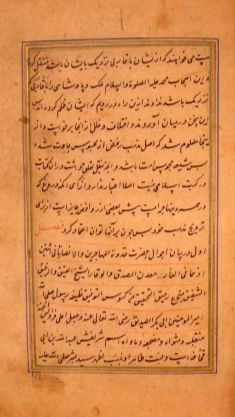
This interest led me to a remarkable manuscript that became the focus of my recent research. It belongs to the literary genre known as manāqib—works celebrating the virtues and exemplary deeds of distinguished religious or political figures; in our case, the four righteous caliphs, the Rashidun (632–651). Although these texts are often regarded primarily as devotional literature, they also provide a valuable window into the political and intellectual concerns of the societies that produced them.
At first glance, the manuscript appeared to be a fairly conventional work praising the reign of ʿAbdallāh Khān II. As I worked through it more carefully, however, a much richer picture emerged. Beneath its formal and rhetorical language, the text carefully developed arguments about political legitimacy, the defense of Sunni Islam, and the ruler’s responsibility to preserve religious order. Rather than simply reflecting contemporary debates, it highlights what true Sunni orthodoxy and orthopraxy are.
The project also reinforced an important lesson: every text exists within a wider intellectual landscape, responding to earlier works, borrowing familiar arguments, or engaging in conversations with other authors. Reconstructing these connections is one of the most rewarding aspects of manuscript research because it allows us to recover intellectual exchanges that took place several centuries ago.
The result of my research was a study of the Manāqib, examining the manuscript not only as a historical source but also as a vehicle through which political legitimacy and Sunni religious identity were articulated in late sixteenth-century Central Asia. The project resulted in an annotated translation of the manuscript, eight indices, and a preliminary research study amounting to approximately 350 pages.
Like many research projects, however, this one did not really end where I expected it to.
Only after completing my work on the Manāqib did I encounter another fascinating Persian treatise: Radd-i Rawāfiḍ (Refutation of the Rawāfiḍ), written before 1007 AH/1599 CE by the renowned Naqshbandī Sufi and Hanafi jurist Shaykh Aḥmad Sirhindi (1564–1624). According to the work itself, the author drew on first-hand accounts from Shiʿi refugees who had fled to Mughal India after the four-month siege and capture of Mashhad by the Shibanids in 998 AH/1589 CE.
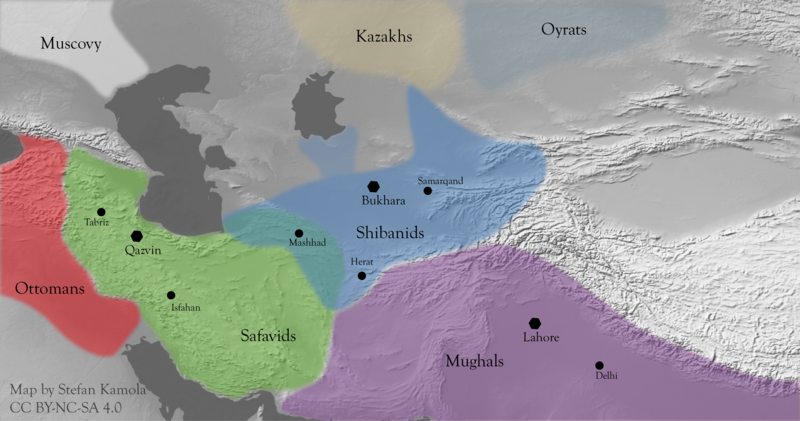
What immediately caught my attention was how closely the two works echoed one another. Although written independently, they respond to the same historical events and reveal strikingly similar concerns. Both support the military campaigns of ʿAbdallāh Khān II against Safavid influence in Khurasan, yet neither presents these campaigns as merely political or military achievements. Instead, both authors interpret them as part of a broader effort to restore and defend Sunni orthodoxy and orthopraxy.
Reading these treatises side by side opens up new ways of understanding how political events were transformed into religious arguments and how scholars working in different intellectual environments interpreted the same historical developments. The comparison also highlights the movement of ideas across Central Asia, Safavid Iran, and Mughal India, reminding us that these regions formed a connected intellectual world rather than isolated political spheres.
The discovery convinced me that these two texts deserve to be studied together. I am therefore now undertaking a comparative analysis of these nearly contemporary treatises in the hope of gaining a deeper understanding of the intellectual responses to one of the major political and confessional conflicts of the late sixteenth-century Islamic world.
Perhaps this is the greatest pleasure of working with historical manuscripts. Just when one project seems complete, another unexpectedly begins. Every manuscript read carefully has the potential to raise new questions, reveal new connections, and open up entirely new paths of research.
References
Dodkhudoeva, Lola, “Unikal’naya rukopis’ epokhi Shibanidov iz fonda Tsentra pis’mennogo naslediia Tadzhikistana”, in Pis’mennyePamiatnikiVostoka[“A Unique Manuscript of the Shibanids’ Epoch from the Fund of the Center of Written Heritage of Tajikistan”, inWrittenmonumentsoftheOrient], T. 18, no. 2 (45), Sankt-Petersburgh: IVRAN, 2021, p. 114 -132 (in Russian)
Dodkhudoeva, Lola, “Vtoroi etap formirovaniia Islamskogo prava v Transoksiane perioda predmoderna: svidetel’stva rukopisei” [The Second Stage in the Formation of Islamic Law in Premodern Transoxiana: Evidence of Manuscripts], Islamovedenie,T. 14, no. 3 (57) 2023, p. 99-132, https://doi.org/10.21779/2077-8155-2023-14-3-99-133 (in English)
Dodkhudoeva, Lola, “K voprosu o graniakh sunnitskoi ortodoksii v ritorike bukharskogo ulema epokhi sunnitsko-shiitskogo protivostoianiia (po materialam traktata Manakib al-hulafa. 997/1588 g.)”, in Tsentral’naia Azia skvoz’ veka: Obshchestvo, Kul’tura, Teksty / Sb. V chest’ prof. D.A. Alimovoi [“To the Question of the Facets of Sunni Orthodoxy in the Rhetoric of Bukhara Ulema of the Epoch of Sunni-Shia Confrontation (On the Materials of the Treatise Manaqib al-Khulafa, 997-1588)”, in Central Asia Through the Ages: Societies, Cultures, Texts. Essays in Honor of Prof. Dilorom Alimova], edited by Marianne Kamp and Florian Schwarz, Tashkent–Vienna: Аkademnashr, 2025, p. 63–76 (in Russian)