


The Scythian ságaris: single- or double-bladed axe?
21.01.2026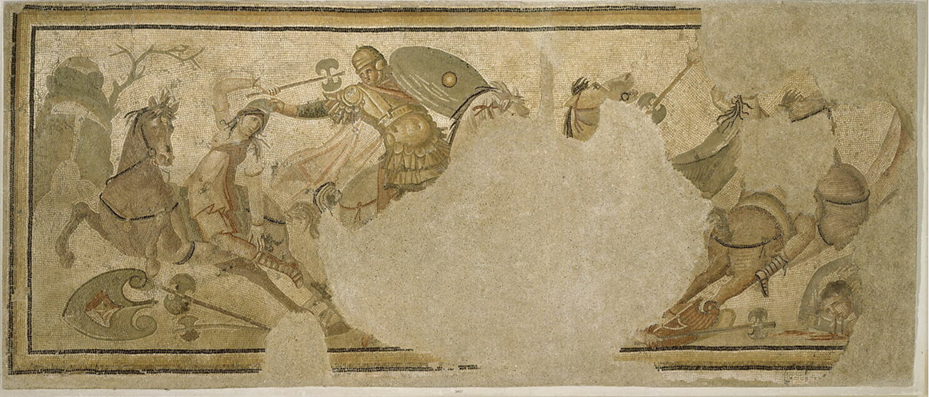
The focus of my research during JESH Fellowship at the Institute of Iranian Studies of the Austrian Academy of Sciences (Vienna) in March–April 2024 was the ságaris (Gr. σάγαρις) – a term used in Classical sources to designate a specific Scythian weapon. The final results are published (Vertiienko 2025, 23–46) and can be downloaded from this link: https://doi.org/10.15407/arheologia2025.01.023
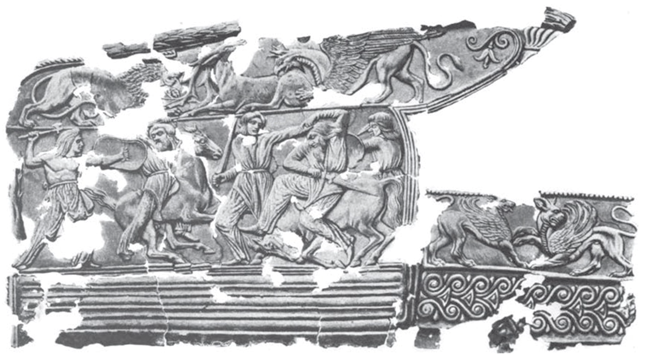
An important starting point for my research was one of the most “mysterious” images of a Scythian warrior on the silver gilded overlay of a quiver (gorytos) from the Solokha mound (4th c. BC, Zaporizhya district, Ukraine), depicted below. The last figure from the left in the battle scene is a young beardless Scythian with a long hair. He is armed with a single-bladed axe in his right hand and a wicker shield on his left one (Fig. 1). My research on the ságaris axe among ancient Iranian-speaking peoples sparked my interest in how closely this image corresponds to its description in textual sources. I also wondered whether the historical ságarishad two blades or one, as depicted in this image on the gorytos overlay.
In order to answer this question, I will consider the following aspects: the lexical history and meaning of the term ságaris, how it is represented in ancient art (including objects from Scythian burial mounds) and its archaeological context.
Lexical history of the word ságaris
The Greek Etymological Dictionary compiled by Robert Beekes (2010) states simply that ságaris is a “foreign word without an etymology”. Some scholars believed that ságarisdoes not have an Indo-European origin. But, according to Giovanni Alessio there is a similarity between ságaris and Latin sagitta (arrow), as well as the non-Indo-European Berberian *zaġāya ‘spear’, and Old Hebrew səḡōr ‘spear/javelin’ or ‘battle-axe’ in Psalm 35.3. The last was originally translated as ‘weapon’ and later as ‘spear’ (‘javelin’, ‘lance’, ‘pike’), which seems somewhat strange, since the word ‘spear’ (ḥă-nîṯ) comes before it. The old translation made in 1883 by Franz Delitzsch in his commentary to this fragment of the Psalm directly compared the word səḡōr with ságaris. The other similar word is Assyrian šukurru, traditionally translated as ‘axe’. However, the Chicago Assyrian Dictionary translates this word as ‘spear’. This šukurru is probably related to Latin secūris ‘axe’ and Proto-Slavic *sekyra ‘axe’, from which various designations of this weapon developed in many Slavic languages, in particular, Ukrainian sokyra. I would also emphasize for this case to Slav. *sěkti ‘to cut, mow’ and Latin secō ‘to cut, mow, sever’, which could be compared with Heb. śakkīn, Aram. sakkīn. However, there are two independent words for ‘axe’ in the Greek lexicon. The first, aksínē (ἀξἴνη), has a similarity to the Akkadian word ḫaṣṣinu ‘axe’ (cf. Aram. ḥaṣṣīnā), which has led scholars to stress of its borrowing from Semitic languages. However, Beekes believes that the Semitic and Greek words are loans from an Anatolian language. The second, pélekus (πέλεκυς), has also long been compared with Akkadian pilakku which, despite the richness of the lexicon associated with the nomination ‘axe’, denoted not ‘axe’ but ‘spindle’.
The meaning and translation of ságaris
According to the Greek Dictionary by Henry G. Liddell and Robert Scott ságaris is a ‘single-edged weapon’ used by Scythians and some other tribes. This word already existed in the Greek Lexicon by Hesychios from Alexandria, who lived between the 5th and 6th c. CE. The meaning is given there as ‘single-edged axe’ (Hesch., Lexicon, 16.1).
Herodotus’s Histories is the main source for information about the Scythians themselves. The historian mentions ságaris twice (Hdt., IV, 5.3 and IV,70). The first case concerns the genealogical legend on the origin of the Scythians from the three sons of a semilegendary king Targitaus. We get to know that the youngest brother, Colaxais, took up the golden gifts and among them was a weapon ságaris. Then his older brothers agreed to bestow the whole kingdom on Colaxais. After that, these golden heavenly gifts were honoured by Scythians every year (Hdt., IV.7). In the second case, the ságarisis listed among other weapons, without specifying its material. These weapons were ritually stuck into a drinking bowl (κύλικα), in private rite of “fraternisation”, during which an oath contract was made (Hdt., IV.70).
Indeed, the Greek Dictionary of Liddle and Scott ends the article on the meaning of ságaris providing a possible translation as ‘two-edged axe’ only because of a single instance of a “two-edged axe” in a late poetic work of the 1st c. AD, from the Greek Anthology (Anth. Gr. 6.94). Evidence of the existence of such a two-bladed axe comes also from images of Amazons depicted with double-bladed axes, which are known from the Roman Period (Figs 2, 3).
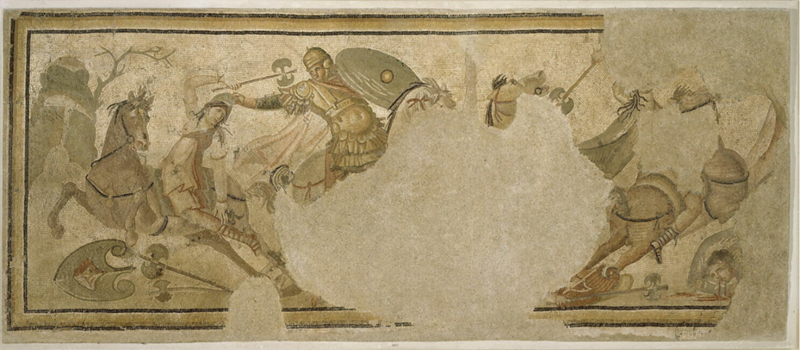
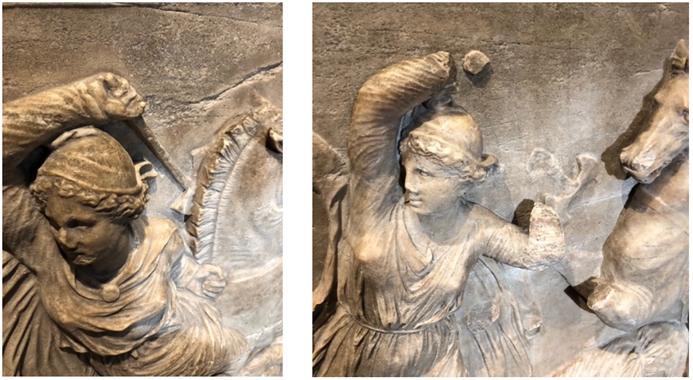
The uncertain translation of ságaris led some Scythologists to interpret it as a double-bladed axe. The rarity of such axes in the Northern Black Sea region prompted Vladimir Kisel (2008) to argue that Herodotus’ description referred not to the Black Sea Scythians but to eastern tribes of Siberia and Central Asia. He viewed the ságaris as an eastern weapon, a pickaxe (chekan in Russian). This view, also supported by Vladimir Nikonorov (2015), has become common in studies of Scythian and Central Asian weaponry. However, Herodotus clearly identifies the ságaris as a type of axe when describing the arms of the Sacae, whom he identifies with the Scythians (Hdt., VII, 64.2).
Persian and Amazons battle-axe ságaris in ancient art
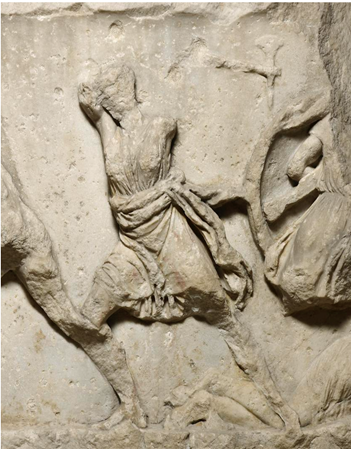
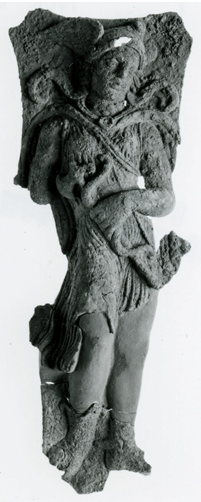
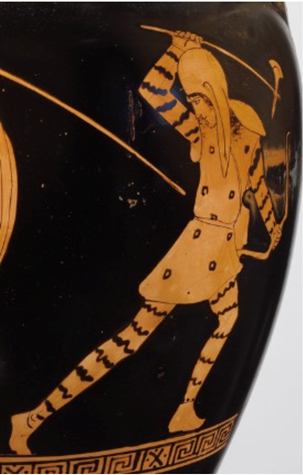
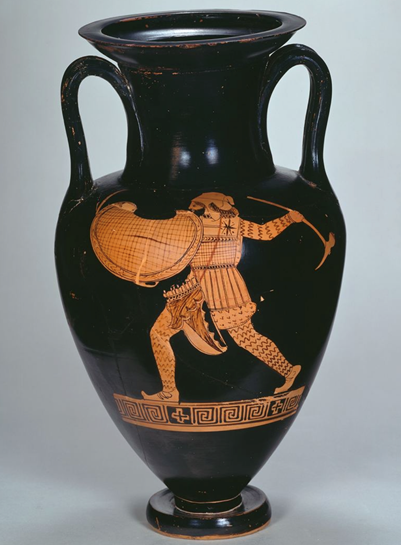
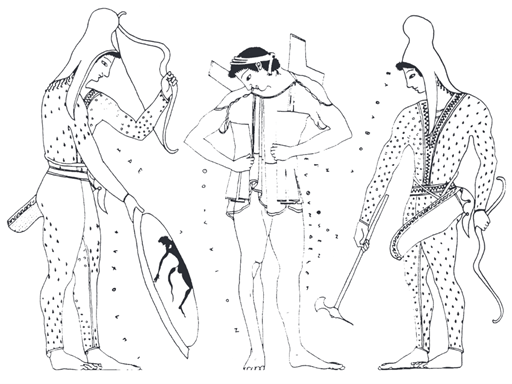
Another clarification of the type of ságaris can be found in Xenophon’s Anabasis (Xen., Anab., IV, 4.16). In the description of the captured Persian warrior, a list of his weapons is given, which consisted of a ‘Persian bow’ (τόξον Περσικὸν), a ‘quiver’ (φαρέτραν) and a ‘ságaris like those of the Amazons’ (σάγαριν οἵανπερ καὶ αἱ Ἀμαζόνες). But what does it look like in ancient Greek art? The analysis of ancient sources shows that Greeks had knowledge of ságaris as a specific type of battle-axes depicted on monumental friezes (Fig. 4), bronzes (Fig. 5) and vase paintings among the Amazons (Fig. 6), Persians (vase painting and decoration of a so-called Alexander sarcophagus) (Fig. 7) and Scythians (Fig. 8).
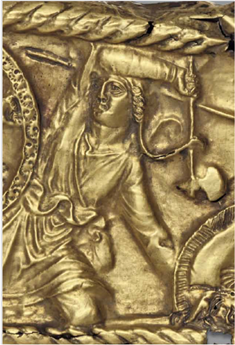
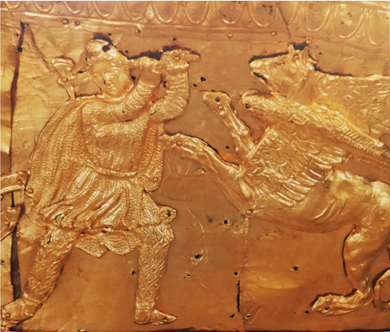
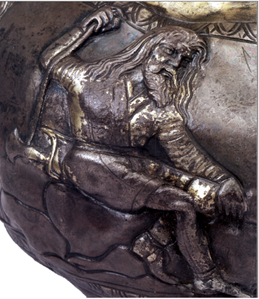
Images of similar weapons carried by Amazons can also be found on the Graeco-Scythian metalwork (toreutics) of the 4th c. BC. These are the images of an Amazon armed with a single-bladed axe on a golden sword scabbard from the Chortomlyk (Fig. 9) and on the gold plate from the Velyka Bliznytsia mound (Fig. 10). The images of Scythian warriors leaning with the same single-bladed axes are represented on a silver gilded bowl from the barrow No. 3 of the “Chastye kurgany” Group (4th c. BC, Voronezh district, Russia) (Fig. 11).
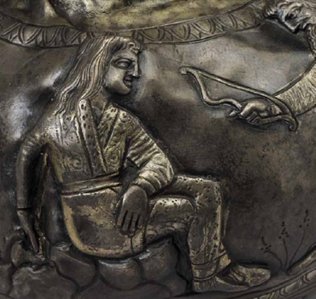
However, according to the above-mentioned written testimony of Xenophon, one can conclude that not only mythical Amazons, but also Iranian warriors were armed with similar single-edged axes ságaris (Xen., Anab., IV, 4.16). As well, in ancient art we see that the similar battle-axes can be found on images not only of Amazons, but also Persian and Scythian warriors, including the Solokha quiver.
The archaeological and social aspects of Scythian battle-axes
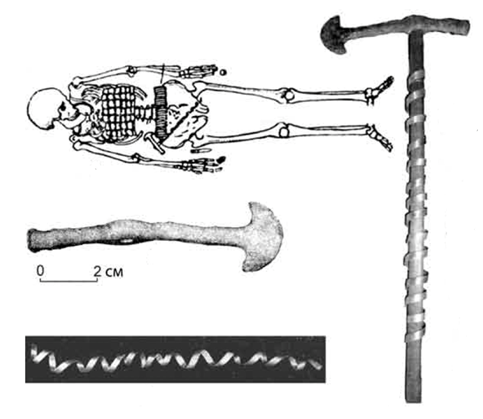
In the Northern Black Sea region, the single-bladed axes prevailed for the period of the 6th through 4th c. BC. Among archaeological finds, we can enumerate about fifty single-bladed axes of different types (the newest list collected by Daragan and Polin (2023, p. 28–39, Table 1) includes 54 finds) and only four double-edged ones. However, the Scythian monumental sculpture demonstrates different types of axes. I would like to point to the axe in the burial of a Scythian aristocratic warrior in the Talaevskyi mound(4th c. BC, Western Crimea, Ukraine) which is like a ságaris-type weapon in art (Fig. 12).
Another example of a similar type of axes is single-bladed bronze “votive” battle-axe from the mound No. 18, burial No. 2 near the village of L’vovo (4th c. BC, Kherson Region, Ukraine). The next example is the image of the close to it axe on the ‘Borysphenes’ coins from Olbia (4th c. BC, Mykolaiv Region, Ukraine).
It is possible that different types of axes could have an independent symbolic meaning, marking insignia of power of different levels of the nomadic military aristocracy. The well-known example of such object is a unique golden axe from the First Kelermes mound (7th c. BC), which is a work of West Asian (Assyrian?) metal-working masters. It is obvious that this process could have been accompanied by military lexical borrowings, as in the case with ságariswhich indicated similarity to the Assyrian name of a weapon šukurru.
Conclusions
To sum up, my analysis of narrative, visual and archaeological sources has led me to the conclusion that ságaris should be identified as a ‘single-bladed battle-axe’. At the same time, Classical sources give the same term ságaris for the definition of battle-axes of all ancient Iranian-speaking peoples, including the Scythians. The same weapon is also attributed to the Amazons. The visual sources in various forms of ancient art (vase painting, monumental sculpture, sarcophagus decoration, and metalwork) show more differentiated types of axes for the same characters, which, nevertheless, in the Classical and Hellenistic period are united by the fact that they are single-bladed axes. It is not until the Roman period that we see depictions of the two-bladed labrys-axe for the Amazons. As for archaeological sources, there are no exact correspondences to the forms represented in art (except for the axe from the Talaevskyi mound). At the same time, the known Scythian battle-axes, with rare exceptions, have a single chopping blade, which undoubtedly brings them closer to the images of axes in art.
Accordingly, the identification of ságaris with the double-bladed battle-axe or pick is debatable. This word seems to have entered the ancient Greek lexicon from nomadic circles, most likely from the Black Sea Scythians, as a borrowing. Possibly, it could have come into Scythian from Semitic languages during the West Asian campaigns (7th c. BC), as indicated by the similarity of ságaris to Assyrian šukurru and Old Hebrew səḡōr. Perhaps it was at this time the battle-axe acquired a special cultic significance in Scythian culture, which we can further see in Herodotus’ reports (the axe as one of the golden gifts of heaven and its use in an oath contract). Archaeological evidence of this sacralisation could be the golden axe from the First Kelermes mound (7th c. BC), produced and decorated in Western Asia. It should be emphasised that typologically and functionally, battle-axes of the Scythians and other Iranian-speaking nomads were quite differentiated weapons, and therefore the generalised nomination of the name ságaris to all known types of axes is hardly correct.
Bibliography
Alekseev, A. Yu. 2012. Zoloto skifskikh tsarey v sobranii Ermitazha. Saint Petersburg: Izdatel’stvo Gosudarstvennogo Ermitazha.
Daragan, M., Polin S. 2023. Axes in the Funerary Ceremonies of the Northern Pontic Scythians. In: Meyer, C. (ed.) Situating Eurasia in Antiquity: Nomadic Material Culture in the First Millennium BCE, ed. C. Meyer, Arts 12/124 (Special Issue), p. 1-47.
Farmakovsky, B. V. 1922. Gorit iz kurgana Solokhi. Izvestiya Rossiyskoy akademii istorii material’noy kul’tury, II, p. 23-48.
Ivantchik, A. 2006. “Scythian” archers on archaic Attic vases: problems of interpretation. Ancient Cilvilizations from Scythia to Siberia, 12/3-4, p. 197-271.
Kalashnik, Yu. P. 2014. Grecheskoye zoloto v sobranii Ermitazha: Pamyatniki antichnogo yuvelirnogo iskusstva iz Severnogo Prichernomor’ya. Saint Petersburg: Izd-vo Gos. Ermitazha.
Kisel, V. A. 2008. Σαγάρις Gerodota v arsenale drevnikh kochevnikov. In: Derevyanko, A. P., Makarov, N. A. (eds). Trudy II (XVIII) Vserossiyskogo arkheologicheskogo s’yezda v Suzdale. T. II. Moscow: IA RAN, p. 110-112.
Nikonorov, V. P. 2015. Kul’t boyevykh toporov u drevnikh iranoyazychnykh narodov: skify Severnogo Prichernomor’ya. In: Nikonorov, V. P., Alyokshin, V. A. (eds). Akademicheskoye vostokovedeniye v Rossii i stranakh blizhnego zarubezh’ya (2007—2015): Arkheologiya, istoriya, kul’tura. Zapiski Vostochnogo Otdeleniya Rossiyskogo Arkheologicheskogo Obshchestva. Nov. ser. T. III [XXVIII]; Trudy IIMK RAN, XLV. Sankt-Peterburg: Kontrast, p. 395-424.
Vertiienko, H. 2025. Scythian σάγαρις: Word – Image – Archaeological Object. Arheologia, No. 1, p. 23-46.