


Bolaji Ajao, former Summer School student
18.08.2025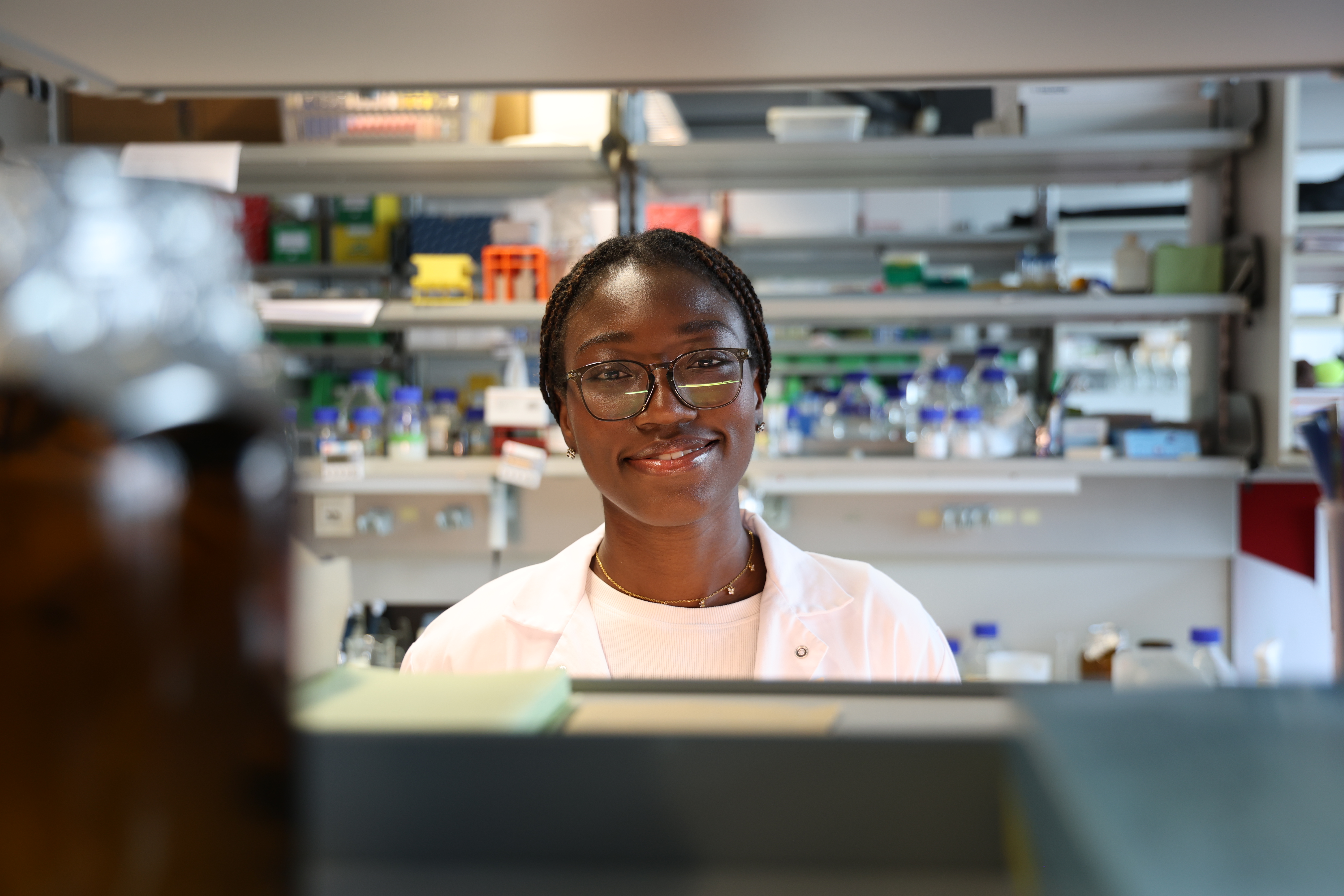
Bolaji is a biomedical engineering student at the Universidad de Monterrey in Mexico. This summer, she joined Sofia Grade’s lab at the Vienna BioCenter through the Summer School program, where she explored neurodevelopmental aspects of Huntington’s disease by studying axonal pathways in the striatum. She plans to pursue graduate studies in neuroscience and continue gaining international research experience.
We spoke with Bolaji about her journey into science, her time in the Grade lab, and what’s next for her.
Everyone calls me Bolaji. I'm originally from Nigeria but have lived in Mexico since I was five years old. I’m currently in my fourth year of a biomedical engineering degree at Universidad de Monterrey, in the north of Mexico—it's often called the “city of mountains.” Before coming to the Vienna BioCenter, I already had some research experience. I worked in a lab studying facial pain using the mouse nervous system, and I also did a smaller project involving electroencephalogram, using brain wave recordings to help detect conditions like epilepsy. I always knew I wanted to gain more international experience in neuroscience, so I started looking for summer research programs abroad. That’s how I found the Vienna BioCenter Summer School—and I actually didn’t know about the Talents for Future program until Sofia [Grade] reached out and invited me to stay for three months instead of two. Of course, I said yes!
I’ve always been curious about science, I loved watching women doing science on TV growing up, and it helped me see it as something I could do, too. But the real turning point came in high school when my younger sister was born with microcephaly and a specific condition called cerebellar hypoplasia. Watching how little was understood about her condition, even by doctors, really stuck with me. It made me wonder: what’s actually happening in the brain in these cases? That’s when I realized I wanted to understand the underlying mechanisms of diseases like this one. So I started reading neuroscience articles and discovered that people actually do this kind of research as a profession. That’s what sparked my interest in neuroscience, and it’s what eventually led me to biomedical engineering, a field where I could combine biology with building and designing tools myself.
I joined the Grade lab because I was really excited about Sofia’s research on Huntington’s disease. It aligned closely with my interests in neuroscience, and the lab has been incredibly welcoming and supportive. My main project this summer focuses on the striatum, a brain region affected in Huntington’s. I’m studying changes in the axonal pathways, basically looking at whether the disease has a neurodevelopmental component, not just neurodegeneration. I’m using histochemistry and brain slicing, which I’d done before, but I’ve also had the chance to try new techniques and approaches here. One highlight has been developing a pipeline to help map these axonal pathways more systematically, something the lab can keep using after I leave. Also, during this experience I finally got over my fear of cell culture! I used to avoid it because it felt so delicate and precise, but now it’s one of the parts I enjoy most.
The resources and tools here are really advanced, and that’s made a big difference in how smoothly experiments run. I also really value the mentorship, working closely with experienced women in neuroscience like Sabrina [Villar-Pazos] and Sofia [Grade] has been incredibly inspiring. They give very specific and thoughtful feedback, which has helped me grow a lot as a researcher.
I still need to complete an internship as part of my bachelor's program, and I’d love for it to be something in line with what I’ve been doing here, ideally continuing to work on Huntington’s or a similar neurological disease. After that, I definitely plan to pursue a master’s or PhD, and I’d be happy to return to the Vienna BioCenter for either of those paths.