


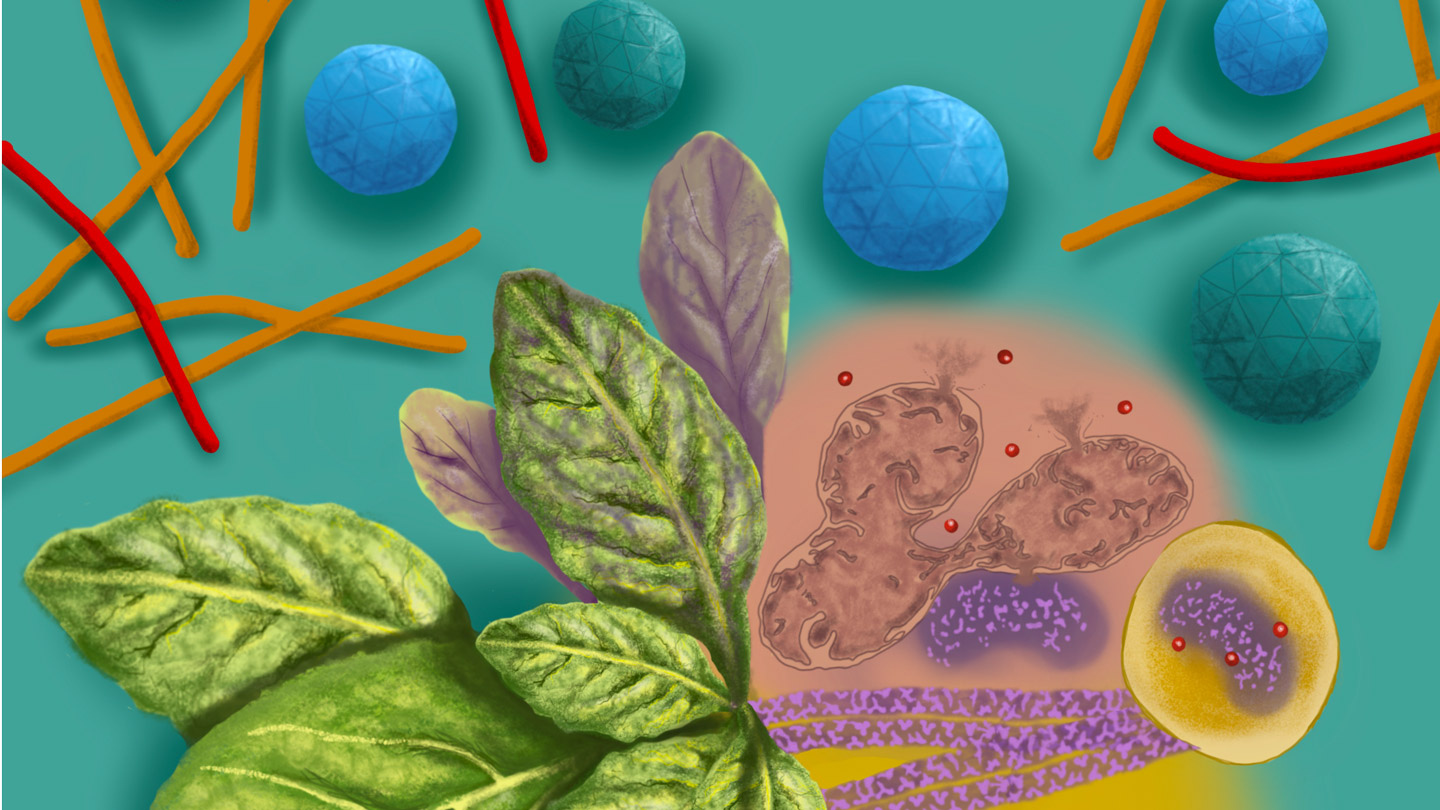
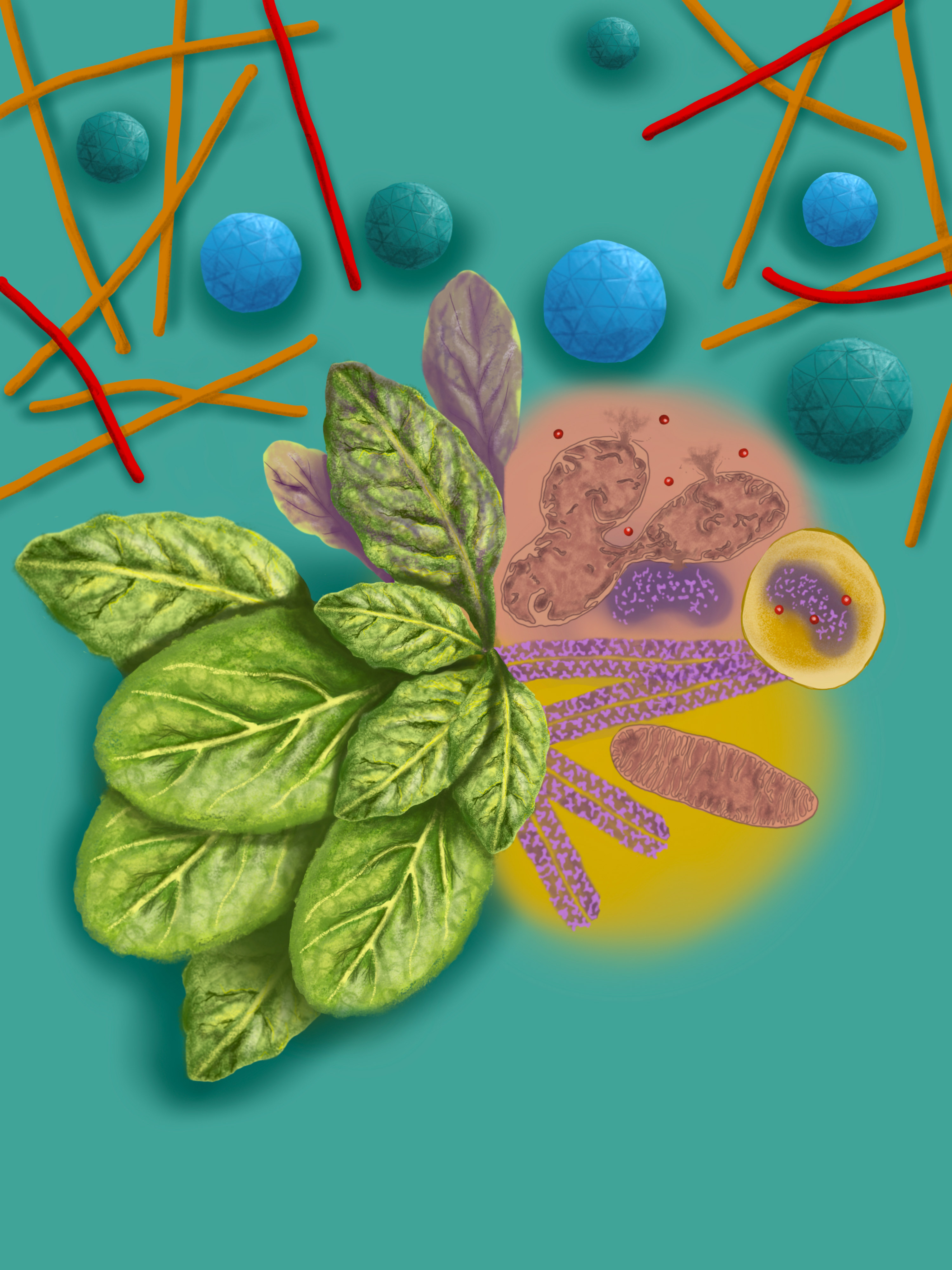
Viruses spark deadly pandemics and destroy crops worth billions of dollars each year. When plant cells come under attack by viruses, they face a delicate balance: respond strongly enough to contain the infection, but not so strongly that the immune reaction itself causes damage. A new study published in Science, led by Marion Clavel in the group of Yasin Dagdas at the GMI - Gregor Mendel Institute of Molecular Plant Biology of the Austrian Academy of Sciences (OeAW) and Heidelberg University, shows that autophagy – the cell’s cleanup and recycling system – helps plant cells keep this balance, buying cells time to repair damage.
Many of the most damaging viruses belong to a class known as positive-sense single-stranded RNA viruses (+ssRNA), a group that includes deadly plant pathogens as well as the virus responsible for the COVID-19 pandemic. To make more copies of themselves, these viruses make use of the membranes inside the host’s cell. The viruses remodel these membranes, creating optimal pockets for producing more viral copies.
In their new study, Yasin Dagdas, formerly at the GMI of the OeAW and now at Heidelberg University, and his team, including first and corresponding author Marion Clavel, now group leader at the Max Planck Institute of Molecular Plant Physiology, looked at autophagy’s function during viral attack. Autophagy has been known to play a role in defending plants against viral infections, but until now, how it did so remained largely elusive.
Looking at plants in which the autophagy machinery is defective, the researchers observed that these plants are more vulnerable to attack by +ssRNA viruses. Contrary to what might be expected, though, autophagy does not simply gobble up the viruses: Careful analysis showed that plants defective in autophagy aren’t overrun by viruses or viral particles. Instead, autophagy responds to the damage caused by viruses inside the cells.
When viruses remodel organelles such as the energy-producing mitochondria, the organelles become heavily distorted, Dagdas explains. “The mitochondria are distinctively unhappy, they have membrane defects and change shape; this cellular distress switches on selective autophagy.” During selective autophagy, receptors bind only to specific cellular components – the cargo – which are then picked up and targeted for degradation. Dagdas and his team therefore looked for, and expected to find, receptors that engage with the damaged mitochondria. “Surprisingly, we found instead that two enzymes in the cell’s cytosol interact with the cargo and the autophagy machinery”, Dagdas recounts.
Under normal conditions, these two enzymes – NIT1 and IMPDH – form long, filament-like structures. During viral infection, however, the organelles rupture and leak their contents into the cytosol. This triggers the enzymes to break apart into their individual units. In this changed state, they interact both with proteins that regulate cell death and bind to the autophagy machinery, effectively sending cell death-inducing proteins to be degraded. By changing the balance between filament and the individual units, the plant can control the amount of cell death-inducing protein that is degraded.
During pathogen attack, the cell mounts an immune response. However, because the immune response leads to cell death, the cell needs to carefully control its immune output. The discovered autophagy pathway provides the break needed for this; it acts as a rheostat to tune the level of immune response. “If cells die too quickly in the face of viral attack, the plant will quickly die due to systemic necrosis,” Dagdas explains. “Autophagy prevents plant cells from dying too fast, buying them time to cope with viral infection and improving the plant’s chances of survival. Having too much or too little immunity is bad – you need an optimal immune response,” Dagdas says. In humans, an overactive immune response leads to autoimmune diseases. “Selective autophagy is dampening this trigger-happy immune mechanism so that plant cells can fight infection better.”
Selective autophagy fine-tunes plant immunity to promote cell survival during viral infection, Marion Clavel, Anita Bianchi, Roksolana Kobylinska, Roan Groh, Xi Zhang, Juncai Ma, Ranjith K. Papareddy, Nenad Grujic, Lorenzo Picchianti, [...] and Yasin Dagdas, Science (2026)
DOI: 10.1126/science.adu9554