


The Phonogrammarchiv as a CLARIN K-Centre
Since 2015, the Phonogrammarchiv has been registered as a Knowledge Centre (K-Centre) within the Common Language Resources and Technology Infrastructure (CLARIN) network. CLARIN was founded in 2012 and is a European Research Infrastructure Consortium (ERIC).
The goal of CLARIN is to broaden access to language data and metadata as well as to tools facilitating linguistic research. Within the CLARIN network, currently 31 K-Centres support institutions and individuals by offering their expertise in their specific areas of competence with regard to languages and dialects. As an Austrian K-Centre the Phonogrammarchiv is part of the Konsortium CLARIAH-AT; the current K-Centre certificate of the Phonogrammarchiv can be found here.
Open Science since 1899
Already 125 years ago, the Phonogrammarchiv of the Austrian Academy of Sciences was founded with an open science approach: Right from the start, its goal was to produce recordings for re-use in academic research, and languages and dialects were one of its main concerns. Still an active archive, the Phonogrammarchiv now houses large collections of audio recordings – since 2002 also video recordings – from all over the world, covering global language and dialect development over more than a century. Some of our holdings have been registered as UNESCO Memory of the World or Memory of Austria.
Resources & Services
As the oldest sound archive in the world, we have a long tradition and rich experience in knowledge sharing and capacity building. As a CLARIN K-Centre we give access to our collections (data & metadata) – depending on legal and ethical clearance either online, on demand or onsite. Entry point to our collections is our online catalogue.
Researchers have always been our main users, but we aim to make our collections as widely available as possible, e.g. to educators, museums, the media, artists, the general public. Particularly important to us is to collaborate with the descendants of those who were recorded.
In addition to access to our resources, we offer advice and training in the following fields:
For more detailed insights in our current activities, see our contribution to Tour de CLARIN and the publication CLARIAH-AT: Back (and) to the Future.
Contact
If you are interested in using our resources or accessing our services, please contact us: pha(at)oeaw.ac.at
UNESCO
“SOUND RECORDINGS OF AUSTRIAN DIALECTS 1951–1983” INCLUDED IN UNESCO’S NATIONAL MEMORY OF THE WORLD REGISTER
In 2018, this corpus of Austrian dialect recordings was included in UNESCO’s Memory of Austria Register.
These sound recordings were made between 1951 and 1983 in methodologically novel ways and constitute a comprehensive documentation of Austria’s dialect landscape after the middle of the 20th century across all regions.
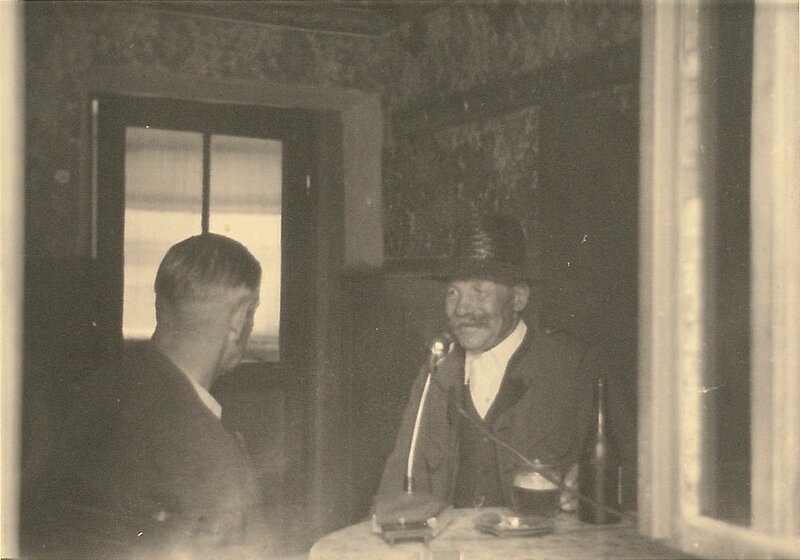
The corpus consists of 1748 audio recordings on magnetic tape, resulting from a cooperation of the Phonogrammarchiv and the co-called “Wörterbuchkanzlei” at the ÖAW (i.e. “Kommission zur Schaffung des Österreichisch-Bayerischen Wörterbuches”, after 1969 “Kommission für Mundartkunde und Namenforschung”), and constitutes an important part of the Phonogrammarchiv’s holdings of dialect recordings.
The recordings were made in the course of large-scale field research carried out in numerous places in all provinces of Austria and are a valuable primary source for various areas of research. In addition, they represent a special part of Austria’s cultural heritage and the identity (or identities) of its inhabitants.

For the first time in German linguistics, the contributors to the corpus achieved a systematic documentation of dialectal language in its actual use by capturing the speakers’ free speech, or by recording them in conversations. In accordance with the actual demographic situation, besides varieties of German they also recorded samples of other regional native languages spoken in Austria. Due to their age of up to 70 years, these recordings also document dialectal features which have long since vanished. Spanning three decades, the corpus likewise allows to trace linguistic change in the recorded varieties. In addition, since the speakers often talked about their immediate living environment and aspects of their culture, or offered specimens of their narrative tradition, the corpus is of high socio-historical and historico-cultural import.
The recordings will now be digitized, annotated and analysed in phase one of the cooperation project “Corpus of Austrian Dialect Recordings from the 20th Century”, which is carried out in close collaboration between the ACDH’s Research Department “Variation and Change of German in Austria”, the Phonogrammarchiv, and the FWF Special Research Programme “German in Austria. Variation – Contact – Perception”(F60).
Links:
Memory of Austria Register, Tonaufnahmen österreichischer Dialekte 1951-1983
ORF Science: Geistberger / Wieselberg: Dialektarchiv ist UNESCO-Welterbe
ÖAW: Dialektaufnahmen der ÖAW im „Gedächtnis der Menschheit“
audio samples
Cooperation project Corpus of Austrian Dialect Recordings from the 20th Century
“Kotek Collection” Included in UNESCO’s National “Memory of the World” Register
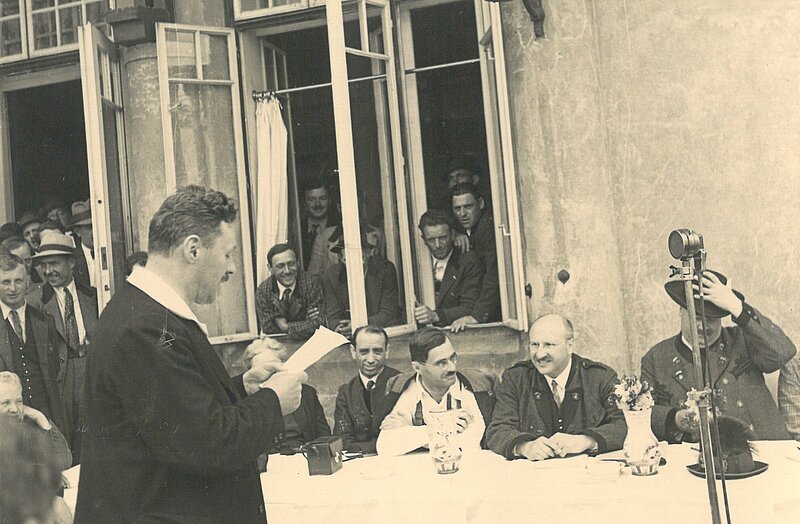
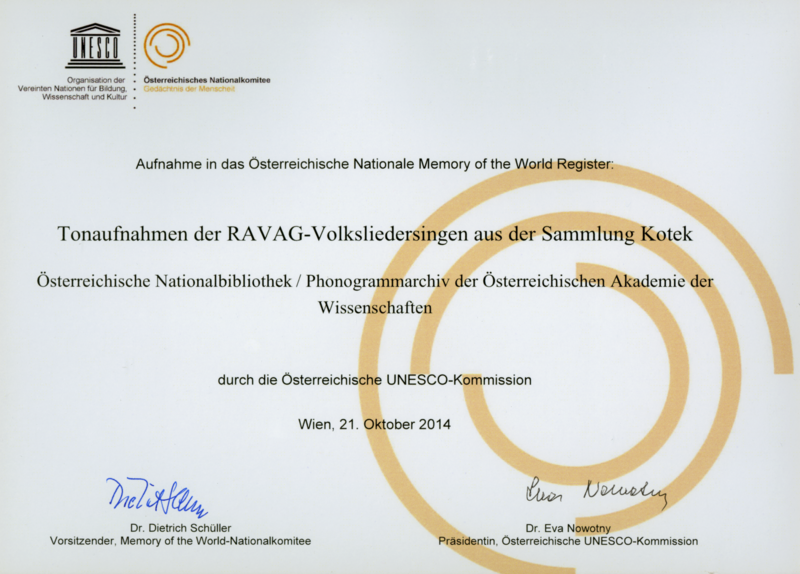
In 2014, this important collection of early folk music recordings from the holdings of the Phonogrammarchiv of the Austrian Academy of Sciences and the archive of the Österreichisches Volksliedwerk of the Austrian National Library was included in the national “Memory of the World”-Register”.
The so-called “Kotek Collection”, consigned equally to both institutions by its initiator, represents a unique collection of audio recordings that are significant with regard to ethnomusicology, the history of the media and also the history of scholarship.
The 63 shellac discs (118 matrix numbers) and 17 decelith instantaneous discs, all of which are unique items today, contain hundreds of performances by singers or singing groups from all Austrian provinces.
These performances were recorded in the years 1934–37 on the occasion of 12 “Volksliedersingen” (folk song singing events) that were organized and recorded for the Radio-Verkehrs-AG by Viennese folk music researcher Dr Georg Kotek together with journalist Andreas Reischek. (These recordings of parts of the respective events were also broadcast after the events.) The collection thus represents the result of the first attempt at documenting the diversity of contemporary singing practices and interpretations of traditional songs and yodels across the country under equal conditions by means of live audio recordings.
(The collection has no match among the few research recordings or the studio productions of the then-entertainment industry.)
Today, the Kotek Collection is one of the most important historical sources for folk music research in Austria, since it constitutes a representative sample of the folk singing repertoire in its day considered authentic by contemporary experts, and, perhaps more importantly, a sample of contemporary music practice in Austria in the first half of the 20th century. The unaltered original discs (as well as their analogue copies on magnetic tape) are stored in the Phonogrammarchiv under optimal conditions. The discs were digitized based on novel state-of-the-art methods of signal retrieval.
Historical Collections (1899–1950) Included in UNESCO’S “Memory of the World” Register
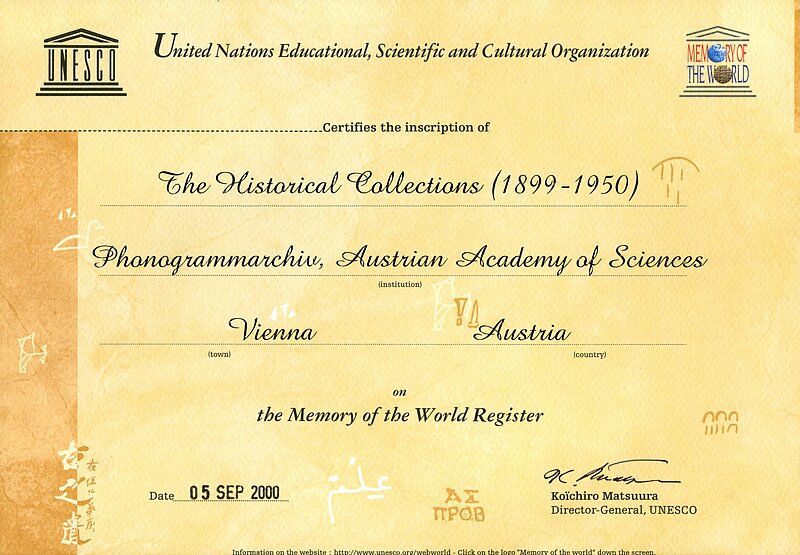
In 1999, the Phonogrammarchiv’s Historical Collections (1899–1950) (voice portraits, ethnological recordings by Pöch, Dirr, Trebitsch, Idelsohn, etc.) were included in UNESCO’s “Memory of the World” Register.
Phonogrammarchiv Awarded the UNESCO/Jikji Prize
In 2007 the Phonogrammarchiv was awarded this international prize for its contributions to the field of safeguarding audio and video documents. The Jikji Prize is donated by the city of Cheongju, Republic of Korea, to commemorate the printing of the oldest existing book produced using movable metal print in the world, created by Buddhist monks in a Cheongju monastery in 1377, i.e. 78 years before the Gutenberg Bible. The prize is awarded biennially “to reward efforts contributing to the preservation and accessibility of documentary heritage as a common heritage of humanity” and is endowed with 30,000 USD.
The award ceremony took place on September 4th, 2007 in the Cheongju Culture Centre in the presence of 1200 invited guests. Dietrich Schüller and Bernhard Graf accepted the prize on behalf of the Phonogrammarchiv from mayor Nam Sang-Woo. Congratulations came, among others, from the Minister of Culture of the Republic of Korea, and in video messages from UN Secretary-General Ban Ki-Moon and UNESCO Director-General Koichiro Matsuura.
The Phonogrammarchiv in turn endowed the prize money for the digitisation of the José Maceda Collection of the University of the Philippines, which had been inscribed to the International Register of the Memory of the World Programme in 2007. The Phonogrammarchiv also provided training to the Filipino technicians in Vienna.