


How resilient are critical infrastructures such as communication networks or power supply? Where will the increasing role of artificial intelligence in the development and use of modern weapons lead us? And what role does technology play in dealing with climate change?
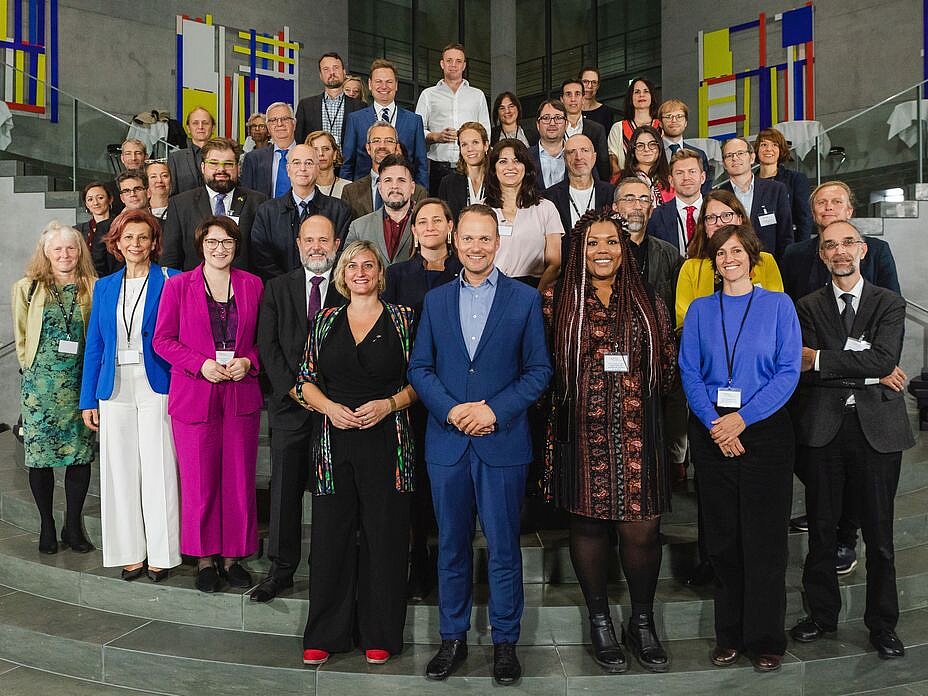
These and other current topics were intensively discussed at the annual meeting of the European Parliamentary Technology Assessment (EPTA) network in Berlin on October 17. Under the title "Disruption in society - TA to the rescue?", the Office of Technology Assessment (TAB) at the German Bundestag welcomed members of parliament from several European countries.
How likely is a blackout?
In his keynote speech, Marc Elsberg talked about his work on his successful novel "Blackout”. He described possible consequences and as yet unsolved problems that could arise in such a situation. Jaro Krieger-Lamina from the Institute of Technology Assessment (ITA) of the Austrian Academy of Sciences, presented the study on supply security and blackout precautions in the Austrian power grid, which was written by the ITA for the Austrian Parliament.
Austrian Member of Parliament Gerhard Deimek emphasized the valuable work of technology assessment for parliament. He said that it was essential to prepare for a wide variety of disasters. Therefore, the personal commitment of politicians and the population is also needed. This was also emphasized by Katri Liekkilä, Chairwoman of the Finnish Civil Protection Authority NESA. In the panel, she reported on examples of best practice in preparing the population for a crisis in Finland.
Dying forests, self-thinking weapon systems
Also discussed was the use of autonomous weapon systems. Which weapon may act autonomously, which may not, and how can the limits be enshrined in international law? Another panel focused on how to save Europe's forests, which are already suffering greatly from climate change, and preserve them for the future.
"Every day we are confronted with uncertainty, for example when it comes to our energy supply or our health," emphasizes ITA Director Michael Nentwich. "We cannot value international collaboration enough if we want to be ready to cope with technological change and take on the challenges we are currently facing."