



Biologists, chemists and IT experts thrive to create artificial life. Right now, this is still a vision. The application of engineering techniques on biology, however, is crucial for the current development.
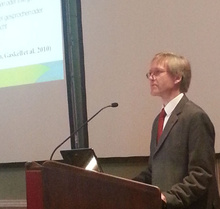
On May 14, the Austrian Academy of Sciences hosted a symposium on synthetic biology, which was organized by nanotechnology pioneer Uwe Sleytr. Among the speakers was ITA expert Helge Torgersen, who for many years has been doing research on technology communication.
Torgersen's talk "The power of the relation for the image of new technologies" analysed the public perception on the issue: "People will always try to relate technologies to something they know. They need to be able to relate to something."
Right now, there was still uncertainty about how best to relate to synthetic biology. Some would relate it to genetic engineering, others to nanotechnology, or to information technology. "In Europe it is easy to see a connection to genetic engineering. Some say we must learn from past mistakes, but there is a limit as to how far this is possible today."
Depending on various view points, there are more or less sympathies for this new branch of biology. When compared with information technology, terms like "hacker community", "open source" or "creative process" convey a different message.
The different reactions proof to Torgersen that it is all about the system we relate to. "A conflict about synthetic biology similar to past conflicts about genetic engineering is far from being unavoidable", he says.
14.05.2013
Denise Riedlinger