


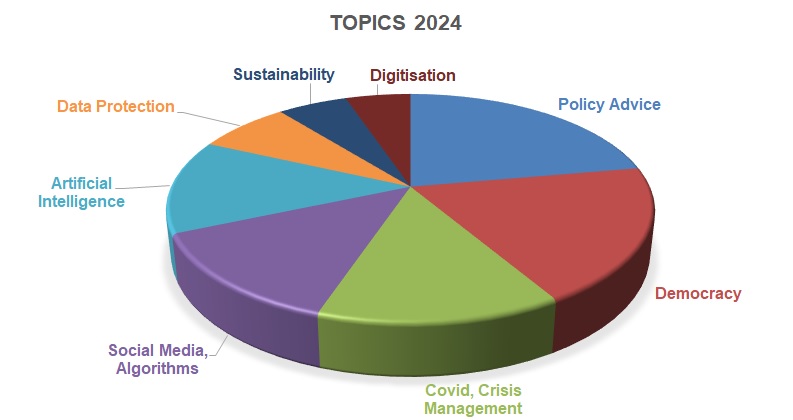
To what extent do social media endanger democracy today? How well are they suited for disseminating information? ITA security expert Stefan Strauß was quoted many times as co-author of an ÖAW statement on the topic. Other ITA highlights included numerous media appearances of sociologist Alexander Bogner on ‘policy advice in times of crisis’, an ITA team participating in the World Food Day 2024, and Astrid Mager's contribution to an international study on the global impact of digitisation.
Are social media a danger to democracy?
On 26 February, National Council President Wolfgang Sobotka and ÖAW President Heinz Fassmann presented a much-publicised statement on this issue at the Austrian Parliament. As part of the panel of authors, ITA security expert Stefan Strauß warned against manipulation, for example in political elections or consumer decisions. Social media have the potential to polarise and emotionalise, often with an intent to generate profit. For Strauß, regulation and media literacy are crucial in order to adequately deal with this phenomenon.
Transparency as the key to electoral success
Sociologist Alexander Bogner has established himself as an important voice on effective political crisis management in German-speaking countries and beyond. The principal author of a pandemic review study commissioned by the Austrian government emphasised that ‘it must be transparent who advises politicians and how these experts get appointed.’ Despite the efforts of policymakers to manage the crisis, key questions about policy advice remain unanswered. According to Bogner, the public has a right to be informed about how and by whom evidence is shaped, who asks the questions, and what range of answers is actually taken into account.
Focus on the global impact digitisation
Astrid Mager, a science and technology studies scholar at ITA, is an expert on automation bias and the social impact of digitisation. As part of an international expert panel, she co-authored a study on the perception and critical discussion of digitisation in different countries around the globe. For Mager, cultural and socio-political differences are key factors: even within the EU, the struggle for viable data protection guidelines has sparked heated discussions that have revealed different views and political currents in different countries. Therefore, in order to make ethical decisions, technology governance approaches must consider the social, cultural and political contexts of regulatory measures, according to the study authors.
ITA scientists at World Food Day
On 16 October, the UN Food and Agriculture Organisation (FAO) celebrated Global World Food Day – a day of action around the topic of nutrition and food production. This year's motto was: ‘The right to food for a better life and a better future’. A team of ITA scientists, led by Ulrike Bechtold and Mahshid Sotoudeh, joined in the activities: the ITA is currently working on this urgent social challenge in the EU project ‘ToNoWaste’. The project's mission is to encourage stakeholders in European food systems to make better choices for more sustainable production and consumption patterns. ‘The production of food and all the steps that go along with food production play a pivotal role. For example, the ecological footprint of food is eventually also relevant for planetary and human health,’ says Bechtold.