
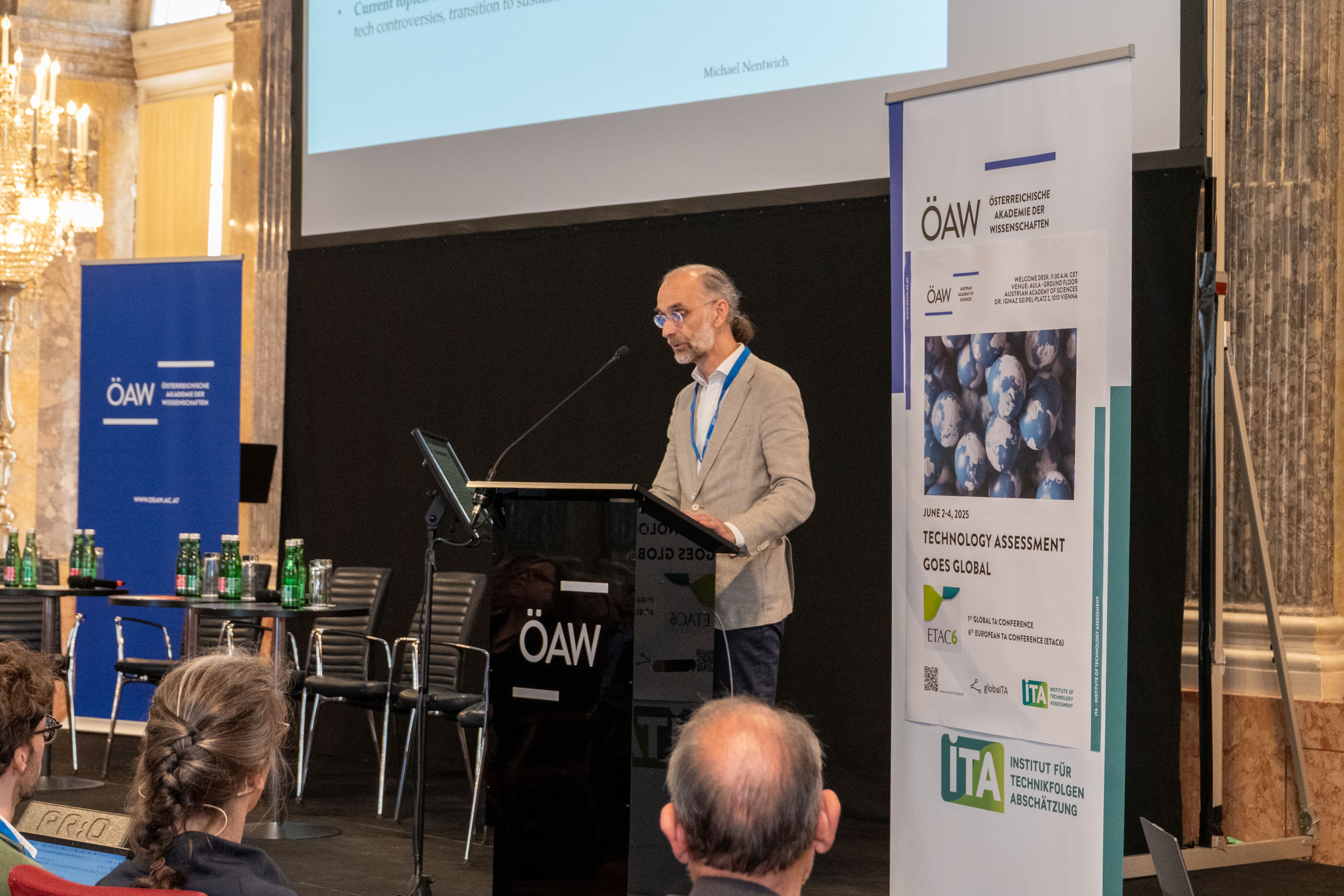


Michael Nentwich, why do we need technology assessment? The term is still unfamiliar in many places today.
Nentwich: That's true, it's also referred to as technology evaluation. But the fact is that technology assessment (TA) is unique because it brings together scientists from the engineering, natural, humanities, social and economic sciences with the same goal: to research and evaluate the impact of technologies on people and the environment and draw conclusions for society. We began to realise how important this was in the 1980s.
Why were the 1980s so important for the development of TA?
Nentwich: That was when the environmental movement in Austria reached a peak, people were demonstrating in Zwentendorf or Hainburg. In 1987, the Chernobyl nuclear disaster occurred. Before Chernobyl, there was the dramatic chemical accident in the Indian city of Bhopal in 1984, which destroyed entire regions for decades. In the 1990s, genetic engineering caused a substantial technology conflict – all these developments paved the way for technology assessment.
Forty years ago, people’s attitude was more in the vein of ‘New things are just great!’ New materials such as plastic, innovations in energy and computers – the applications seemed limitless. However, there were a number of alarming environmental and health scandals: people were developing lung cancer due to asbestos. The insecticide DDT was used in agriculture and in households to kill ants. Today, both are banned due to their toxicity and cancer risk. Such incidents showed that new technologies were often accepted and implemented far too enthusiastically and quickly.
Another key moment at that time was the publication of the climate report ‘The Limits to Growth’, which made people start to become more cautious and rethink their attitudes. It became increasingly clear that we need to investigate technologies and assess their consequences before we apply them on a broad scale. And that is actually the core of technology assessment: thinking about the possible consequences in advance.
Which conflict-prone technologies is the ITA currently investigating?
Nentwich: The first thing that comes to mind is artificial intelligence. We should have considered the possibilities and risks at a much earlier stage. Now AI is used on a global scale – within just two years, people have started working with ChatGPT on their mobile phones or computers. Lawyers are already using AI to evaluate documents. There is definitely added value in research, the financial sector and many other areas. But we also see more and more problems come to the surface. Democracies around the world have already been severely damaged by misinformation and fake-news. Some say the market will regulate itself, while others want to slow down a development that is already well underway. It seems that history is repeating itself. That is why technology assessment will always be necessary. In a complex world, it reminds us that sometimes we need “slow AI” instead of fast learning.
Technology assessment was invented in the 1970s in the USA: At that time, the Office of Technology Assessment (OTA) advised the US Congress. How did Ernst Braun, the first head of the working group, manage to establish TA in Austria?
Nentwich: Many places in Europe followed the example of the USA. In the 1980s, many countries established TA institutions that still exist today, including Germany, France and the Netherlands, as well as the EU Parliament. For Austria, a trip to the USA by Heinz Fischer was a key moment. The future Federal President and then Minister of Research visited the OTA at the US Parliament in 1984 and was deeply impressed. Ernst Braun picked up on this and even quoted US Congressman Emilio Dadario in his plea for the institutionalisation of TA on the national holiday in 1984 (see quote below). On 21 June 1985, the moment had finally arrived: the ‘Technology Assessment Working Group’ was affiliated to the Austrian Academy of Sciences' Institute for Socio-Economic Development Research (ISOZÖK), and Ernst Braun became its director. The first research focus, which was also of interest to politicians, was microelectronics. In 1988, the working group finally became a temporary research centre, and we have been a permanent institute of the Austrian Academy of Science since 1994.
What is the relationship between technology assessment and politics?
Nentwich: In fact, we are closer to politics than many other branches of research because one of our tasks is to provide fact-based policy advice. We have been conducting studies for the Austrian Parliament since 2017 and have just experienced first-hand how a political party criticised our findings for political reasons. The topic of our current study is generative AI, which also addresses how fake news and falsified audio or video recordings threaten democracy.
Technology assessment always attempts to reach national decision-makers. But of course, we have to think globally today. At the European level, we have been working together through the EPTA network since 1990, which gives us a very good overview of which issues are currently relevant for which countries. We also regularly contribute to studies for the European Parliament, and we have just hosted the first global conference on technology assessment here at the Academy of Sciences. Representatives from the UN, OECD, African Union and EU were present, as were experts from all continents, from Latin America to Australia. One thing is clear: to achieve something in this highly technological and digitized world, we have to pull together, exchange knowledge and collaborate.
Ernst Braun referred to the original proposal of Congressman Emilio Daddario to bring about the institutionalisation of TA in Austria:
“Technology assessment is a form of policy research which provides a balanced appraisal to the policymaker. It identifies policy issues, assesses the impact of alternative courses of action and presents findings. It is a method of analysis that systematically appraises the nature, significance, status, and merit of a technological progress”