


Times of Change - Pre- and Post Roman Imperial Transformation processes
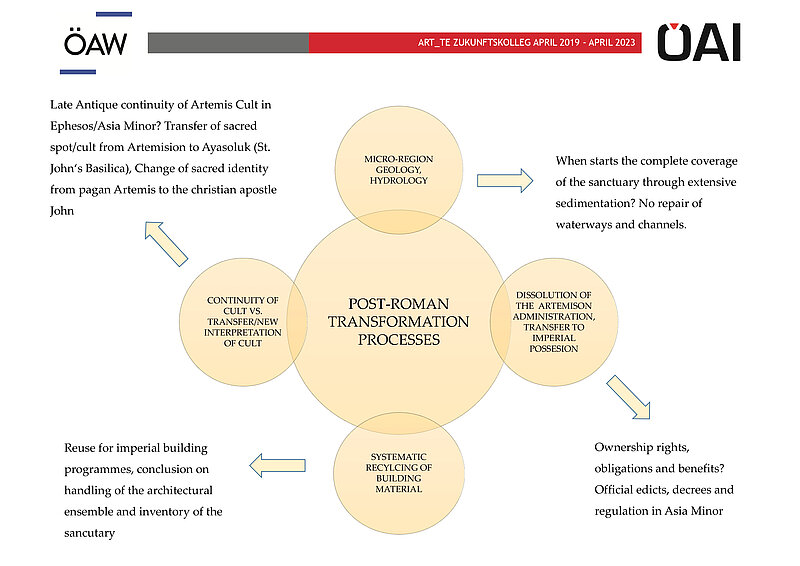
This thematic focus is dedicated to the times of change at the sanctuary in the late Hellenistic as well as Late Antique periods, with a view on the Medieval phases of use. These transformations had an impact on the topography, architecture and equipment, yet also the relationship of the sanctuary to the city, the inner organisational structure, and the hierarchy of the cult personnel. Ultimately, the reforms of Augustus shaped the Artemision and contributed substantially to the boom of the sanctuary in the Roman early and high imperial periods.
The Late Antique history of the sanctuary has scarcely been investigated, a history which culminated in its closure and abandonment. In the literature, reference to a church in the Temple of Artemis is still made, for which however there is absolutely no substantive evidence. Nevertheless, it should not be ruled out, and it should be investigated on the basis of all of the existing early Christian building elements whether there is in fact evidence of Christian cult buildings within the temenos. Based on the current state of research, it can be assumed that the area gradually fell into ruin and – at the latest after the Justinianic period – was used as a quarry for building materials.
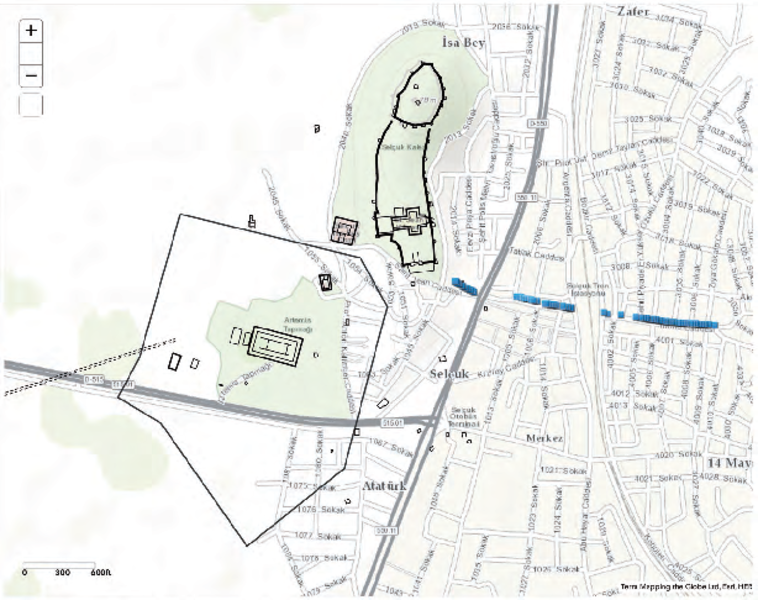
A precise mapping and evaluation of all of the building elements which securely originate from the Artemision and which are found in Ephesos and on the Ayasoluk is elemental for the understanding of the history of the sanctuary's decay, and for how the ancient building material was dealt with during Late Antiquity, the Byzantine period, and the Selçuk-Ottoman era. The question regarding explicit evidence for stone-robbing activities in the sanctuary is also interesting. When precisely this development began, how large the workshop area was, and what wares were produced there, is only very vaguely known until now.
It is also completely unclear what steps were taken to counteract the accumulation of sediment, frequently caused by seasonal flooding, in Late Antiquity and afterwards. By means of an assessment of drill cores and several metres high earth profiles, the process of burial by sediment at the Artemision will be traced for the first time from a geomorphological process and in combination with the archaeological evidence.