


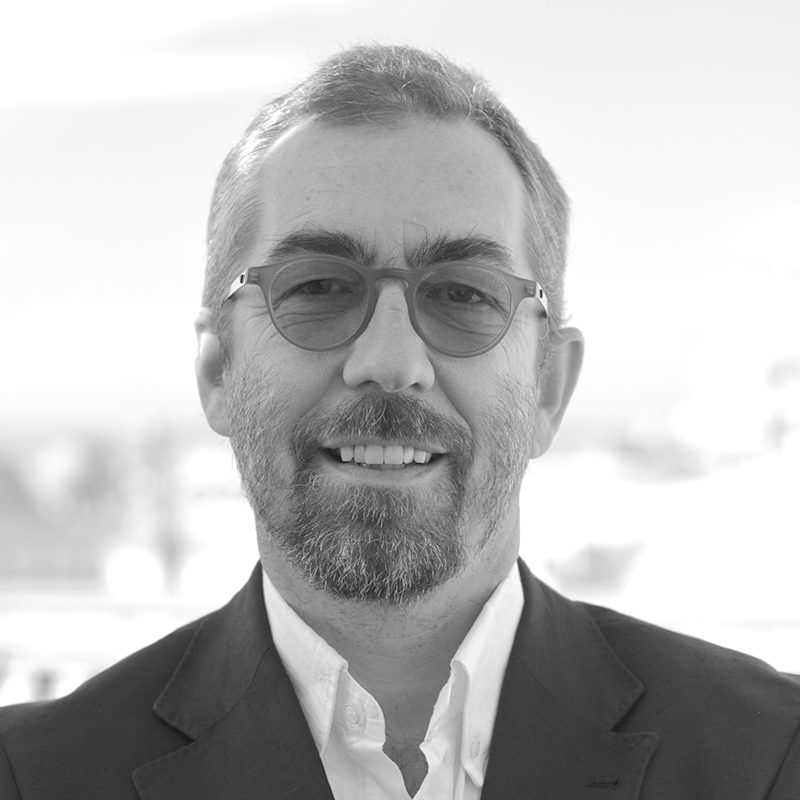
Walter Peissl marks the end of an era at the Institute of Technology Assessment (ITA) of the Austrian Academy of Sciences. He was and is a technology assessment expert without ifs and buts – a role model of our profession. Without fear of contact with other ways of thinking, perspectives, and disciplines. With a sure instinct for how to communicate what, when, and to whom. With a good dose of scepticism and a critical approach, but without partisanship. He has managed the difficult balancing act of maintaining a distance from politics and yet being committed, arguing scientifically but not avoiding confrontation.
Dr. Walter Peissl, Deputy Director of the ITA, retired. He has dedicated himself to technology assessment for over three decades.
As one of the very first employees of the Technology Assessment Unit (TAU), the forerunner of the ITA, Walter Peissl was instrumental in establishing technology assessment in Austria practically from the very beginning. He became deputy director in 1990. During his time, the institute developed from a small, highly motivated research group into a highly professional scientific research institution with around 25 employees. Since all the other members of the original group (apart from the author of these lines) have either moved on or retired, Walter was the living institutional memory until a few days ago. He, who learned from the founding father of technology assessment in Austria and first director, Ernest Braun, went through the school of the political consulting professional and second director, Gunther Tichy, and experienced and helped shape all the ups and downs of the establishment and consolidation of the institute, leaves us a great legacy.
Walter Peissl stands for the fundamental right to privacy
It is undisputed that Walter Peissl as a researcher, despite many other thematic excursions, primarily stands for the protection of privacy. In addition to spreading the idea that every new technology must be examined for its benefits and risks for society before it is used, the topic of privacy can justifiably be described as his life's work. For many years, he was the face of the concept of privacy, especially in Austria. In a way, those who are working on the topic today are standing on his shoulders. This is a great achievement, even if the fight for the protection of this democratically valuable fundamental right is far from over.
First on the international stage
He has also helped to build up the Institute's international reputation, having represented the ITA in the European Parliamentary Technology Assessment (EPTA) network since 1993 and co-founding the German-language Netzwerk Technikfolgenabschätzung (NTA) in 2004. He was also actively involved in a number of EU projects, thereby promoting the Institute's professional and social networking with the TA community.
Over the course of his 36 years at the Institute, Walter Peissl has carried out a total of 77 projects, many of which he led himself. These projects cover practically all of the Institute's subject areas over the decades, with a focus on information and communication technologies. As a true TA practitioner, he was not afraid to repeatedly familiarize himself with a new topic and to embrace interdisciplinarity. In three dozen years, he has also published a great deal: an impressive 300 entries in the ITA publications database and almost 200 lectures.
A future with AI
Of course, Walter will not retire completely: he has just been appointed to the AI Advisory Board of the Austrian Federal Government. However, we will miss him as a colleague at the Institute who was always available, as a source of input for ongoing projects, as an acquirer of new projects and commissions, and as a prudent deputy director of the Institute. We celebrated his farewell as it should be: in the company of companions and colleagues from Austria and abroad, some of whom became friends, and even in the presence of our Scientific Advisory Board members. Walter's life's work in the service of technology assessment was honoured in detail in several speeches, musical and cabaret interludes.
Author: Michael Nentwich
June 19, 2024