


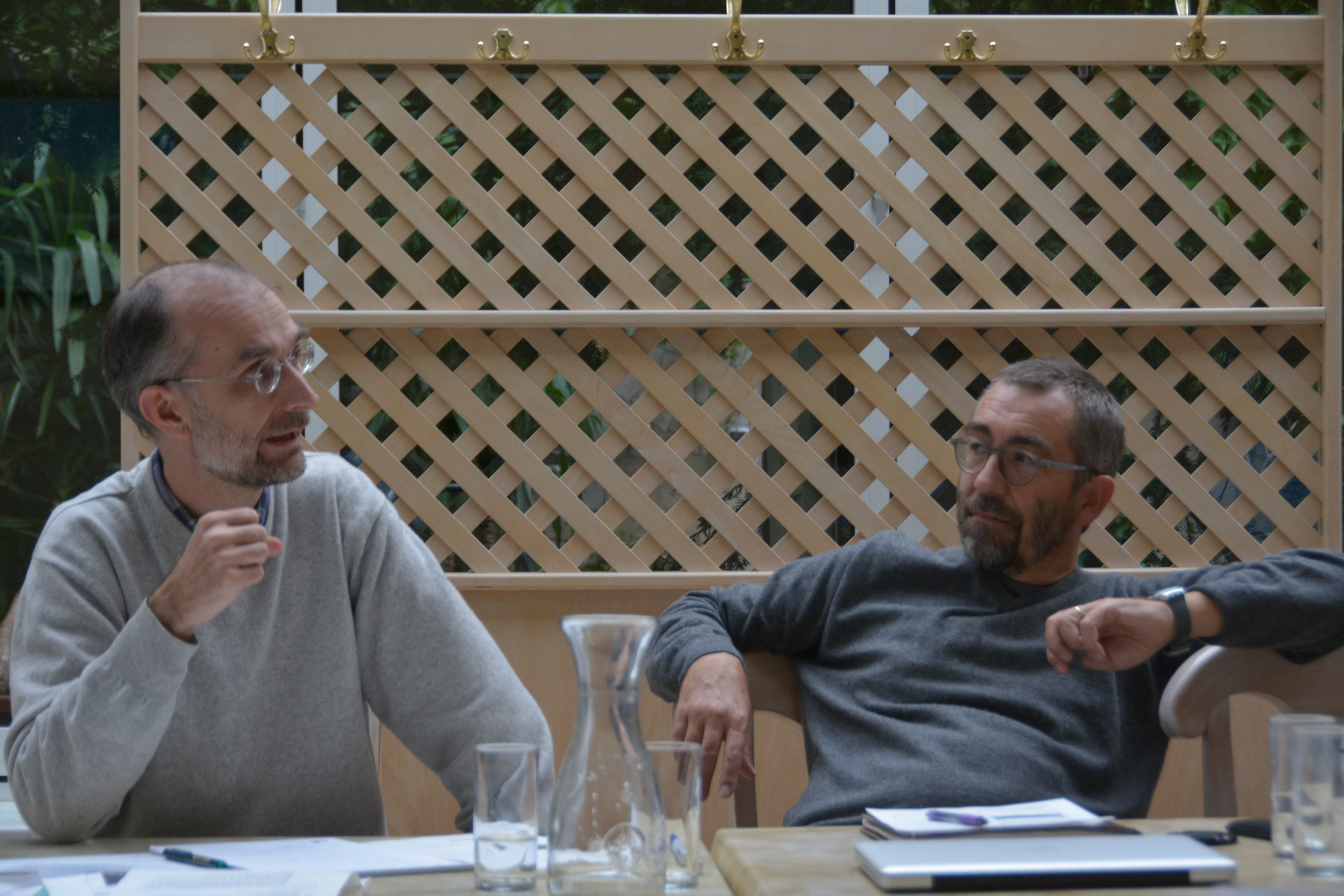
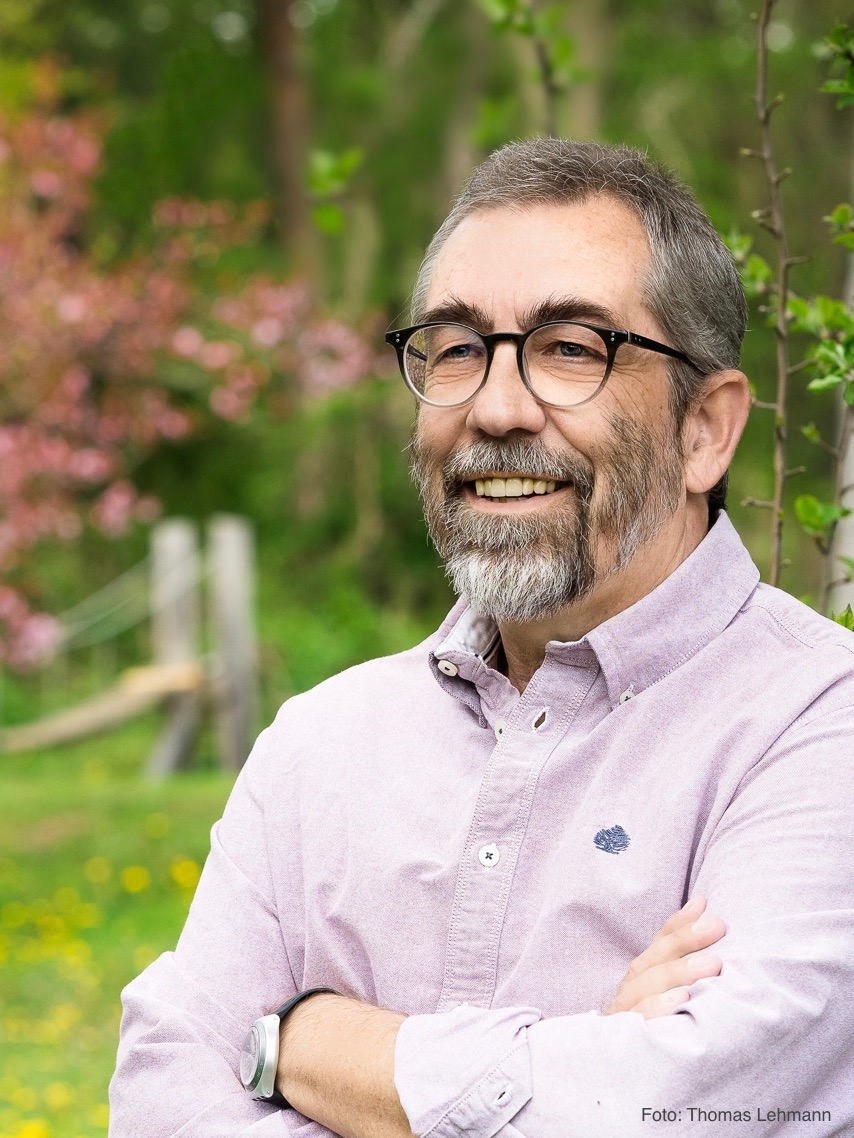
36 years...
Walter Peissl: Yes, I started on April 11, 1988.
We should actually be compiling a book now, "The Peissl Archives".
Peissl: There are lists of publications (see below, note) and the text on "30 years of ITA", where you can also find a lot about my work.
And what do you find when you look back?
Peissl: I think about how far we have come. We started out as a group of idealists, five other researchers and myself, including the first head of our "Technology Assessment Unit" (TAU), as it was called at the time, Ernest Braun. Now we work in an advisory capacity in the Austrian Parliament and are as well connected internationally with the European Parliamentary Technology Assessment (EPTA) network and other collaborations as is possible at European level.
But I'm also thinking of the friends I've made, the trips to Australia and gigs by the band Kollegium Kalksburg.
That is your trademark, I think: The researcher who always remained a fulfilled human.
Peissl: I don't believe that you should only dedicate yourself to one thing in life. There are too many beautiful things that are worth living for. This also enriches my work, because my research has always been about focusing on people: Whether in questions of consumer protection, privacy or safety in the workplace.
The workings of science and policy advice have been heavily debated in Austria recently. How have you experienced this connection?
Peissl: For me, technology assessment (TA) in its original form, meaning always with an eye on people, the environment and politics, is inconceivable without policy advice. This usually takes place in parliaments, but also in ministries, at EU level, etc. The USA showed us how to do it in the 80s, and we from this first generation found it such an exciting model that we said: We'll just do it in Austria too! Despite some adversity at the beginning, it was a concept that we were passionate about.
We then worked in Parliament for the first time in 1991 at the only parliamentary Enquete Commission to date, "Technology assessment as applied to the field of genetic engineering", which was held for several months in the run-up to the decision on the Genetic Engineering Act. Members of all five parliamentary groups were there, which was unheard of and still is rare. However, the big leap towards Parliament only came with the current Director, Michael Nentwich. After years of preparatory work, we finally received the first contract for a working group together with the AIT in 2017. The second tender was won exclusively by the ITA. For me, this is an arrival after a three-decade-long process. This requires staying power and a lot of patience.
Geopolitical conflicts are burning - what is the current state of technology assessment?
Peissl: I see a very positive development in Europe: EPTA is still a strong voice for global efforts, and the STOA committee is our link to the EU Parliament. Developments are of course global, Artificial Intelligenz is relevant everywhere, but in the Global South, for example, we have different working methods and problems. The geopolitical situation with China also needs to be discussed: Is it possible to do TA in a non-democratic system? It would also be very important to get Australia on board for GlobalTA, because they have different perspectives on climate change.
Your main topic of research was and is data protection and privacy. You are a well-known face in the media. You were even recently appointed as a member of the Austrian government's first AI advisory board. What is the current state of data protection?
Peissl: There was a boom to explore the interests of privacy and data protection in preparation for the General Data Protection Regulation. We were able to contribute a lot of our work to the projects, such as the SurPRISE project. Now it's more about concrete applications of systems or software. TA is less involved in this process. At the moment, we are working more on the social aspects of artificial intelligence as well as sustainability and social fairness. Key topics are changing, including at EU level, so it's good that we at the ITA work on a broad and interdisciplinary basis.
What issues were important to you for technological development in Austria?
Peissl: In 1988, I carried out a study on the question of whether internal data transmission should be handled by a digital private branch exchange. Or should it run via LANs with Ethernet? We discovered that it's not the technology, but that it's often about who has more power in an organization. The IT department used to be less important than the in-house operations department, because that's where the telephone system was managed. That was a key learning experience: in the end, it is often not the technology that is important for implementation, but the social and non-technical implications. That is technology assessment in a nutshell.
Another development that comes to mind was the size of cell phones: At first, everyone wanted a smaller and smaller cell phone, until they realized that there is a distance from A to B, namely from ear to mouth, which can be estimated on average and should always remain the same - cell phones got bigger again. Now there are Bluetooth headsets, now smartphones have become even bigger.
I know you as someone who has a very strong sense of justice. Do you see that as the main motivation for your life's work?
Peissl: Yes. The issue of justice is a cornerstone of TA. If we perceive all people as equal and there are still differences, we have to investigate where the differences come from: They often come from different interests and designs in economic systems. We can ask questions and not become unscientific if we claim that capitalism promotes inequality. This has been proven many times over. Even if I see that five large tech companies from the USA influence many countries through the tools they provide and which generate a certain global behavior, that is not unscientific.
But I'm not going to attribute anything to myself. I will always attribute everything to the respective team. That's why it's always been important to me that we have people we work well with. My concern has always been to put forward reasonable arguments, to the best of my knowledge and belief, as to why we think what should be done and how. In Austria, we have a constitution, fundamental rights and a lot of knowledge about sustainability and climate change. We can say with a clear conscience that we have always had our finger on the pulse of what is available as a scientific basis. We have never acted in an activist, but always in a factual manner.
Publications Overview
Technology Assessment in a Globalized World, (Springer 2023)
Hrsg.: Leonhard Hennen, Julia Hahn, Miltos Ladikas, Ralf Lindner, Walter Peissl, Rinie van Est
Foresight und Technikfolgenabschätzung: Monitoring für das Österreichische Parlament, Ausgabe Mai 2024
Nentwich, M., Eppler, W., Gnisa, F., Gudowsky-Blatakes, N., Kehl, C., Krieger-Lamina, J., et al.
Parlamentarische TA. Grünwald R., Peissl W.
In Technikfolgenabschätzung – Handbuch für Wissenschaft und Praxis (Nomos 2021)
Biometrie für Konsument/innen: Bequeme Schlüsseltechnologie oder Überwachungstool? Schaber, F., Strauss, S., & Peissl, W.
In Konsumentenpolitisches Jahrbuch 2021 : Trends, Rechtsentwicklung und Judikatur der letzten zwei Jahre (LexisNexis 2021)
Democratising utopian thought in participatory agenda setting. Gudowsky, N., Bechtold, U., Peissl, W., & Sotoudeh Mahshid,.
European Journal Of Futures (Springer, Mai 2021)
Drei Jahrzehnte institutionalisierte TA in Österreich. Das Institut für Technikfolgen-Abschätzung der Österreichischen Akademie der Wissenschaften. Nentwich, M., & Fuchs, D.