


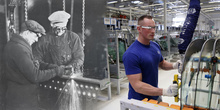
What impact will big data, robots and artificial intelligence have on future employment? Are we being replaced by fully automatic and connected machines that can perform our tasks faster, more precisely and cheaper?
Human-machine interaction
Who assists whom? People control machines that are increasingly taking on everyday tasks. We are just beginning to communicate with the automated conveying and production machines. In our daily life, mobile phones are just as much a part of our understanding as assistance systems in nursing care for the elderly and nursing care for the sick. Automation is not new, it is only advancing into completely new areas of life. It intervenes more quickly and deeply in those areas that were primarily intended by and for people," says Tanja Sinozic. However, in case of problems you quickly come up against limits; talking about it with machines only works to a very limited extent. In such cases, automation quickly leads to less power, control and self-determination," says Sinozic.
TA17 conference
The Institute for Technology Assessment of the Austrian Academy of Sciences (ÖAW) will highlight these aspects and questions at the conference "Neue Arbeitswelt und Digitalisierung – Welche Folgen haben neue Organisationsformen und Technologien?" on 19 June 2017 from an interdisciplinary perspective. Among other things, approaches from the work philosophy are taken into account as well as new life models, the human-machine relationship, the requirements for future educational offers as well as trust, monitoring and discrimination in times of Big Data.
National and international experts analyze which framework conditions we have to create in order to use technical progress in the sense of social justice. Taking into account current scientific studies and findings, we will present suggestions on how we can confront the new realities of the world of work and how we can shape our future.
Links
12.06.2017
Thomas Bayer