


Adrian C. Pirtea
Principal Investigator

Adrian C. Pirtea is the Principal Investigator of the ERC Starting Grant project RevIdEM. He is a historian of Eastern (Byzantine) and Oriental Christianity, specializing in Syriac Patristic, ascetic and mystical literature, but also in the connections between the Syriac world and other cultural areas (Byzantine, Arabic, Caucasian, Iranian) between ca. 300 and 1300 AD. He earned his PhD in Byzantine and Eastern Christian Studies from Freie Universität Berlin (2017) and has held research and teaching positions at the same institution, and in the Corpus Coranicum project at the Berlin-Brandenburg Academy of Sciences (BBAW) from 2017 to 2020. Between 2020 and 2022, Adrian was a Marie Skłodowska-Curie Fellow at the University of Vienna’s Institute for Byzantine and Modern Greek Studies. Since October 2023, he has been a Postdoctoral Researcher and Junior Resarch Group Leader at the Institute for Medieval Research of the Austrian Academy of Sciences (Department of Byzantine Research). His current work within RevIdEM explores the Syriac and Christian Arabic reception of the Apophthegmata Patrum and Late Antique monastic hagiography among Melkite, Syro-Orthodox, and East Syriac Christians in the Eastern Mediterranean, Syria and northern Mesopotamia between the 11th and 13th centuries.
Benedetta Contin

I hold a PhD in Armenian Language and Literature and a PhD in Languages, Societies and Cultures (Oriental Studies) from the University of Geneva (Switzerland, 2011) and the University Ca’ Foscari Venice (Italy, 2012). Between 2012 and 2016, I was a lecturer at the Department of Asian and African Mediterranean Studies of the University Ca‘ Foscari and in 2014 I was awarded a two-years grant from the Gulbenkian Foundation (Junior Postdoc scholarship in Armenian Studies). In 2017-2018, I was fellow researcher at the FSCIRE in Bologna and from 2018 to 2020 associate senior researcher within the ERC 9 SALT project (2018-2020), led by Prof. Christophe Erismann. As principal investigator of a FWF-Lise-Meitner project (yr. 2020-2022, Grant-DOI: 10.55776/M2988), I worked on the reception and re-elaboration of Aristotelian philosophy in the twelfth and thirteenth centuries Mediterranean Armenia and the south Caucasus. In 2022 and 2023 I taught two classes at the Institute of Byzantine and Modern Greek Studies of the University of Vienna (spring semester 2023) and cooperated with the Institute of Balkan Studies of the Austrian Academy of Sciences as author within the project HEMSEE lead by Dr. Konrad Petrovszky. In 2023 I started my collaboration within the ERC project RevIdEM “Reviving the Ascetic Ideal in the Eastern Mediterranean. Entangled Memories of Early Egyptian Monasticism in Medieval Syriac, Arabic and Armenian Christianity (969-1375 CE)", by focusing on the reception of Syriac and Greek texts in the south Caucasus (Armenian highlands) and Mediterranean Armenia.
Alice Croq
associate professor at the Université Paul-Valéry-Montpellier-III (France)

Alice Croq was trained in Islamic and Eastern Christian studies in Paris, Oxford and the Middle East.
After her doctorate at the École pratique des hautes études (sup. M. Debié), she was a post-doctoral fellow in the ANR ChrIs-cross project (2021-2023). She worked on Syriac and Arabic manuscripts and Islamic legal documents. She then started a post-doctoral fellowship at the Austrian Academy of Sciences as part of the ERC project 'Reviving the Ascetic Ideal in the Eastern Mediterranean' (PI A. Pirtea). During her year in the team, she was particularly interested in the reception of Syriac texts in Coptic milieus. In 2024, she was hired as an associate professor at the Université Paul-Valéry-Montpellier-III (France), where she teaches Islamic history and Arabic language.
Andy Hilkens

Andy Hilkens (PhD in History, Ghent University, 2014) is a cultural historian of the pre-modern Eastern Mediterranean and the Caucasus. He specializes in intercultural interaction and its results, positive (circulation of knowledge and literature, translation of texts, multilingualism, and religious dialogue) as well as negative (polemics and religious conflict), with a particular focus on the entangled history of Syriac and Armenian churches. His research is located at the intersection of Syriac, Byzantine, Armenian and Coptic studies: Syriac historiography, Syriac and Armenian hagiography, Syriac and Armenian parabiblical literature, the Armenian reception of Syriac literature and vice versa, debates between Syriac and Armenian Miaphysite Christians in the eleventh and twelfth centuries, Syriac-Armenian bilingualism, and the Armenian and Coptic reception of Ephrem Graecus.
In the context of RevIdEM he investigates the representation of the desert fathers in the Armenian menologion of Hovsep‘ of Constantinople (991-992). He also teaches Coptic at the University of Vienna. He has previously held a Newton International Fellowship at the University of Oxford and fellowships at the university of Florence, Ghent and Jerusalem. He was also a scientific collaborator in the LOEWE-Cluster Minority Studies: Language and Identity at the University of Frankfurt.
Philipp Abel-Dunner
Project Manager, Austrian Academy of Sciences
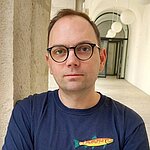
Philipp Abel-Dunner studied ecology and ecosystem sciences at the University of Vienna (2008-2015), specialising in fish ecology. After working in visitor management at the Donau-Auen National Park and Schönbrunn Zoo, he started working at the Austrian Academy of Sciences Press in 2008 and is currently responsible for logistics, sales and marketing. Since 2024 he is project manager at the Project RevIdEm.