


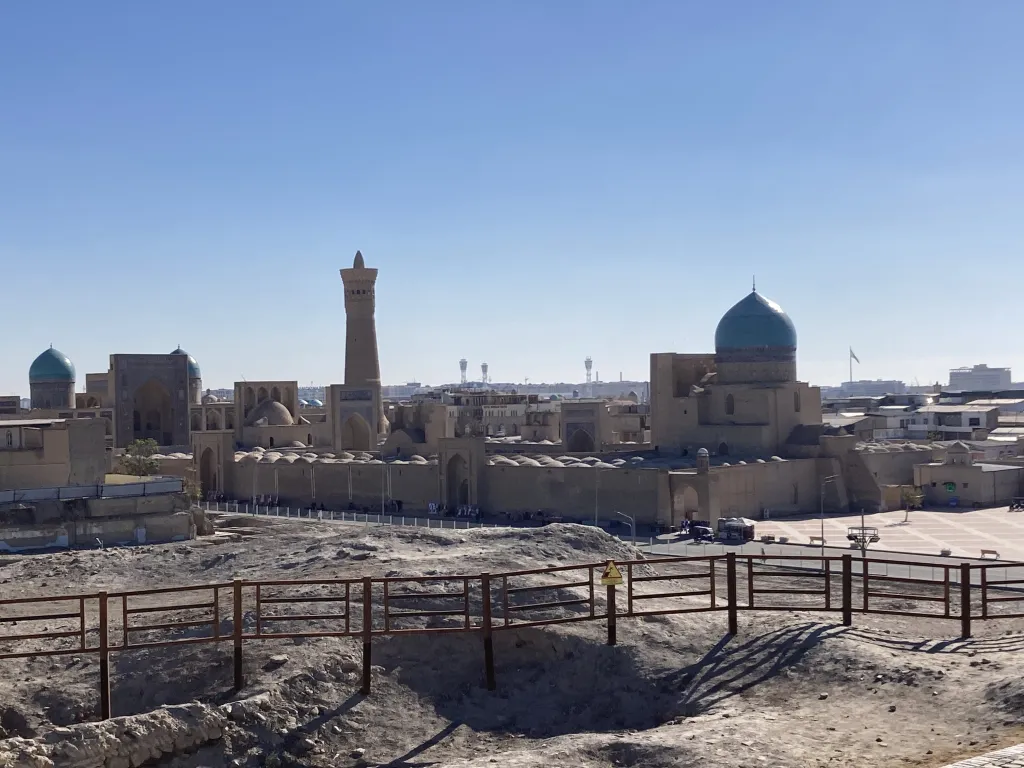
The term “Bukharan Jews” originates from the city of Bukhara and the Emirate of Bukhara, in today’s Uzbekistan, where a sizeable number of Jews lived. Nevertheless, members of the Bukharan Jewish community came from places all over Central Asia, as well as Iran, Iraq, Syria and Yemen.
According to Michael Zand, the first Jews in Central Asia settled in the southwestern parts of contemporary Turkmenistan during the Achaemenid period, sometime after 559 BC. The first evidence for the presence of Jews in Central Asia is a story in the Talmud about a member of the religious academy in Pūmbědīṯā, Samuel bar Bisena, who had travelled to Marv in the early 4th-century. A number of Babylonian Jewish religious authorities engaged in the silk trade, and the Marv Oasis, located on one of the routes, is home to archaeological findings with early Hebrew inscriptions.
Already in the 10th century, a specific Judaic ritual tradition – Minhag Khorasan – was mentioned in Jewish sources.
A text from the 8th or 9th century states that Kāṯ, the capital of Ḵhwārazm was founded by Narseh, who was “the son of a Jew”. Moreoever, the king of Khwarezm would consult the ahbar among his other subjects, referring to non-Muslim religious authorities, particularly Jewish rabbis. Further excavations in the mid-20th century near Bayrām-ʿAlī (near the ruins of ancient Marv) found graves dated to the 5th-7th centuries with inscriptions in Hebrew script.
In the 16th century, forced resettlement of Jewish silk weavers from northeastern Iran, conquered in 1590 by the armies of Shaybanid Khan Abdallah (ca. 1583–98), led to the development of Jewish communities in Samarkand and Bukhara. They might have come from Persia, but also Khwarezm and Khazaria.
These Persian-speaking Jews worked as dyers and weavers and developed the empire’s textile industry. Supposedly, one could recognize Bukharan Jews by their purple-dyed hands. Other legends state that Jewish silk weavers were transferred to Central Asia by Tīmūr from Sabzavar, Shiraz, and Baghdad.
After Iran had become Shiʿite under the Safavids in the 16th century, the links with Central Asia declined. Bukhara absorbed many Jews from territory disputed between the Safavids and the Shaybanids.
At the end of the sixteenth century, Bukhara became the new center of Jews in that region. By 1620, a synagogue and a Jewish quarter, today known as the Maḥalla-ye Kohna (old quarter), was established in the city.
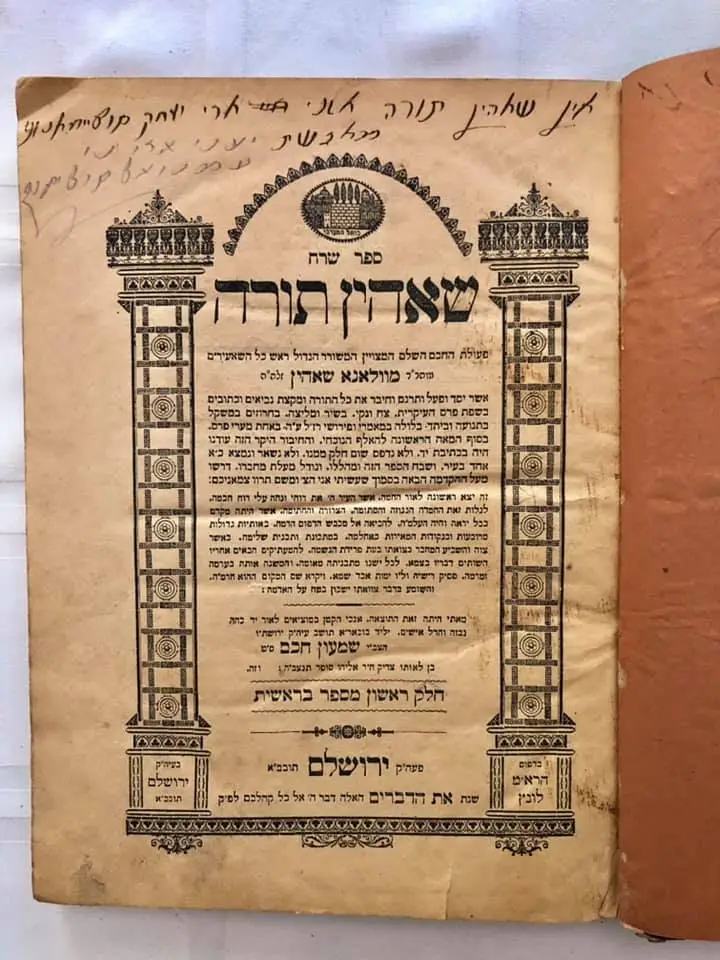
In 1749 Yosef b. Isaac (Yūsuf Yahūdī) wrote the epic poem “Antioḵus-nāma” (Book of Antiochus), testifying to the close cultural ties that Bukharan Jews had with other Jewish communities as well as with the Persian literary tradition and poetry. This work also attests to the shift of language from Judeo-Persian to Judeo-Tajik. The translation and publication of books in Judeo-Persian was connected to the first immigrants from Bukhara to Jerusalem in the late 19th century. They were active in establishing printing houses, translating books from Hebrew to Judeo-Persian, and disseminating them to the communities in Central Asia and Iran. About 120 books in Judeo-Persian were printed in Jerusalem in the late 19th and early 20th centuries.
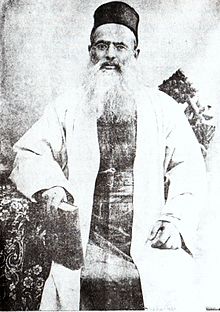
Rabbi Yōsēf Mamān Maḡrebī (1752-1823), a native of Tetuan, Morocco, arrived in Bukhara to raise funds for the community of Safed in Palestine. In Bukhara, he succeeded to replace the Khorasani rite with the Sephardic rite. When he later moved to Jerusalem, he became a major figure in the translation and publication of Judeo-Persian books.
For an overview of Judeo-Tajik by Chana Tolmas please see: Jewish Languages
Conversion to Islam persisted up to the Russian conquest in the mid-19th century. There was a community of Jews who had converted to Islam, called challah (lit. “nor this nor that”), who were a distinct group, separate from both Jews and Muslims. At this time, about 13 percent (300 families of about 1,500) of the Jewish population of Bukhara were challah, living in separate quarters but right next to the Jewish quarter. In Samarkand, the challah had a trading row of their own in the town market as well as their own synagogue.
The first census of the Russian empire (1897) counted 11,463 adherents of Judaism in Central Asian territory of which at least 9,500-10,000 were Central Asian Jews. Data from various independent sources suggest that there were 6,000-6,500 Jews in the Emirate of Bukhara, 4,000-4,500 of them in the city itself.
Some Bukharan Jews financed the commercial activities of Muslim merchants who engaged in wholesale trade with Russia. Jews themselves also entered the wholesale trade with neighboring areas of the Russian empire, importing Russian goods. The Russian authorities encouraged this by permitting the so-called “indigenous” (i.e. Persian Jews, and not Ashkenazi/European) Jews to become members of merchant guilds in Russian provinces where Jewish settlement was otherwise forbidden. They were also allowed to participate in the trade fairs in Orenburg and at Nizhni Novgorod.
Central Asian Jews living in Turkestanskiĭ Kraĭ were divided into two categories: “Indigenous Jews,” those who had lived there before the Russian conquest and “foreign Jews”. Only the former enjoyed rights equal to those of locals. “Foreign Jews" were only allowed to settle in special towns or areas. By 1906, however, it become obvious that enforcing the regulation was unrealistic since too many segments of the population were involved in the industrial and trade activities of Bukharan Jews and therefore either opposed it openly or turned a blind eye.
With the establishment of the Turkestan Soviet Republic in 1918, the control over Central Asian Jews there was handed over to the Jewish section (Evsektsiya) of the Communist Party, which consisted almost entirely of Ashkenazi Jews. The class of Central Asian Jewish businessmen and industrialists came to an end. Many moved into agriculture (kolkhozes). In 1928, there were 28 Jewish kolkhozes in Uzbekistan with the membership of 418 families.
In the late 1920s and early 1930s Central Asian Jews formed the overwhelming majority of workers in the silk mill and soap factory in Samarkand and the cotton gin in Kokand.
The total number of Central Asian Jews at the end of the 19th century was probably between 16,000 and 17,000. In 1926, the Soviet census states the number of Central Asian Jews in the USSR as 18,698 by far most of them dwelling in what is now Uzbekistan and Tajikistan. They were already outnumbered however, by Ashkenazi Jews, who continued to gain proportionally. Samarkand, with 7,740 Central Asian Jews, was the largest center.
Emigration of Bukharan Jews took place in several waves. The first Bukharan immigrants to Jerusalem founded a neighborhood in the late 19th century, which until today is called the “Bukharan quarter” (Shekhunat ha-Bukharim). Bukharan Jews also moved to Afghanistan, where they were active in trade of Karakul skin, silk, or fabrics (among other things), or to Bombay. In the 1930s, more Bukharan Jews left Central Asia due to the economic and political crises caused by Stalin’s rule. They fled to Afghanistan and Iran, and from there to Palestine, India, or Europe. After that, it was for a long time not possible to leave the Soviet Union, because the borders were closed. Only in the early 1970s emigration started again, mainly to Israel and the United States. Around this time the Bukharan community in Vienna was established. The final wave of emigration happened with the dissolution of the Soviet Union. Today, most Bukharan Jews live in Israel, the United States, Vienna, London and Germany (Hannover). Approximately 2500 Jews remain in Uzbekistan, primarily in the cities of Bukhara, Samarkand, and Tashkent.