


Thomas Bergauer
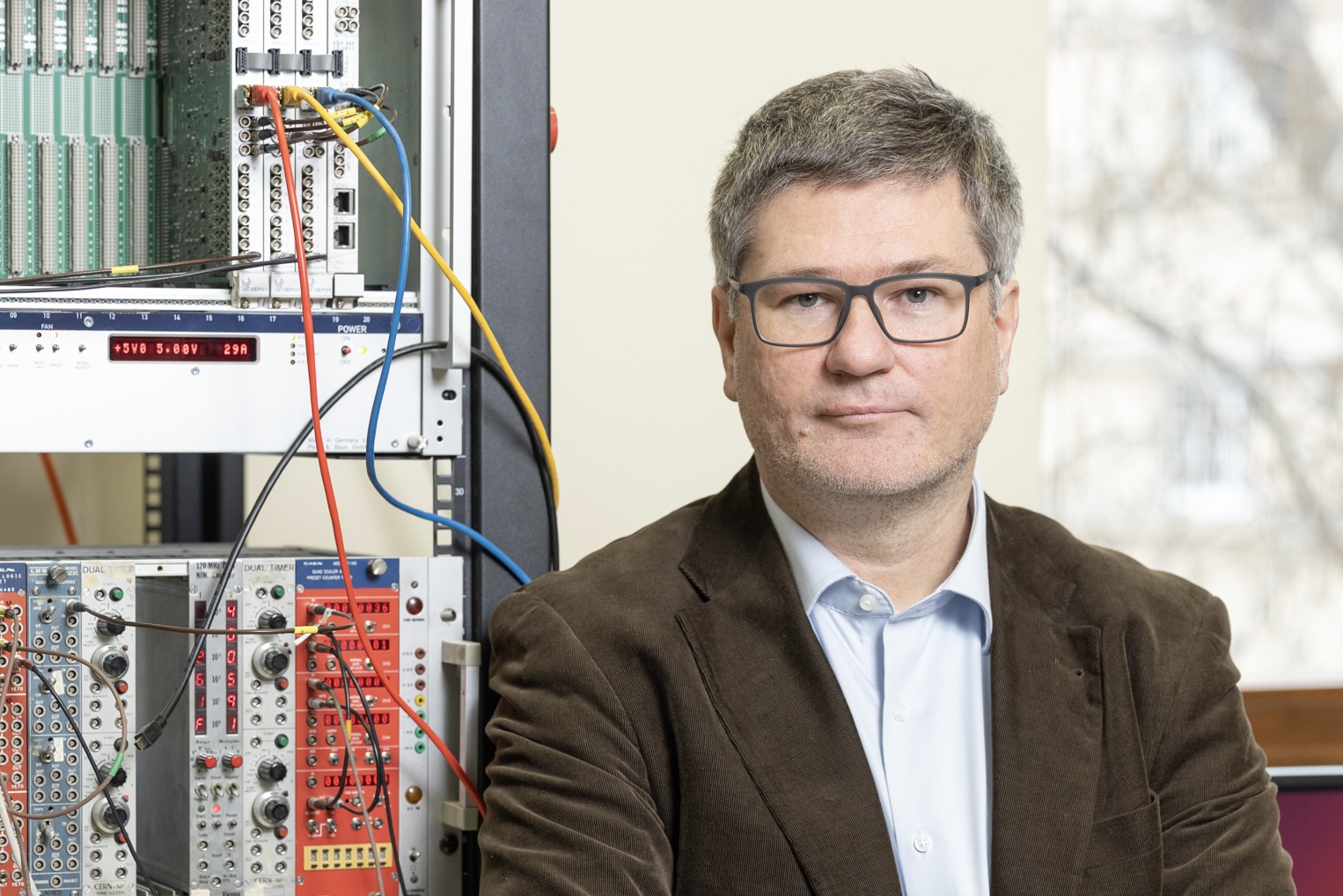
Thomas Bergauer
- Group Leader Detector Development
- Detector Development
- Belle,
- CMS Tracker,
- Detector Development
- +43 (1) 51581 - 2836
- Thomas.Bergauer(at)oeaw.ac.at
- HEPHY
- 314
Biographical sketch
Thomas Bergauer performs strategic R&D on particle detectors for future High Energy Physics (HEP) experiments and applications in medical imaging and other domains. He works on high-precision lightweight detectors with an ultra-low material budget for future electron/positron colliders using Depleted Monolithic Active Pixel Sensors (DMAPS), which integrate the sensing element with readout electronics. For hadron machines, he performs research on radiation hard detectors at ultra-high fluences, as well as on precision timing and innovative wide-bandgap semiconductor material like Silicon Carbide. To fully exploit the possibilities of the ion therapy center MedAustron with its synchrotron, he is involved in several projects ranging from beam instrumentation and ion imaging to microdosimetry. He established close collaboration with the semiconductor industry in Austria and internationally for his research.
He has been leading the semiconductor group at HEPHY since 2008 and the department for detector development since 2019, where he is responsible for the operation of the experimental facilities.
Funding
Granted third-party funding
- AIDAinnova: (2021-2024): Second AIDA follup up, now with focus on DMAPS (HV-CMOS sensors)
- AIDA-2020 (2015-2019): AIDA-successor in Horizon 2020 framework (task leader)
- AIDA (2011-2014): Advanced infrastructures for detectors at accelerators (task leader)
- EUDET (2005-2010): Detector R&D towards the International Linear Collider (associated partner)
- FFG Projekt MAPLE: "Monolithic Active Pixel Sensor for Lepton Collider Experiments", project leader, Call "Industriedissertationen", 2025-2028
- FFG Projekt Flash-BPM: "Online Dosimetry for FLASH Radiotherapy", project leader, Call "Bridge", 2025-2028
- FFG Projekt "SpaceSiC: Silicon Carbide dosimeter for space applications and ion therapy", project leader, Call "Industriedissertationen", 2024-2027 (OFFG000373)
- FFG Projekt "CASTID: CMOS Active Sensors as Telescope and Imaging Device" (2024-2025) project leader (OFFG000370)
- FFG Project "RadHardDetSim: Radiation Hardening of Silicon Carbide Particle Detectors using Device Simulation" (2022-2025), project leader (OFFG000345)
- FFG Project "HiBPM: Hi-Precision Beam Position and Intensity Monitor for Accurate Cancer Treatment with Ions" (2021-2024), project leader (OFFG000308)
- FFG Project "DMAPS: Entwicklung eines ultraschnellen monolithischen CMOS Pixeldetektors für ionisierende Strahlung" (2020-2023), project leader (OFFG000291)
- FFG Project "Ion Imaging: Bildgebung mit hochenergetischen Protonenstrahlen für eine verbesserte Krebsbehandlung" (2019-2022), project leader (OFFG000281)
- FFG Project "Entwicklung eines bildgebenden Verfahrens mittels Protonenstrahlen" (2018-2021), project leader (FFG0260)
- FFG Project "Entwicklung von Siliziumsensoren für die Energiemessung in einem Kalorimeter" (2018-2021), project leader (FFG0248)
- FFG Project "Entwicklung von Teststrukturen und -systemen zur Überwachung des Herstellungsprozesses von Siliziumdetektoren" (2017-2020), project leader (FFG0219)
- FFG Project "Strahlenharte Siliziumdetektoren für zukünftige Physikexperimente und Medizinanwendungen" (2014-2017), project leader (FFG0186)
Former and Current Positions
- Austrian Representative in the (Restricted) European Committee for Future Accelerators (RECFA)
- Chairman of the CERN Detector R&D Committee (DRDC)
- Reviewer of Swiss, French and Polish funding agencies
- Member of the International Scientific Committee of the TREDI workshop series
Memberships in Editorial Board
Guest editor for Nuclear Instruments in Physics Research A
Academic Honors and Awards
- Houskapreis 2014 (2nd rank) with the development of radiation-hard semiconductor detectors with Infineon (Video)
Teaching
- VO+UE "Techniken der Signalerfassung und Auswertung" (VO 141.A88 + UE 141.A89) at TU Wien
- LU "Experimente am MedAustron Teilchenbeschleuniger - Angewandte Teilchenphysik und medizinische Physik" (LU 141.A99) at TU Wien
- PR "Experimentelle Methoden der Hochenergiephysik" (PR 141.A31 and 141.A46), TU Vienna
- PR "Messmethoden in der Hochenergiephysik" (PR 260051), University of Vienna
- VO "Grundlagen der Teilchendetektoren" (VO 141.250)
Lecturer at international schools
- Silicon Detectors in High Energy Physics, at "School on Silicon Detector Technologies" (Institute for Research in Fundamental Sciences), Tehran (Iran), 2011
- Semiconductor Detectors in High Energy Physics at "The Actual Problems of Microword Physics" (Gomel, Belarus, 2009
Research interests
- Development of silicon particle detectors for tracking and calorimeter purposes
- Application of detectors for medical imaging
- R&D on radiation-hard silicon detectors for future HEP experiments
- Precision timing for pile-up suppression in HL-LHC and FCC-hh
- Monolithic detectors with ultra-high spacial precision and low material budget
- New semiconductor materials like Silicon Carbide with superior properties
- Development of the Silicon Vertex Detector of the Belle II experiment at KEK (Japan)
- Industrialization of the production of Si detectors for HEP applications
- Radiation Protection
Outreach activities
Numerous public lectures about particle physics, CERN, particle accelerators like the LHC, the Higgs Boson and applications of HEP research in medical imaging, promoting particle physics to the general public.
Titles and Talks in German:
- LHC -- die größte Maschine der Welt
- Kosmische Strahlung in Alltag und Technik
Audience: Adults (VHS, HEPHY exhibition), Kids (schools),…
Further Information
Publications
- Commissioning of low particle flux for proton beams at MedAustron. / Ulrich-Pur, Felix; Adler, Laurids; Bergauer, Thomas et al.
In: Nuclear Instruments and Methods in Physics Research, Section A: Accelerators, Spectrometers, Detectors and Associated Equipment, Vol. 1010, 11.09.2021, p. ARTN 165570. - A Low Mass On-Chip Readout Scheme for Double-Sided Silicon Strip Detectors. / Irmler, C.; Bergauer, T.; Frankenberger, A. et al.
In: Nuclear Instruments and Methods in Physics Research, Section A: Accelerators, Spectrometers, Detectors and Associated Equipment, Vol. 732, 21.12.2013, p. 109-112. - Characterizing the delivered spill structure of medical proton and carbon-ion beams at MedAustron using a high frequency silicon carbide readout. / Knopf, Matthias; Gsponer, Andreas; Kausel, Matthias et al.
In: Nuclear Instruments and Methods in Physics Research, Section A: Accelerators, Spectrometers, Detectors and Associated Equipment, Vol. 1082, 170984, 02.2026. - Search for $t$-channel scalar and vector leptoquark exchange in the high-mass dimuon and dielectron spectra in proton-proton collisions at $s$ = 13 TeV. / Collaboration, CMS; Adam, Wolfgang; Andrejkovic, Janik Walter et al.
In: JOURNAL OF HIGH ENERGY PHYSICS, Vol. 2025, No. 12, 01.12.2025. - Search for charged-lepton flavour violation in top quark interactions with an up-type quark, a muon, and a tau lepton in proton-proton collisions at $s=13$ TeV. / Collaboration, CMS; Adam, Wolfgang; Andrejkovic, Janik Walter et al.
In: JOURNAL OF HIGH ENERGY PHYSICS, Vol. 2025, No. 12, 01.12.2025. - Search for a new scalar resonance decaying to a Higgs boson and another new scalar particle in the final state with two bottom quarks and two photons in proton-proton collisions at $s=13$ TeV. / Collaboration, CMS; Adam, Wolfgang; Andrejkovic, Janik Walter et al.
In: JOURNAL OF HIGH ENERGY PHYSICS, Vol. 2025, No. 12, 01.12.2025. - Design and simulation of a 4H-SiC low gain avalanche diode with trench-isolation. / Onder, Sebastian; Gaggl, Philipp; Buerin, Juergen et al.
In: Nuclear Instruments and Methods in Physics Research, Section A: Accelerators, Spectrometers, Detectors and Associated Equipment, Vol. 1080, 170740, 11.2025. - From single particles to clinical beam rates: A wide dynamic range beam monitor. / Waid, Simon; Gaggl, Philipp; Thalmeier, Richard et al.
In: Nuclear Instruments and Methods in Physics Research, Section A: Accelerators, Spectrometers, Detectors and Associated Equipment, Vol. 1080, 170674, 11.2025. - Search for a cH signal in the associated production of at least one charm quark with a Higgs boson in the diphoton decay channel in pp collisions at $s=13$ TeV. / Collaboration, CMS; Adam, Wolfgang; Andrejkovic, Janik Walter et al.
In: JOURNAL OF HIGH ENERGY PHYSICS, Vol. 2025, No. 11, 01.11.2025. - Search for a heavy pseudoscalar Higgs boson decaying to a 125 GeV Higgs boson and a Z boson in final states with two tau and two light leptons in proton-proton collisions at $s=13$ TeV. / Collaboration, CMS; Adam, Wolfgang; Andrejkovic, Janik Walter et al.
In: JOURNAL OF HIGH ENERGY PHYSICS, Vol. 2025, No. 10, 01.10.2025. - Pileup mitigation in high rate spectroscopy using the deconvolution method. / Knopf, Matthias; Radmanovac, Daniel; Barna, Sandra et al.
In: Nuclear Instruments and Methods in Physics Research, Section A: Accelerators, Spectrometers, Detectors and Associated Equipment, Vol. 1078, 170560, 09.2025. - Measurement of light-by-light scattering and the Breit-Wheeler process, and search for axion-like particles in ultraperipheral PbPb collisions at $s_NN$ = 5.02 TeV. / Collaboration, CMS; Adam, Wolfgang; Andrejkovic, Janik Walter et al.
In: JOURNAL OF HIGH ENERGY PHYSICS, Vol. 2025, No. 8, 01.08.2025. - Measurement of the inclusive $ tt $ cross section in final states with at least one lepton and additional jets with 302 pb$^−1$ of pp collisions at $ s $ = 5.02 TeV. / Collaboration, CMS; Adam, Wolfgang; Andrejkovic, Janik Walter et al.
In: JOURNAL OF HIGH ENERGY PHYSICS, Vol. 2025, No. 4, 01.04.2025. - Search for pair production of heavy particles decaying to a top quark and a gluon in the lepton+jets final state in proton-proton collisions at $s$ = 13 TeV. / Collaboration, CMS; Adam, Wolfgang; Andrejkovic, Janik Walter et al.
In: The European Physical Journal C, Vol. 85, No. 3, 01.03.2025. - Constraints on standard model effective field theory for a Higgs boson produced in association with W or Z bosons in the H textrightarrow$ bb $ decay channel in proton-proton collisions at $ s $ = 13 TeV. / Collaboration, CMS; Adam, Wolfgang; Andrejkovic, Janik Walter et al.
In: JOURNAL OF HIGH ENERGY PHYSICS, Vol. 2025, No. 3, 01.03.2025. - Differential cross section measurements for the production of top quark pairs and of additional jets using dilepton events from pp collisions at $s$ = 13 TeV. / Collaboration, CMS; Adam, Wolfgang; Andrejkovic, Janik Walter et al.
In: JOURNAL OF HIGH ENERGY PHYSICS, Vol. 2025, No. 2, 01.02.2025. - Search for long-lived heavy neutral leptons in proton-proton collision events with a lepton-jet pair associated with a secondary vertex at $ s $ = 13 TeV. / Collaboration, CMS; Adam, Wolfgang; Andrejkovic, Janik Walter et al.
In: JOURNAL OF HIGH ENERGY PHYSICS, Vol. 2025, No. 2, 01.02.2025. - Search for high-mass resonances in a final state comprising a gluon and two hadronically decaying W bosons in proton-proton collisions at $ s $ = 13 TeV. / Collaboration, CMS; Adam, Wolfgang; Andrejkovic, Janik Walter et al.
In: JOURNAL OF HIGH ENERGY PHYSICS, Vol. 2025, No. 2, 01.02.2025. - Measurements of inclusive and differential cross sections for top quark production in association with a Z boson in proton-proton collisions at $ s $ = 13 TeV. / Collaboration, CMS; Adam, Wolfgang; Andrejkovic, Janik Walter et al.
In: JOURNAL OF HIGH ENERGY PHYSICS, Vol. 2025, No. 2, 01.02.2025. - Search for a heavy resonance decaying into a Z and a Higgs boson in events with an energetic jet and two electrons, two muons, or missing transverse momentum in proton-proton collisions at $ s $ = 13 TeV. / Collaboration, CMS; Adam, Wolfgang; Andrejkovic, Janik Walter et al.
In: JOURNAL OF HIGH ENERGY PHYSICS, Vol. 2025, No. 2, 01.02.2025. - Study of WH production through vector boson scattering and extraction of the relative sign of the W and Z couplings to the Higgs boson in proton-proton collisions at s=13TeV. / Collaboration, CMS; Adam, Wolfgang; Andrejkovic, Janik Walter et al.
In: Physics Letters B, Vol. 860, 01.01.2025, p. 139202. - Search for bottom quark associated production of the standard model Higgs boson in final states with leptons in proton-proton collisions at s=13TeV. / Collaboration, CMS; Adam, Wolfgang; Andrejkovic, Janik Walter et al.
In: Physics Letters, Section B: Nuclear, Elementary Particle and High-Energy Physics, Vol. 860, 139173, 01.01.2025, p. ARTN 139173. - Measurement of inclusive and differential cross sections of single top quark production in association with a W boson in proton-proton collisions at $ s $ = 13.6 TeV. / Collaboration, CMS; Adam, Wolfgang; Andrejkovic, Janik Walter et al.
In: JOURNAL OF HIGH ENERGY PHYSICS, Vol. 2025, No. 1, 01.01.2025. - Studies of B-s2*(5840)(0) and B-s1(5830)(0) mesons including the observation of the B-s2*(5840)(0) -> (BKS0)-K-0 decay in proton- proton collisions at root s=8 TeV. / Sirunyan, A. M.; Tumasyan, A.; Adam, W. et al.
In: European Physical Journal C, Vol. 78, No. 11, 15.11.2018, p. ARTN 939. - Search for R-parity violating supersymmetry in pp collisions at root s=13 TeV using bjets in a final state with a single lepton, many jets, and high sum of large-radius jet masses. / Sirunyan, A. M.; Tumasyan, A.; Adam, W. et al.
In: Physics Letters, Section B: Nuclear, Elementary Particle and High-Energy Physics, Vol. 783, 15.08.2018, p. 114-139. - Search for new physics in events with two soft oppositely charged leptons and missing transverse momentum in proton-proton collisions at root s=13 TeV. / Sirunyan, A. M.; Tumasyan, A.; Adam, W. et al.
In: Physics Letters, Section B: Nuclear, Elementary Particle and High-Energy Physics, Vol. 782, 15.07.2018, p. 440-467. - Search for excited quarks of light and heavy flavor in gamma plus jet final states in proton-proton collisions at root s=13 TeV. / Sirunyan, A. M.; Tumasyan, A.; Adam, W. et al.
In: Physics Letters, Section B: Nuclear, Elementary Particle and High-Energy Physics, Vol. 781, 15.06.2018, p. 390-411. - Search for single production of a vector- like T quark decaying to a Z boson and a top quark in proton-proton collisions at root s=13 TeV. / Sirunyan, A. M.; Tumasyan, A.; Adam, W. et al.
In: Physics Letters, Section B: Nuclear, Elementary Particle and High-Energy Physics, Vol. 781, 15.06.2018, p. 574-600. - Search for gauge-mediated supersymmetry in events with at least one photon and missing transverse momentum in pp collisions at ,root s=13 TeV. / Sirunyan, A. M.; Tumasyan, A.; Adam, W. et al.
In: Physics Letters, Section B: Nuclear, Elementary Particle and High-Energy Physics, Vol. 780, 15.05.2018, p. 118-143. - Search for supersymmetry in events with one lepton and multiple jets exploiting the angular correlation between the lepton and the missing transverse momentum in proton-proton collisions at root s=13 TeV. / Sirunyan, A. M.; Tumasyan, A.; Adam, W. et al.
In: Physics Letters, Section B: Nuclear, Elementary Particle and High-Energy Physics, Vol. 780, 15.05.2018, p. 384-409. - Search for pair production of vector-like quarks in the bW(b)over-barW channel from proton-proton collisions at root s=13TeV. / Sirunyan, A. M.; Tumasyan, A.; Adam, W. et al.
In: Physics Letters, Section B: Nuclear, Elementary Particle and High-Energy Physics, Vol. 779, 15.04.2018, p. 82-106. - Search for Higgs boson pair production in events with two bottom quarks and two tau leptons in proton-proton collisions at root s=13 TeV. / Sirunyan, A. M.; Tumasyan, A.; Adam, W. et al.
In: Physics Letters, Section B: Nuclear, Elementary Particle and High-Energy Physics, Vol. 778, 15.03.2018, p. 101-127. - Search for the pair production of third-generation squarks with two-body decays to a bottom or charm quark and a neutralino in proton-proton collisions at root s=13 TeV. / Sirunyan, A. M.; Tumasyan, A.; Adam, W. et al.
In: Physics Letters, Section B: Nuclear, Elementary Particle and High-Energy Physics, Vol. 778, 15.03.2018, p. 263-291. - Search for heavy resonances decaying to a top quark and a bottom quark in the lepton plus jets final state in proton-proton collisions at 13 TeV. / Sirunyan, A. M.; Tumasyan, A.; Adam, W. et al.
In: Physics Letters, Section B: Nuclear, Elementary Particle and High-Energy Physics, Vol. 777, 15.02.2018, p. 39-63. - Search for Higgsino pair production in pp collisions at root s=13 TeV in final states with large missing transverse momentum and two Higgs bosons decaying via H -> b(b)over bar. / Sirunyan, A. M.; Tumasyan, A.; Adam, W. et al.
In: Physical Review D, Vol. 97, No. 3, 08.02.2018, p. ARTN 032007. - Azimuthal anisotropy of charged particles with transverse momentum up to 100GeV/c in PbPb collisions at root S-NN=5.02 TeV. / Sirunyan, A. M.; Tumasyan, A.; Adam, W. et al.
In: Physics Letters, Section B: Nuclear, Elementary Particle and High-Energy Physics, Vol. 776, 15.01.2018, p. 195-216. - Measurements of t(t)over-bar cross sections in association with b jets and inclusive jets and their ratio using dilepton final states in pp collisions at root s=13 TeV. / Sirunyan, A. M.; Tumasyan, A.; Adam, W. et al.
In: Physics Letters, Section B: Nuclear, Elementary Particle and High-Energy Physics, Vol. 776, 15.01.2018, p. 355-378. - Constraints on anomalous Higgs boson couplings using production and decay information in the four-lepton final state. / Sirunyan, A. M.; Collaboration, C. M. S.; Tumasyan, A. et al.
In: Physics Letters, Section B: Nuclear, Elementary Particle and High-Energy Physics, Vol. 775, 15.12.2017, p. 1-24. - Search for black holes and other new phenomena in high-multiplicity final states in proton-proton collisions at root s=13 TeV. / Sirunyan, A. M.; Tumasyan, A.; Adam, W. et al.
In: Physics Letters, Section B: Nuclear, Elementary Particle and High-Energy Physics, Vol. 774, 15.11.2017, p. 279-307. - Combination of searches for heavy resonances decaying to WW, WZ, ZZ, WH, and ZH boson pairs in proton-proton collisions at root s=8 and 13 TeV. / Sirunyan, A. M.; Tumasyan, A.; Adam, W. et al.
In: Physics Letters, Section B: Nuclear, Elementary Particle and High-Energy Physics, Vol. 774, 15.11.2017, p. 533-558. - Measurement of vector boson scattering and constraints on anomalous quartic couplings from events with four leptons and two jets in proton-proton collisions at root s=13 TeV. / Sirunyan, A. M.; Tumasyan, A.; Adam, W. et al.
In: Physics Letters, Section B: Nuclear, Elementary Particle and High-Energy Physics, Vol. 774, 15.11.2017, p. 682-705. - Search for single production of vector-like quarks decaying into a b quark and a W boson in proton-proton collisions at root s=13 TeV. / Sirunyan, A. M.; Tumasyan, A.; Adam, W. et al.
In: Physics Letters, Section B: Nuclear, Elementary Particle and High-Energy Physics, Vol. 772, 15.09.2017, p. 634-656. - Coherent J/psi photoproduction in ultra-peripheral PbPb collisions at root s(NN)=2.76 TeV with the CMS experiment. / Khachatryan, V.; Sirunyan, A. M.; Tumasyan, A. et al.
In: Physics Letters, Section B: Nuclear, Elementary Particle and High-Energy Physics, Vol. 772, 15.09.2017, p. 489-511. - Search for high-mass Z gamma resonances in proton-proton collisions at root s=8 and 13 TeV using jet substructure techniques. / Sirunyan, A. M.; Tumasyan, A.; Adam, W. et al.
In: Physics Letters, Section B: Nuclear, Elementary Particle and High-Energy Physics, Vol. 772, 15.09.2017, p. 363-387. - Search for physics beyond the standard model in events with two leptons of same sign, missing transverse momentum, and jets in proton-proton collisions at root s=13TeV. / Sirunyan, A. M.; Tumasyan, A.; Adam, W. et al.
In: European Physical Journal C, Vol. 77, No. 9, 01.09.2017, p. ARTN 578. - Search for single production of a heavy vector-like T quark decaying to a Higgs boson and a top quark with a lepton and jets in the final state. / Khachatryan, V.; Sirunyan, A. M.; Tumasyan, A. et al.
In: Physics Letters, Section B: Nuclear, Elementary Particle and High-Energy Physics, Vol. 771, 15.08.2017, p. 80-105. - Search for third-generation scalar leptoquarks and heavy right-handed neutrinos in final states with two tau leptons and two jets in proton-proton collisions at root s=13 TeV. / Sirunyan, A. M.; Tumasyan, A.; Adam, W. et al.
In: JOURNAL OF HIGH ENERGY PHYSICS, No. 7, 26.07.2017, p. ARTN 121. - Measurement of the cross section for electroweak production of Z gamma in association with two jets and constraints on anomalous quartic gauge couplings in proton-proton collisions at root s=8 TeV. / Khachatryan, V.; Sirunyan, A. M.; Tumasyan, A. et al.
In: Physics Letters, Section B: Nuclear, Elementary Particle and High-Energy Physics, Vol. 770, 15.07.2017, p. 380-402. - Search for heavy gauge W ' bosons in events with an energetic lepton and large missing transverse momentum at root s=13TeV. / Khachatryan, V.; Sirunyan, A. M.; Tumasyan, A. et al.
In: Physics Letters, Section B: Nuclear, Elementary Particle and High-Energy Physics, Vol. 770, 15.07.2017, p. 278-301. - Search for leptophobic Z ' bosons decaying into four-lepton final states in proton-proton collisions at root s=8 TeV. / Khachatryan, V.; Sirunyan, A. M.; Tumasyan, A. et al.
In: Physics Letters, Section B: Nuclear, Elementary Particle and High-Energy Physics, Vol. 773, 15.06.2017, p. 563-584. - Search for dijet resonances in proton-proton collisions at root s=13 TeV and constraints on dark matter and other models. / Sirunyan, A. M.; Tumasyan, A.; Adam, W. et al.
In: Physics Letters, Section B: Nuclear, Elementary Particle and High-Energy Physics, Vol. 769, 15.06.2017, p. 520-542. - Search for narrow resonances in dilepton mass spectra in proton-proton collisions at root s=13 TeV and combination with 8 TeV data. / Khachatryan, V.; Sirunyan, A. M.; Tumasyan, A. et al.
In: Physics Letters, Section B: Nuclear, Elementary Particle and High-Energy Physics, Vol. 768, 15.05.2017, p. 57-80. - Search for heavy resonances decaying into a vector boson and a Higgs boson in final states with charged leptons, neutrinos, and b quarks. / Khachatryan, V.; Sirunyan, A. M.; Tumasyan, A. et al.
In: Physics Letters, Section B: Nuclear, Elementary Particle and High-Energy Physics, Vol. 768, 15.05.2017, p. 137-162. - A search for new phenomena in pp collisions at root s=13TeV in final states with missing transverse momentum and at least one jet using the alpha(T) variable. / Khachatryan, V.; Sirunyan, A. M.; Tumasyan, A. et al.
In: European Physical Journal C, Vol. 77, No. 5, 08.05.2017, p. ARTN 294. - Search for top squark pair production in compressed-mass-spectrum scenarios in proton-proton collisions at root s=8 TeV using the alpha(T) variable. / Khachatryan, V.; Sirunyan, A. M.; Tumasyan, A. et al.
In: Physics Letters, Section B: Nuclear, Elementary Particle and High-Energy Physics, Vol. 767, 15.04.2017, p. 403-430. - Search for high-mass diphoton resonances in proton-proton collisions at 13 TeV and combination with 8 TeV search. / Khachatryan, V.; Sirunyan, A. M.; Tumasyan, A. et al.
In: Physics Letters, Section B: Nuclear, Elementary Particle and High-Energy Physics, Vol. 767, 15.04.2017, p. 147-170. - Search for heavy neutrinos or third-generation leptoquarks in final states with two hadronically decaying tau leptons and two jets in proton-proton collisions at root s=13 TeV. / Khachatryan, V.; Sirunyan, A. M.; Tumasyan, A. et al.
In: JOURNAL OF HIGH ENERGY PHYSICS, No. 3, 14.03.2017, p. ARTN 077. - Search for high-mass Z$gamma$ resonances in $ mathrm{ e }^{+}mathrm{ e }^{-}gamma $ and $ mu^{+}mu^{-}gamma $ final states in proton-proton collisions at $sqrt{s}= $ 8 and 13 TeV. / Collaboration, CMS; Khachatryan, V.; Adam, W. et al.
In: JOURNAL OF HIGH ENERGY PHYSICS, Vol. 01, No. 2017, 17.01.2017, p. 076. - The impact and persistence of electrostatic charge on the passivation of silicon strip sensors. / Konig, A.; Bergauer, T.; Schmidt, P.
In: Nuclear Instruments and Methods in Physics Research, Section A: Accelerators, Spectrometers, Detectors and Associated Equipment, Vol. 838, 01.12.2016, p. 55-61. - Measurement of the ZZ production cross section and $mathrm{ Z } to {ell^+ell^-ell^{prime+}ell^{prime-}} $ branching fraction in pp collisions at $ sqrt{s} = $ 13 TeV. / Collaboration, CMS; Khachatryan, V.; Adam, W. et al.
In: Physics Letters, Section B: Nuclear, Elementary Particle and High-Energy Physics, Vol. 763, No. 2016, 27.10.2016, p. 280. - Measurement of the W boson helicity fractions in the decays of top quark pairs to lepton+jets final states produced in pp collisions at $ sqrt{s} = $ 8 TeV. / Collaboration, CMS; Khachatryan, V.; Adam, W. et al.
In: Physics Letters, Section B: Nuclear, Elementary Particle and High-Energy Physics, Vol. 762, No. 2016, 11.10.2016, p. 512. - Search for lepton flavour violating decays of the Higgs boson to $mathrm{ e }tau$ and $mathrm{ e }mu$ in proton-proton collisions at $sqrt{s}= $ 8 TeV. / Collaboration, CMS; Khachatryan, V.; Adam, W. et al.
In: Physics Letters, Section B: Nuclear, Elementary Particle and High-Energy Physics, Vol. 763, No. 2016, 06.10.2016, p. 472. - Measurement of the Z gamma -> nu(nu)over-bar gamma production cross section in pp collisions at root s=8 TeV and limits on anomalous ZZ gamma and Z gamma gamma trilinear gauge boson couplings. / Khachatryan, V.; Sirunyan, A. M.; Tumasyan, A. et al.
In: Physics Letters, Section B: Nuclear, Elementary Particle and High-Energy Physics, Vol. 760, 15.09.2016, p. 448-468. - Search for supersymmetry in events with soft leptons, low jet multiplicity, and missing transverse energy in proton-proton collisions at root s=8 TeV. / Khachatryan, V.; Sirunyan, A. M.; Tumasyan, A. et al.
In: Physics Letters, Section B: Nuclear, Elementary Particle and High-Energy Physics, Vol. 759, 15.08.2016, p. 9-35. - Search for supersymmetry in electroweak production with photons and large missing transverse energy in pp collisions at root s=8TeV. / Khachatryan, V.; Sirunyan, A. M.; Tumasyan, A. et al.
In: Physics Letters, Section B: Nuclear, Elementary Particle and High-Energy Physics, Vol. 759, 15.08.2016, p. 479-500. - Measurements of the Higgs boson production and decay rates and constraints on its couplings from a combined ATLAS and CMS analysis of the LHC pp collision data at s√=7 and 8 TeV. / Adam, W.; Asilar, E.; Bergauer, T. et al.
In: JOURNAL OF HIGH ENERGY PHYSICS, No. 8, 05.08.2016, p. ARTN 045. - Measurement of spin correlations in tf production using the matrix element method in the muon plus jets final state in pp collisions at root S=8 TeV. / Khachatryan, V.; Sirunyan, A. M.; Tumasyan, A. et al.
In: Physics Letters, Section B: Nuclear, Elementary Particle and High-Energy Physics, Vol. 758, 15.07.2016, p. 321-346. - Search for supersymmetry in the multijet and missing transverse momentum final state in pp collisions at 13 TeV. / Khachatryan, V.; Sirunyan, A. M.; Tumasyan, A. et al.
In: Physics Letters, Section B: Nuclear, Elementary Particle and High-Energy Physics, Vol. 758, 15.07.2016, p. 152-180. - Search for a low-mass pseudoscalar Higgs boson produced in association with a b(b)over-bar pair in pp collisions at root s=8 TeV. / Khachatryan, V.; Sirunyan, A. M.; Tumasyan, A. et al.
In: Physics Letters, Section B: Nuclear, Elementary Particle and High-Energy Physics, Vol. 758, 15.07.2016, p. 296-320. - Belle-II VXD radiation monitoring and beam abort with sCVD diamond sensors. / Adamczyk, K.; Aihara, H.; Angelini, C. et al.
In: Nuclear Instruments and Methods in Physics Research, Section A: Accelerators, Spectrometers, Detectors and Associated Equipment, Vol. 824, 11.07.2016, p. 480-482. - Measurement of t(t)over-bar production with additional jet activity, including b quark jets, in the dilepton decay channel using pp collisions at root s=8TeV. / Khachatryan, V.; Sirunyan, A. M.; Tumasyan, A. et al.
In: European Physical Journal C, Vol. 76, No. 7, 07.07.2016, p. ARTN 379. - Measurement of the CP-violating weak phase phi(s) and the decay width difference Delta Gamma(s) using the B-s(0) -> J/psi phi (1020) decay channel in pp collisions at root s=8 TeV. / Khachatryan, V.; Sirunyan, A. M.; Tumasyan, A. et al.
In: Physics Letters, Section B: Nuclear, Elementary Particle and High-Energy Physics, Vol. 757, 15.06.2016, p. 97-120. - Search for supersymmetry in events with a photon, a lepton, and missing transverse momentum in pp collisions at root s=8 TeV. / Khachatryan, V.; Sirunyan, A. M.; Tumasyan, A. et al.
In: Physics Letters, Section B: Nuclear, Elementary Particle and High-Energy Physics, Vol. 757, 15.06.2016, p. 6-31. - Measurement of the ratio B(B-s(0) -> J/psi f(0)(980))/B(B-s(0) -> J/psi phi(1020)) in pp collisions at root s=7 TeV. / Khachatryan, V.; Sirunyan, A. M.; Tumasyan, A. et al.
In: Physics Letters, Section B: Nuclear, Elementary Particle and High-Energy Physics, Vol. 756, 15.05.2016, p. 84-102. - Searches for a heavy scalar boson H decaying to a pair of 125 GeV Higgs bosons hh or for a heavy pseudoscalar boson A decaying to Zh, in the final states with h -> tau tau. / Khachatryan, V.; Sirunyan, A. M.; Tumasyan, A. et al.
In: Physics Letters, Section B: Nuclear, Elementary Particle and High-Energy Physics, Vol. 755, 15.04.2016, p. 217-244. - Search for a Higgs boson decaying into gamma*gamma -> ll gamma with low dilepton mass in pp collisions at root s=8 TeV. / Khachatryan, V.; Sirunyan, A. M.; Tumasyan, A. et al.
In: Physics Letters, Section B: Nuclear, Elementary Particle and High-Energy Physics, Vol. 753, 15.02.2016, p. 341-362. - Angular coefficients of Z bosons produced in pp collisions at root S=8 TeV and decaying to mu(+)mu(-) as a function of transverse momentum and rapidity. / Collaboration, CMS; Khachatryan, V.; Sirunyan, A. M. et al.
In: Physics Letters, Section B: Nuclear, Elementary Particle and High-Energy Physics, Vol. 750, 12.11.2015, p. 154-175. - Search for narrow high-mass resonances in proton-proton collisions at root s=8 TeV decaying to a Z and a Higgs boson. / Khachatryan, V.; Sirunyan, A. M.; Tumasyan, A. et al.
In: Physics Letters, Section B: Nuclear, Elementary Particle and High-Energy Physics, Vol. 748, 02.09.2015, p. 255-277. - Search for a pseudoscalar boson decaying into a Z boson and the 125 GeV Higgs boson in l(+)l(-)b(b)over-bar final states. / Collaboration, CMS; Khachatryan, V.; Sirunyan, A. M. et al.
In: Physics Letters, Section B: Nuclear, Elementary Particle and High-Energy Physics, Vol. 748, 02.09.2015, p. 221-243. - Measurements of the ZZ production cross sections in the 2l2 nu channel in proton-proton collisions at root s=7 and 8 TeV and combined constraints on triple gauge couplings. / Khachatryan, V.; Sirunyan, A. M.; Tumasyan, A. et al.
In: European Physical Journal C, Vol. 75, No. 10, 29.06.2015, p. ARTN 511. - Constraints on parton distribution functions and extraction of the strong coupling constant from the inclusive jet cross section in pp collisions at root s=7TeV. / Collaboration, CMS; Khachatryan, V.; Sirunyan, A. M. et al.
In: European Physical Journal C, Vol. 75, No. 6, 26.06.2015, p. ARTN 288. - Search for quark contact interactions and extra spatial dimensions using dijet angular distributions in proton-proton collisions at root s=8 TeV. / Collaboration, CMS; Khachatryan, V.; Sirunyan, A. M. et al.
In: Physics Letters, Section B: Nuclear, Elementary Particle and High-Energy Physics, Vol. 746, 15.06.2015, p. 79-99. - Measurement of the cross section ratio sigma(t(t)over-barb(b)over-bar)/sigma(t(t)over-barjj) in pp collisions at root s=8 TeV. / Collaboration, CMS; Khachatryan, V.; Sirunyan, A. M. et al.
In: Physics Letters, Section B: Nuclear, Elementary Particle and High-Energy Physics, Vol. 746, 15.06.2015, p. 132-153. - Search for resonant pair production of Higgs bosons decaying to two bottom quark-antiquark pairs in proton-proton collisions at 8TeV. / Collaboration, CMS; Khachatryan, V.; Sirunyan, A. M. et al.
In: Physics Letters, Section B: Nuclear, Elementary Particle and High-Energy Physics, Vol. 749, 07.06.2015, p. 560-582. - Measurement of the Z boson differential cross section in transverse momentum and rapidity in proton-proton collisions at 8 TeV. / Collaboration, CMS; Khachatryan, V.; Sirunyan, A. M. et al.
In: Physics Letters, Section B: Nuclear, Elementary Particle and High-Energy Physics, Vol. 749, 07.06.2015, p. 187-209. - Measurements of the Upsilon(1S), Upsilon(2S), and Upsilon(3S) differential cross sections in pp collisions at root s=7 TeV. / Collaboration, CMS; Khachatryan, V.; Sirunyan, A. M. et al.
In: Physics Letters, Section B: Nuclear, Elementary Particle and High-Energy Physics, Vol. 749, 07.06.2015, p. 14-34. - Precise determination of the mass of the Higgs boson and tests of compatibility of its couplings with the standard model predictions using proton collisions at 7 and 8 TeV. / Collaboration, CMS; Khachatryan, V.; Sirunyan, A. M. et al.
In: European Physical Journal C, Vol. 75, No. 5, 14.05.2015, p. UNSP 212. - Measurement of the inclusive 3-jet production differential cross section in proton-proton collisions at 7 TeV and determination of the strong coupling constant in the TeV range. / Collaboration, CMS; Khachatryan, V.; Sirunyan, A. M. et al.
In: European Physical Journal C, Vol. 75, No. 5, 01.05.2015, p. ARTN 186. - Search for stealth supersymmetry in events with jets, either photons or leptons, and low missing transverse momentum in pp collisions at 8 TeV. / Collaboration, CMS; Khachatryan, V.; Sirunyan, A. M. et al.
In: Physics Letters, Section B: Nuclear, Elementary Particle and High-Energy Physics, Vol. 743, 09.04.2015, p. 503-525. - Measurement of the production cross section ratio sigma(chi b2(1P))/sigma(chi b1(1P)) in pp collisions at root s=8TeV. / Collaboration, CMS; Khachatryan, V.; Sirunyan, A. M. et al.
In: Physics Letters, Section B: Nuclear, Elementary Particle and High-Energy Physics, Vol. 743, 09.04.2015, p. 383-402. - Measurement of the ZZ production cross sections in the 2ell2nu channel in proton-proton collisions at sqrt{s} = 7 and 8 TeV and combined contraints on triple gauge couplings. / Collaboration, CMS; Khatrchyan, V.; Adam, W. et al.
In: European Journal of Physics, Vol. 75, 18.03.2015, p. 511. - Long-range two-particle correlations of strange hadrons with charged particles in pPb and PbPb collisions at LHC energies. / Collaboration, CMS; Khachatryan, V.; Sirunyan, A. M. et al.
In: Physics Letters, Section B: Nuclear, Elementary Particle and High-Energy Physics, Vol. 742, 06.03.2015, p. 200-224. - Differential cross section measurements for the production of a W boson in association with jets in proton-proton collisions at root s=7 TeV. / Collaboration, CMS; Khachatryan, V.; Sirunyan, A. M. et al.
In: Physics Letters, Section B: Nuclear, Elementary Particle and High-Energy Physics, Vol. 741, 04.02.2015, p. 12-37. - Measurement of the ratio $mathcal{B}( mathrm{B_c^+} rightarrow mathrm{J}/psi, pi^+ pi^+ pi^-)/mathcal{B}( mathrm{B_c^+} rightarrow mathrm{J}/psi, pi^+)$ and the production cross sections times branching fractions of $mathrm{ B_c^+} rightarrow mathrm{J}/psi, pi^+$ and $mathrm{ B^+} rightarrow mathrm{J}/psi, mathrm{K}^+$ in pp collisions at $sqrt{s}$ = 7 TeV. / Collaboration, CMS; Khatrchyan, V.; Adam, W. et al.
In: JOURNAL OF HIGH ENERGY PHYSICS, Vol. 01, No. 2015, 13.01.2015, p. 63. - Measurement of the pp -> ZZ production cross section and constraints on anomalous triple gauge couplings in four-lepton final states at root s=8 TeV. / Collaboration, CMS; Khachatryan, V.; Sirunyan, A. M. et al.
In: Physics Letters, Section B: Nuclear, Elementary Particle and High-Energy Physics, Vol. 740, 05.01.2015, p. 250-272. - Measurement of prompt $psi(2mathrm{S})$ to $mathrm{J}/psi$ yield ratios in $mathrm{Pb}mathrm{Pb}$ and $mathrm{p}mathrm{p}$ collisions at $sqrt{s_mathrm{NN}} = 2.76~mathrm{TeV}$. / Collaboration, CMS; Khatrchyan, V.; Adam, W. et al.
In: Physical Review Letters, Vol. 113, No. 2014, 31.12.2014, p. 262301. - Searches for heavy scalar and pseudoscalar Higgs bosons and for flavor-violating decays of the top quark into a Higgs boson in $mathrm{p}mathrm{p}$ collisions at $sqrt{s}$ = 8 TeV. / Collaboration, CMS; Khatrchyan, V.; Adam, W. et al.
In: Physical Review D, Vol. 90, No. 2014, 23.12.2014, p. 112013. - Search for pair production of third-generation scalar leptoquarks and top squarks in proton-proton collisions at $sqrt{s}$ = 8 TeV. / Collaboration, CMS; Khatrchyan, V.; Adam, W. et al.
In: Physics Letters, Section B: Nuclear, Elementary Particle and High-Energy Physics, Vol. 739, No. 2014, 30.10.2014, p. 229. - Measurement of the $tbar{t}$ production cross section in pp collisions at $sqrt{s}$ =8 TeV in dilepton final states containing one $tau$ lepton. / Collaboration, CMS; Khatrchyan, V.; Adam, W. et al.
In: Physics Letters, Section B: Nuclear, Elementary Particle and High-Energy Physics, Vol. 739, No. 2014, 16.10.2014, p. 23. - Measurement of the production cross section for a W boson and two b jets in pp collisions at $sqrt{s}$ = 7 TeV. / Collaboration, CMS; Chatrchyan, S.; Adam, W. et al.
In: Physics Letters, Section B: Nuclear, Elementary Particle and High-Energy Physics, Vol. 735, No. 2014, 18.06.2014, p. 204. - Search for supersymmetry in pp collisions at $sqrt{s}$ = 8 TeV in events with a single lepton, large jet multiplicity, and multiple b jets. / Collaboration, CMS; Chatrchyan, S.; Adam, W. et al.
In: Physics Letters, Section B: Nuclear, Elementary Particle and High-Energy Physics, Vol. 733, No. 2014, 18.04.2014, p. 328. - Performance studies on the ohmic side of silicon microstrip sensors. / Valentan, M.; Bergauer, T.; Dragicevic, M. et al.
In: Nuclear Instruments and Methods in Physics Research, Section A: Accelerators, Spectrometers, Detectors and Associated Equipment, Vol. 732, 21.12.2013, p. 182-185. - Determination of the top-quark pole mass and strong coupling constant from the $tbar{t}$ production cross section in pp collisions at $sqrt{s}$ = 7 TeV. / Collaboration, CMS; Chatrchyan, S.; Adam, W. et al.
In: Physics Letters, Section B: Nuclear, Elementary Particle and High-Energy Physics, Vol. 728, No. 2013, 06.12.2013, p. 496. - Measurement of the production cross section for $Zgamma to nubar{nu}gamma$ in pp collisions at $sqrt{s}$ = 7 TeV and limits on $ZZgamma$ and $Zgammagamma$ triple gauge boson couplings. / Collaboration, CMS; Chatrchyan, S.; Adam, W. et al.
In: JOURNAL OF HIGH ENERGY PHYSICS, Vol. 10, No. 2013, 24.10.2013, p. 164. - Measurement of the ratio of the inclusive 3-jet cross section to the inclusive 2-jet cross section in pp collisions at $sqrt{s}$ = 7 TeV and first determination of the strong coupling constant in the TeV range. / Collaboration, CMS; Chatrchyan, S.; Adam, W. et al.
In: European Physical Journal C, Vol. 73, No. 2013, 19.10.2013, p. 2604. - Measurement of the hadronic activity in events with a Z and two jets and extraction of the cross section for the electroweak production of a Z with two jets in pp collisions at $sqrt{s}$ = 7 TeV. / Collaboration, CMS; Chatrchyan, S.; Adam, W. et al.
In: JOURNAL OF HIGH ENERGY PHYSICS, Vol. 10, No. 2013, 10.10.2013, p. 062. - Search for supersymmetry in hadronic final states with missing transverse energy using the variables $alpha_T$ and b-quark multiplicity in pp collisions at $sqrt{s}$ = 8 TeV. / Collaboration, CMS; Chatrchyan, S.; Adam, W. et al.
In: European Physical Journal C, Vol. 73, No. 2013, 18.09.2013, p. 2568. - Search for a non-standard-model Higgs boson decaying to a pair of new light bosons in four-muon final states. / Collaboration, CMS; Chatrchyan, S.; Adam, W. et al.
In: Physics Letters, Section B: Nuclear, Elementary Particle and High-Energy Physics, Vol. 726, No. 2013, 11.09.2013, p. 564. - Search for gluino mediated bottom- and top-squark production in multijet final states in pp collisions at 8 TeV. / Collaboration, CMS; Chatrchyan, S.; Adam, W. et al.
In: Physics Letters, Section B: Nuclear, Elementary Particle and High-Energy Physics, Vol. 725, No. 2013, 04.07.2013, p. 243. - Searches for Higgs bosons in pp collisions at $sqrt{s}$ = 7 and 8 TeV in the context of four-generation and fermiophobic models. / Collaboration, CMS; Chatrchyan, S.; Adam, W. et al.
In: Physics Letters, Section B: Nuclear, Elementary Particle and High-Energy Physics, Vol. 725, No. 2013, 01.07.2013, p. 36. - Multiplicity and transverse momentum dependence of two- and four-particle correlations in pPb and PbPb collisions. / Collaboration, CMS; Chatrchyan, S.; Adam, W. et al.
In: Physics Letters, Section B: Nuclear, Elementary Particle and High-Energy Physics, Vol. 724, No. 2013, 24.06.2013, p. 213. - Search for long-lived particles in events with photons and missing energy in proton-proton collisions at $sqrt{s}$ = 7 TeV. / Collaboration, CMS; Chatrchyan, S.; Adam, W. et al.
In: Physics Letters, Section B: Nuclear, Elementary Particle and High-Energy Physics, Vol. 722, No. 2013, 15.04.2013, p. 273. - Search for a Higgs boson decaying into a b-quark pair and produced in association with b quarks in proton-proton collisions at 7 TeV. / Collaboration, CMS; Chatrchyan, S.; Adam, W. et al.
In: Physics Letters, Section B: Nuclear, Elementary Particle and High-Energy Physics, Vol. 722, No. 2013, 11.04.2013, p. 207. - Search for anomalous production of highly boosted Z bosons decaying to μ+μ− in proton–proton collisions at $sqrt{s}$ = 7 TeV. / Collaboration, CMS; Chatrchyan, S.; Adam, W. et al.
In: Physics Letters, Section B: Nuclear, Elementary Particle and High-Energy Physics, Vol. 722, No. 2013, 28.03.2013, p. 28. - Measurement of the $tbar{t}$ production cross section in pp collisions at $sqrt{s}$ = 7 TeV with lepton + jets final states. / Collaboration, CMS; Chatrchyan, S.; Adam, W. et al.
In: Physics Letters, Section B: Nuclear, Elementary Particle and High-Energy Physics, Vol. 720, No. 2013, 14.02.2013, p. 83. - Search for supersymmetry in events with photons and low missing transverse energy in pp collisions at sqrt(s) = 7 TeV. / Collaboration, CMS; Chatrchyan, S.; Adam, W. et al.
In: Physics Letters, Section B: Nuclear, Elementary Particle and High-Energy Physics, Vol. 719, No. 2013, 12.02.2013, p. 42. - Search for supersymmetry in final states with missing transverse energy and 0, 1, 2, or at least 3 b-quark jets in 7 TeV pp collisions using the variable $alpha_T$. / Collaboration, CMS; Chatrchyan, S.; Adam, W. et al.
In: JOURNAL OF HIGH ENERGY PHYSICS, Vol. 01, No. 2013, 10.01.2013, p. 063. - Studies of jet quenching using isolated-photon+jet correlations in PbPb and pp collisions at $sqrt{s_{NN}}$ = 2.76 TeV. / Collaboration, CMS; Chatrchyan, S.; Adam, W. et al.
In: Physics Letters, Section B: Nuclear, Elementary Particle and High-Energy Physics, Vol. 718, No. 2013, 08.01.2013, p. 773. - Search for pair produced fourth-generation up-type quarks in pp collisions at $sqrt{s}$=7 TeV with a lepton in the final state. / Collaboration, CMS; Chatrchyan, S.; Adam, W. et al.
In: Physics Letters, Section B: Nuclear, Elementary Particle and High-Energy Physics, Vol. 718, No. 2012, 05.12.2012, p. 307. - Search for heavy lepton partners of neutrinos in proton-proton collisions in the context of the type III seesaw mechanism. / Collaboration, CMS; Chatrchyan, S.; Adam, W. et al.
In: Physics Letters, Section B: Nuclear, Elementary Particle and High-Energy Physics, Vol. 718, No. 2012, 05.12.2012, p. 348. - Search for new physics in events with opposite-sign leptons, jets, and missing transverse energy in pp collisions at $sqrt{s}$ = 7 TeV. / Collaboration, CMS; Chatrchyan, S.; Adam, W. et al.
In: Physics Letters, Section B: Nuclear, Elementary Particle and High-Energy Physics, Vol. 718, No. 2013, 21.11.2012, p. 815. - Search for exclusive or semi-exclusive $gammagamma$ production and observation of exclusive and semi-exclusive $e^+e^−$ production in pp collisions at $sqrt{s}$=7 TeV. / Collaboration, CMS; Chatrchyan, S.; Adam, W. et al.
In: JOURNAL OF HIGH ENERGY PHYSICS, Vol. 11, No. 2012, 15.11.2012, p. 080. - Search for charge-asymmetric production of W' bosons in top pair + jet events from pp collisions at $sqrt{s}$ = 7 TeV. / Collaboration, CMS; Chatrchyan, S.; Adam, W. et al.
In: Physics Letters, Section B: Nuclear, Elementary Particle and High-Energy Physics, Vol. 717, No. 2012, 31.10.2012, p. 351. - Recent progress in sensor- and mechanics-R&D for the Belle II Silicon Vertex Detector. / Bergauer, T.; Doljeschi, P.; Frankenberger, A. et al.
In: Nuclear Instruments and Methods in Physics Research, Section A: Accelerators, Spectrometers, Detectors and Associated Equipment, Vol. 718, 12.10.2012, p. 279-282. - Inclusive and differential measurements of the $tbar{t}$ charge asymmetry in proton-proton collisions at $sqrt{s}$ = 7 TeV. / Collaboration, CMS; Chatrchyan, S.; Adam, W. et al.
In: Physics Letters, Section B: Nuclear, Elementary Particle and High-Energy Physics, Vol. 717, No. 2012, 17.09.2012, p. 129. - Search for heavy Majorana neutrinos in $mu^{pm}mu^{pm}$ + jets and $e^{pm}e^{pm}$ + jets events in pp collisions at $sqrt{s}$ = 7 TeV. / Collaboration, CMS; Chatrchyan, S.; Adam, W. et al.
In: Physics Letters, Section B: Nuclear, Elementary Particle and High-Energy Physics, Vol. 717, No. 2012, 11.09.2012, p. 109. - Search for physics beyond the standard model in events with a Z boson, jets, and missing transverse energy in pp collisions at $sqrt{s}$ = 7 TeV. / Collaboration, CMS; Chatrchyan, S.; Adam, W. et al.
In: Physics Letters, Section B: Nuclear, Elementary Particle and High-Energy Physics, Vol. 716, No. 2012, 16.08.2012, p. 260-284. - Search for heavy, top-like quark pair production in the dilepton final state in pp collisions at $sqrt{s}$ = 7 TeV. / Collaboration, CMS; Chatrchyan, S.; Adam, W. et al.
In: Physics Letters, Section B: Nuclear, Elementary Particle and High-Energy Physics, Vol. 716, No. 2012, 27.07.2012, p. 103-121. - Measurement of the inclusive production cross sections for forward jets and for dijet events with one forward and one central jet in pp collisions at $sqrt{s}$ = 7 TeV. / Collaboration, CMS; Chatrchyan, S.; Adam, W. et al.
In: JOURNAL OF HIGH ENERGY PHYSICS, Vol. 06, No. 2012, 05.06.2012, p. 036. - Measurement of the $Lambda_b$ cross section and the $overline{Lambda}_b$ to $Lambda_b$ ratio with J/$psiLambda$ decays in pp collisions at $sqrt{s}$ = 7 TeV. / Collaboration, CMS; Chatrchyan, S.; Adam, W. et al.
In: Physics Letters, Section B: Nuclear, Elementary Particle and High-Energy Physics, Vol. 714, No. 2012, 01.06.2012, p. 136. - Search for the standard model Higgs boson decaying to W+W– in the fully leptonic final state in pp collisions at $sqrt{s}$ = 7 TeV. / Collaboration, CMS; Chatrchyan, S.; Adam, W. et al.
In: Physics Letters, Section B: Nuclear, Elementary Particle and High-Energy Physics, Vol. 710, No. 2012, 02.03.2012, p. 91-113. - Measurement of the charge asymmetry in top-quark pair production in proton-proton collisions at $sqrt{s}$ =7 TeV. / Collaboration, CMS; Chatrchyan, V.; Adam, W. et al.
In: Physics Letters, Section B: Nuclear, Elementary Particle and High-Energy Physics, Vol. 709, No. 2012, 03.02.2012, p. 28-49. - Measurement of $W^+W^-$ Production and Search for the Higgs Boson in pp Collisions at $sqrt{s}$ = 7 TeV. / Collaboration, CMS; Chatrchyan, S.; Adam, W. et al.
In: Physics Letters, Section B: Nuclear, Elementary Particle and High-Energy Physics, Vol. Volume 699, No. Issue 1-2, 04.07.2011, p. 25-47. - Measurement of the differential dijet production cross section in proton-proton collisions at =7 TeV. / Collaboration, CMS; Khachatryane, V.; Adam, W. et al.
In: Physics Letters, Section B: Nuclear, Elementary Particle and High-Energy Physics, Vol. Volume 700, No. Issue 3-4, 13.06.2011, p. 187-206. - Search for a heavy gauge boson W' in the final state with an electron and large missing transverse energy in pp collisions at = 7 TeV. / Collaboration, CMS; Khachatryane, V.; Adam, W. et al.
In: Physics Letters, Section B: Nuclear, Elementary Particle and High-Energy Physics, Vol. Volume 698, No. Issue 1, 28.05.2011, p. 21-39. - Search for Supersymmetry in pp Collisions at 7 TeV in Events with Jets and Missing Transverse Energy. / Collaboration, CMS; Khachatryane, V.; Adam, W. et al.
In: Physics Letters, Section B: Nuclear, Elementary Particle and High-Energy Physics, Vol. Volume 698, No. Issue 1, 11.04.2011, p. 196–218. - First Measurement of the Cross Section for Top-Quark Pair Production in Proton-Proton Collisions at Vs = 7 TeV. / Collaboration, CMS; Khachatryane, V.; Adam, W. et al.
In: Physics Letters, Section B: Nuclear, Elementary Particle and High-Energy Physics, Vol. Volume 695, No. Issue 5, 17.01.2011, p. 424-443.
- Process quality control for large-scale silicon sensor productions. / Hinger, V.; Bergauer, T.; Blöch, D. et al.
11th International "Hiroshima" Symposium on the Development and Application of Semiconductor Tracking Detectors. 2018. (Accelerators, Spectrometers, Detectors and Associated Equipment). - Analysis of surface radiation damage effects at HL-LHC fluences: Comparison of different technology options. / Bergauer, T.; Dragicevic, M.; Hinger, V. et al.
11th International "Hiroshima" Symposium on the Development and Application of Semiconductor Tracking Detectors. 2018. (Accelerators, Spectrometers, Detectors and Associated Equipment). - History, status and prospects of producing silicon sensors for HEP experiments at Infineon Technologies. / Bergauer, T.; Blöch, D.; Dragicevic, M. et al.
11th International "Hiroshima" Symposium on the Development and Application of Semiconductor Tracking Detectors. 2018. (Accelerators, Spectrometers, Detectors and Associated Equipment). - Field effect transistor test structures for p-stop strip isolation studies. / König, A.; Bergauer, T.; Dragicevic, M. et al.
14th Topical Seminar on Innovative Particle and Radiation Detectors (IPRD16). 2017. (Proceedings, 14th Topical Seminar on Innovative Particle and Radiation Detectors (IPRD16)). - Tests of a Prototype of the SiliconTracking System of the ILD Concept. / Hänsel, S.; Bergauer, T.; Dragicevic, M. et al.
12th Vienna Conference on Instrumentation - VCI 2010. Nucl. Instr. Meth. A 628 (2011), 2011. p. 282-286 (Proceedings of the 12th International Vienna Conference on Instrumentation). - Corrosion on silicon sensors. / Hartmann, F.; Bergauer, T.; Fontaine, J.C. et al.
Proceedings of the 14th International Workshop on Vertex Detectors - VERTEX 2005. Nuclear Instruments and Methods in Physics Research Section A: Accelerators, Spectrometers, Detectors and Associated Equipment, 2006. p. 80-83 (Volume 569, Issue 1).