


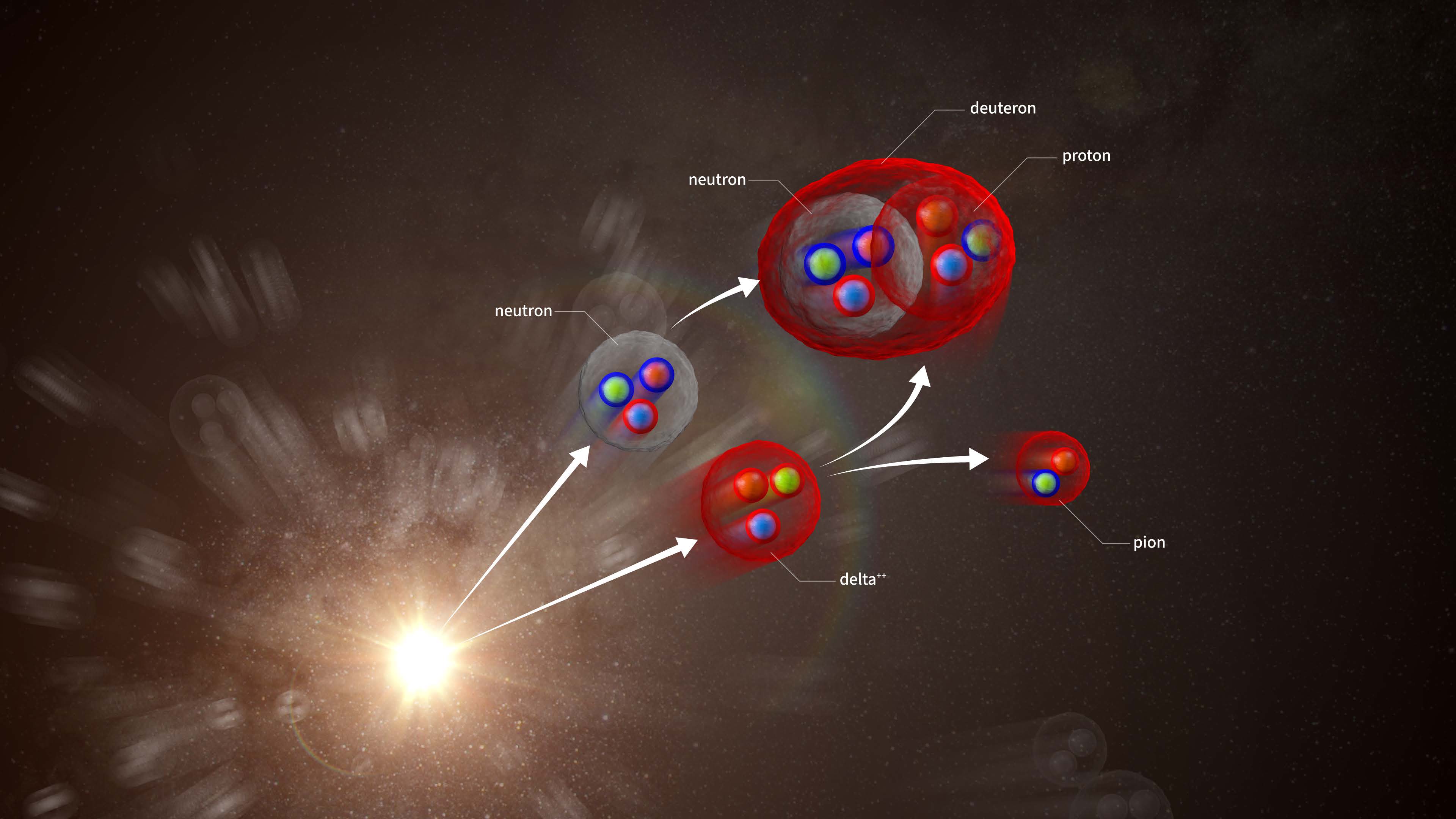
A deuteron is held together by only a few million electron volts, while LHC proton–proton collisions reach the scale of trillions of electron volts and are thus around a million times more energetic. Under such conditions, these light nuclei should be torn apart immediately, yet they are routinely observed. Until now, the microscopic mechanism behind their formation remained unclear.
The new study uses a technique called femtoscopy, which examines how pairs of particles are correlated in momentum, to probe the moment when deuterons are created in proton–proton collisions. The researchers focused on correlations between deuterons and pions, the light particles emitted in large numbers during the collisions. By analysing subtle patterns in these correlations, the ALICE collaboration found clear, model-independent evidence that most deuterons do not emerge directly from the collision itself. Instead, they form through a fusion process that happens after the decay of extremely short-lived intermediate states known as Δ (Delta) resonances. In this process, a pion created in the decay effectively “catalyses” the fusion of two nucleons into a deuteron by carrying away excess energy.
The findings show that roughly 80% of all deuterons and antideuterons observed in these collisions are produced through such resonance-assisted fusion, not by direct emission. This resolves a key question about how light nuclei form and survive in high-temperature hadronic environments. Beyond improving our understanding of how matter behaves under extreme conditions, the result offers a crucial input for astrophysics: accurate modelling of light-nuclei production is essential for interpreting cosmic-ray measurements and for searches for dark-matter signatures that rely on detecting rare antinuclei in space.