


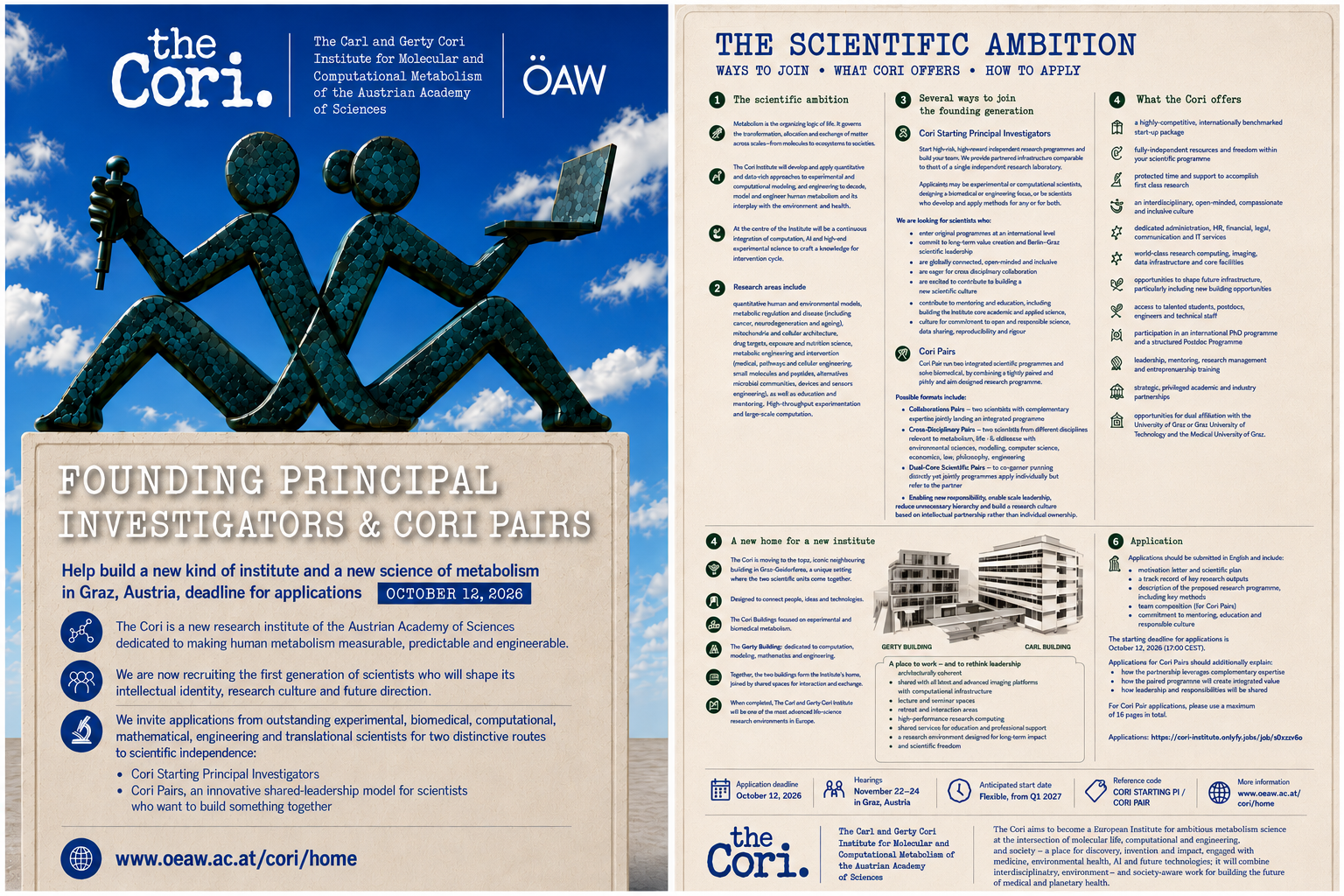
We are now recruiting the first generation of scientists who will shape its intellectual identity, research culture and future direction.
We invite applications from outstanding experimental, biomedical, computational, mathematical, engineering and translational scientists for two distinctive routes to scientific independence:
This is not simply an opportunity to join an established institute. It is an invitation to help invent one.
Metabolism is the organising logic of life. It governs the transformation, allocation and exchange of matter—from molecules and cells to organs, individuals and ecosystems.
The Cori will establish metabolism as a quantitative and actionable discipline by integrating:
At the centre of the institute will be a continuous data–model–intervention cycle: biological measurements inform predictive models; models generate hypotheses and designs; interventions test and reshape metabolic systems. A major long-term ambition is the construction of a quantitative model—a digital metabolic twin—of human metabolism.
We are interested in ambitious research across, but not limited to:
We are especially interested in scientists who connect disciplines that are too often separated: experiment and theory, medicine and engineering, molecules and environments, discovery and application.
More details on areas of interest to Cori at https://www.oeaw.ac.at/cori/research
1. Cori Starting Principal Investigators
Starting PIs will establish independent research programmes and receive the resources, freedom and institutional support required to pursue bold, high-risk and potentially field-defining science.
Applicants may be completing postdoctoral training, preparing to establish their first independent group, or have started an independent laboratory within the past few years.
We are looking for scientists with:
2. Cori Pairs
Carl and Gerty Cori transformed metabolism through scientific partnership. The institute bearing their names will create new opportunities for scientists to lead together. Cori Pairs will allow two outstanding scientists to apply jointly and share the leadership of a laboratory-equivalent scientific programme. Both partners will be recognised and employed as scientific leaders, while sharing infrastructure, personnel and responsibility for a common research environment. Possible formats include:
The Cori Pairs model is intended to distribute responsibility, enable scientists to enter leadership earlier, reduce unnecessary hierarchy and create a research culture based on intellectual partnership rather than individual ownership.
Successful candidates will receive:
Appointments are planned for an initial period of up to seven years, with the possibility of extension for strategically important and exceptionally successful programmes. Cori’s partnership with the three Graz universities is intended to create credible long-term academic perspectives and pathways towards permanent integration.
The Cori is being established in Graz, one of Europe’s most attractive university cities and an increasingly important centre for biomedicine, engineering, artificial intelligence, environmental science and biotechnology.
Its permanent campus will comprise two complementary buildings:
Together, they will embody the two interacting scientific cultures at the heart of the Cori.
Before completion of the permanent campus, founding groups will be accommodated in high-quality temporary facilities within the Graz university environment.
A place to lead—and to rethink leadership
The Cori will combine the ambition of a major international institute with the openness and agility of an organisation still being created.
Founding PIs will not only establish laboratories. They will help determine:
We seek people who want more than a position. We seek scientists who want to create an institution they would themselves have wished to join.
Applications should be submitted in English and include:
Maximum of 10 pages in total
Applications for Cori Pairs should additionally explain:
For Cori Pairs applications, please us a maximum of 14 pages in total.
Application deadline: October 12, 2026
Hearing dates: November 22-24, 2026 in Graz, Austria
Anticipated starting date: Flexible, from Q1 2027
Reference codes: CORI STARTING PI / CORI PAIR
Applications: https://cori-institute.onlyfy.jobs/job/s0xzzv6o
The Cori aims to become the European institute where the most ambitious scientists in metabolism come to decode life, build predictive models and design interventions for health, resilience and sustainability.
We invite you to bring your most original ideas, your most difficult questions—and, perhaps, the person with whom you would most like to answer them.
The Cori and the Austrian Academy of Sciences are committed to scientific excellence, equality, diversity and inclusion. Applications are welcomed from all qualified candidates regardless of gender, nationality, ethnic or social background, disability, age, religion, sexual orientation or personal identity. The working language of the Cori is English.
Graz combines the energy of a major university city with the scale, openness and quality of life of a place where people can genuinely connect. With around 60,000 students among approximately 308,000 permanent residents, it has a strikingly young, international and intellectually vibrant population. It brings together strong traditions in biomedicine, engineering, computation, environmental science and industry, creating an unusually fertile setting for interdisciplinary research. The city is compact, culturally rich and known for excellent food, architecture and music, while mountains, lakes, vineyards and outdoor life are close at hand. For scientists and their families, Graz offers the rare possibility of helping shape a major new institute while enjoying a city that is ambitious without being overwhelming, creative without being hectic, and easy to make one’s own.