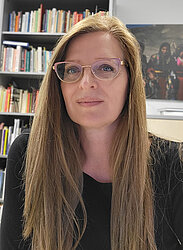
Marieke Brandt is a senior researcher at the ISA, with a primary focus on the anthropology and social and intellectual history of Yemen. She spent five years in Yemen, where she studied Arabic and worked in development and humanitarian cooperation. Since returning to academia in 2011, she has focused on the bottom-up exploration of Yemen’s Ansar Allah (Houthi) movement. This endeavour required extensive preparatory research through both on-site and digital ethnographic fieldwork, as well as the incorporation of emic source material ranging from medieval manuscripts and handwritten genealogies to contemporary media. Since 2013, deteriorating conditions in Yemen limited ethnographic fieldwork to the digital realm, leading her to refine digital anthropological methods and engage in their theoretical reflection.
Over time, her intellectual scope has broadened to address a wide range of questions about human existence. Her work engages themes such as memory, biography and life-writing, as well as the anthropology of encounter, resistance, religion, and ideology. Her work is inherently interdisciplinary and diachronic, spanning from the medieval period to the present, with Yemen – particularly the northern highlands – as its primary geographic anchor.
Her award-winning first monograph, Tribes and Politics in Yemen: A History of the Houthi Conflict (Oxford University Press/Hurst 2017), enquires into the evolution and early trajectory of the Ansar Allah/Houthi conflict within its local context, paying particular attention to vernacular voices and local agencies in policy implementation, ideology dissemination, and religious hermeneutics at the grassroots level. This work led to numerous invitations to deliver named lectures at prestigious universities and institutions such as Harvard, Princeton, and SOAS. It has been extensively reviewed and, in 2025, was translated into Arabic by the Omani publishing house Dar al-Falaq.
Her second monograph, The Tale of a Feud: Domination, Resistance, and Agency in Highland Yemen (Brill 2023), extends understandings drawn from this ethnography into the range of contemporary history and biographical reflection. This social biography, which reviewers have described as “masterful” and “outstanding,” explores how the dominant themes in Yemen’s republican discourse related to national politics, ideology, and religion shaped – and were shaped by – the life of an individual.
Currently, as PI of the ERC Advanced Grant project “Ideology in Context: An Agential Approach to the Study of Ansarallah (Houthi) Ideology” (IDEO-YEMEN), she is working on a monograph on the social and intellectual histories of Ansar Allah/Houthi ideology and its ambivalent relationship with Yemen’s rich modern (post-1930s) intellectual thought. At the centre of this work are vernacular Yemeni concepts and theorizations of identity, community, society, history, gender, development, and the arts. Together with Sam Liebhaber, she plans to make a collection of key texts from Yemen’s modern secular intellectual history accessible through translation.
She has received several prestigious fellowships, and her research has resulted in a substantial und internationally excellent publication record. Her peer-reviewed articles have appeared in journals such as Anthropology of the Middle East, Anthropos, Middle Eastern Studies, International Journal of Middle East Studies, Medieval Worlds, and Journal of Arabian Studies. Many of her publications have been translated into Arabic, underscoring their significance for Yemeni audiences. Her monographs and edited volumes have been reviewed in The Times Literary Supplement, The New York Review of Books, The Middle East Journal, Review of Middle East Studies, International Journal of Middle East Studies, Journal of Arabian Studies, and others.
It is worth mentioning that Marieke is a scholar with a severe disability (deafness), equating to an 80% disability rating.