



In Tibetan Buddhist cultural areas, landscapes are commonly defined by ritual practices and religious imaginations. As a consequence, space is conceptualised and transformed into „ritualised spaces“, which may widely differ, ranging from the cosmological world to personal spaces. A Tibetan Buddhist view of world geography reflects a religious cosmology. To make Tibet the land of Avalokiteśvara involves the action of ritualising a particular land. Through the ritual practice of circumambulation, particular routes become part of religious practices. Ritualised spaces are also manifested in geometrical patterns that are connected to the conceptualised and ritualised space. These range in scale from the layout of settlement structures to the location of buildings or even the arrangement of everyday artifacts. As ritualised spaces can ideally be constructed, they can also be disrupted, for example, by political decisions, natural environmental and climatic changes, or through shifts in religious beliefs. Disruptions may have significant consequences for the ritualised space.
In this context, understanding conceptualisation, processing, and disruption are crucial steps in defining sacred spaces and getting closer to understanding the nature of culturally shaped landscape that is expressed by ritual topography. In using a multidisciplinary approach addressing different villages in Buddhist cultural regions, this project, titled Spatial Concepts in the Western Himalayas (SCWH) based at the Austrian Academy of Sciences, is designed to study how ritual space is defined, constructed, and potentially disrupted in Tibetan Buddhist culture areas.
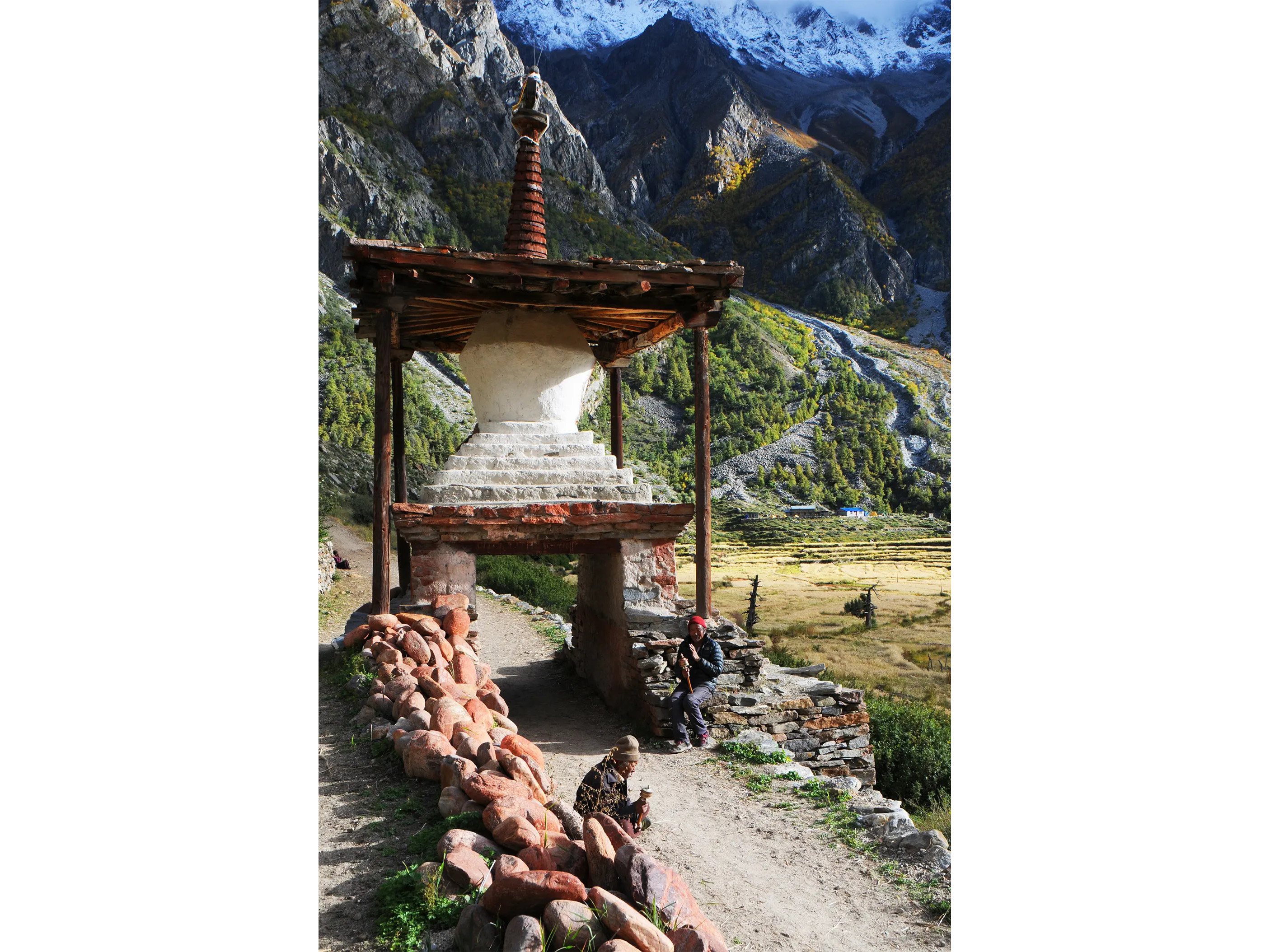
In Tibetan Buddhist cultural areas, landscapes are commonly defined by ritual practices and religious imaginations. As a consequence, space is conceptualised and transformed into „ritualised spaces“, which may widely differ, ranging from the cosmological world to personal spaces. A Tibetan Buddhist view of world geography reflects a religious cosmology. To make Tibet the land of Avalokiteśvara involves the action of ritualising a particular land. Through the ritual practice of circumambulation, particular routes become part of religious practices. Ritualised spaces are also manifested in geometrical patterns that are connected to the conceptualised and ritualised space. These range in scale from the layout of settlement structures to the location of buildings or even the arrangement of everyday artifacts. As ritualised spaces can ideally be constructed, they can also be disrupted, for example, by political decisions, natural environmental and climatic changes, or through shifts in religious beliefs. Disruptions may have significant consequences for the ritualised space.
In this context, understanding conceptualisation, processing, and disruption are crucial steps in defining sacred spaces and getting closer to understanding the nature of culturally shaped landscape that is expressed by ritual topography. In using a multidisciplinary approach addressing different villages in Buddhist cultural regions, this project, titled Spatial Concepts in the Western Himalayas (SCWH) based at the Austrian Academy of Sciences, is designed to study how ritual space is defined, constructed, and potentially disrupted in Tibetan Buddhist culture areas.
Date:
28th October & 29th October 2024
Ort:
Anton Zeilinger Salon
1010 Vienna, Dr. Ignaz-Seipel-Platz 2