


Iranian Studies in Vienna: the Long Night of Research
18.09.2024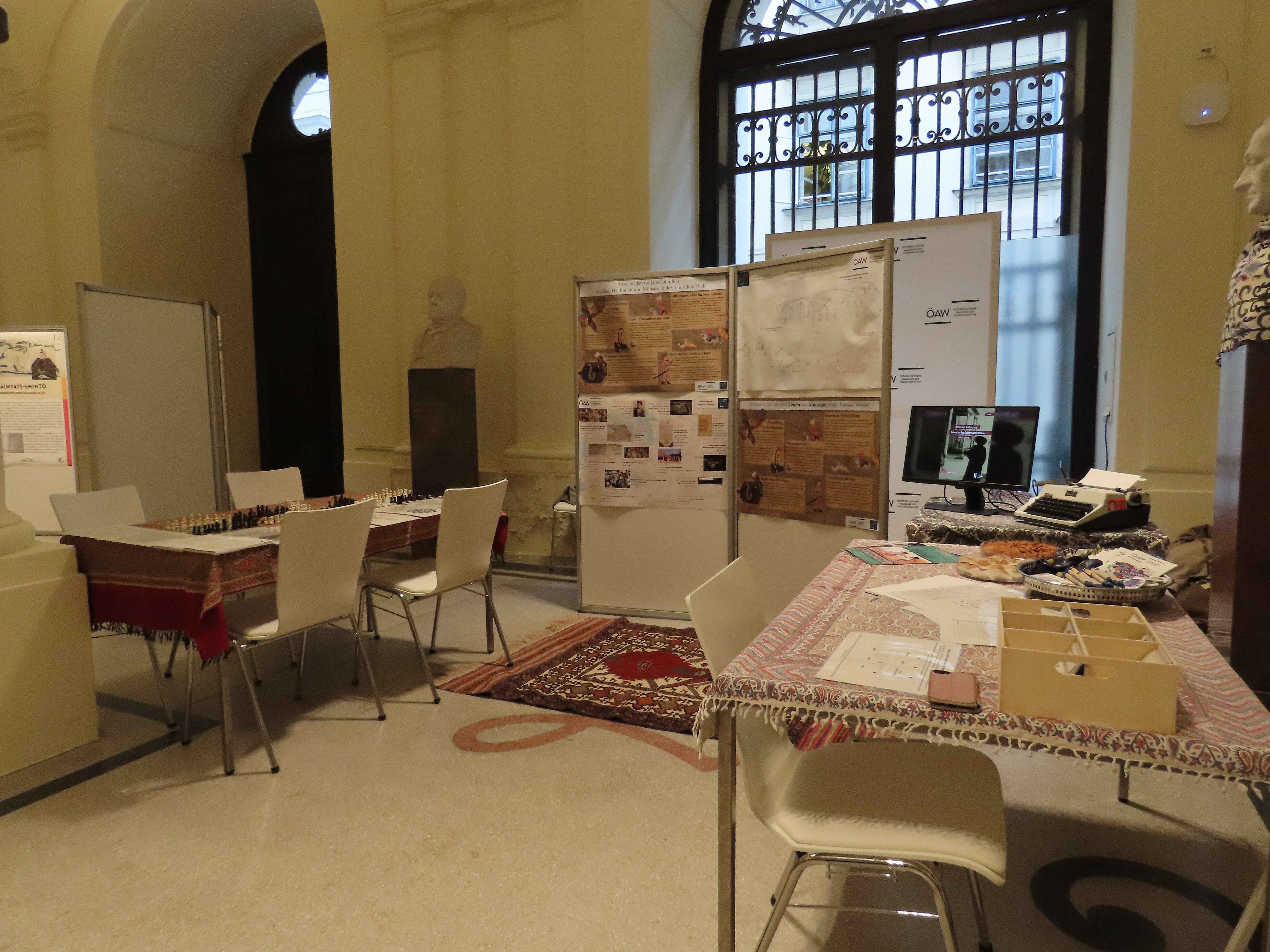
To tackle this issue, we looked for areas of common ground between academic research and daily life. We picked topics which involve motifs or ideas that people might be directly familiar with, loosely based around a theme of similarity and difference. In particular, we looked at languages and writing systems and at chess and chessboards for our main displays. We also put together some poster-style information, including on similarities and differences in mythology and folklore where comparisons can be made of cyclops legends or courtly romances which are also notable in premodern Europe. These are areas where quick parallels can be drawn with people’s own knowledge and experience, from which a small window onto the context can be made, rather than trying to information-load the context first which isn’t viable in a few minutes on an exhibit stall.
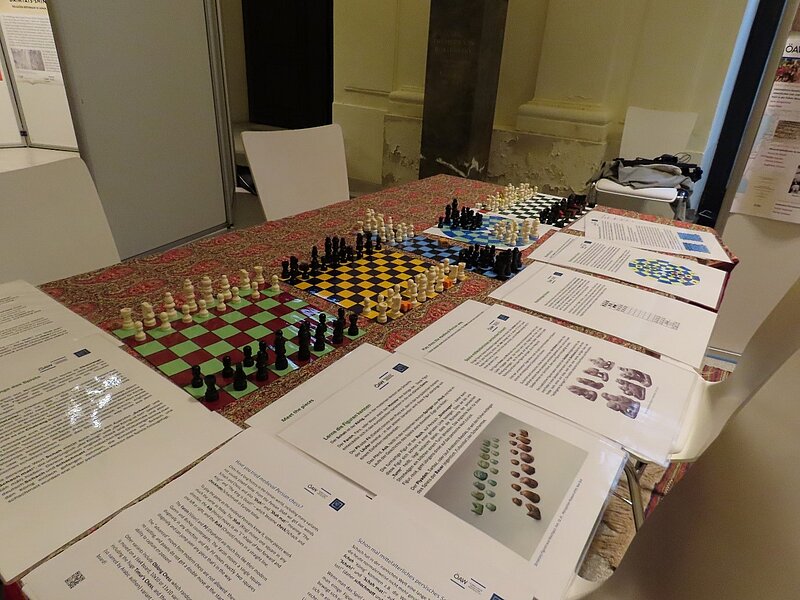
The chess display focused on the medieval history of Chess in the Iranian world and beyond: Iranian-world cultures were central to the development of chess as the world knows it today, the Persian word for a king, Shah, in Germanic languages becomes Schach and then the English word Chess, or Shah mat (the king is dead) becomes checkmate by a similar route. Looking back at the history of chess is both interesting in and of itself, with circular “Roman” chess or the enormous 11x12 square board of “Timur’s Chess” being visually interesting variants, but it also gives a window onto how different societies imagined the game: the bishop piece is an elephant in older variants, and the queen is a much weaker vizier or advisor piece.
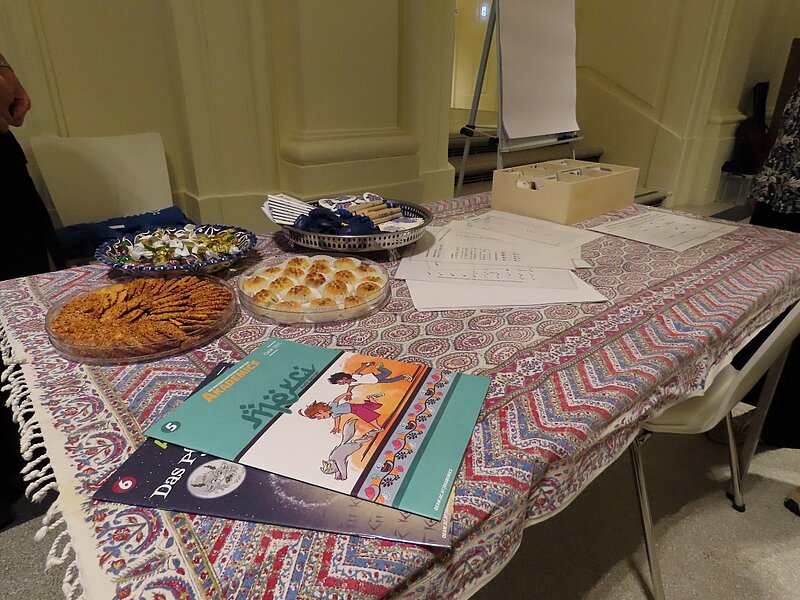
On linguistics, we had some public display information which focused on giving a broader sense of the picture – a wide language-family chart where people could find how languages they knew and were familiar with related to languages in the Iranian world – and activities matching parts of languages and writing in different scripts. An Arabic-script typewriter also proved very popular: especially for younger attendees, the physicality of having something more three-dimensional and mechanical can be very memorable.
Learning through action
It can be tempting for academics to focus on the information content of a display: we are, after all, used to trying to communicate with subject experts or students who are primarily interested in the information. Having activities that people can physically engage with, however, often stands out to people far more than trying to remember a block of text, especially in a situation where people might have seen tens of stalls if they were going around Vienna through the evening and the diversity of information can become overwhelming.
Using activities helps provide a more direct window onto that information. Fine motor skills were required for trying out the different kinds of scripts used in the Iranian world throughout history: we provided transliterated alphabets for Old Persian (written in Persian cuneiform, a type of syllabary), Farsi (written with a version of the Arabic alphabet or “abjad”), Sanskrit (Devanagari, an “abugida”) and Bactrian (written in the Greek alphabet), among others. Trying to write their names in different scripts allowed our visitors to gain an understanding of the principles that underly different writing systems, but also of the cultural connections underpinning the spread of these systems across the Iranosphere.
Sitting down and playing a medieval game of chess, meanwhile, put people more directly in the seat of people in premodern western Asia who would have played the game with much the same rules – though it comes with risks of misconceptions, this shared practice across cultures and times can be a very powerful tool for building empathetic curiosity. It can also provide a better route for people to remember and re-learn information - we gave out fliers with basic medieval Persian chess rules so people could try the classic game with their own sets at home, for example.
Conclusions
Some final thoughts to remember about public engagement in these sorts of events: first, we should remember its limits. The people who visit the LNF are a self-selecting part of the public, so what we have discussed here are the challenges of communicating with people who already actively want to hear about research and find out new things, and who have the time and space to engage with what we do. As such, it’s only one part of a successful programme for engaging beyond academia, though it is an important and useful one.
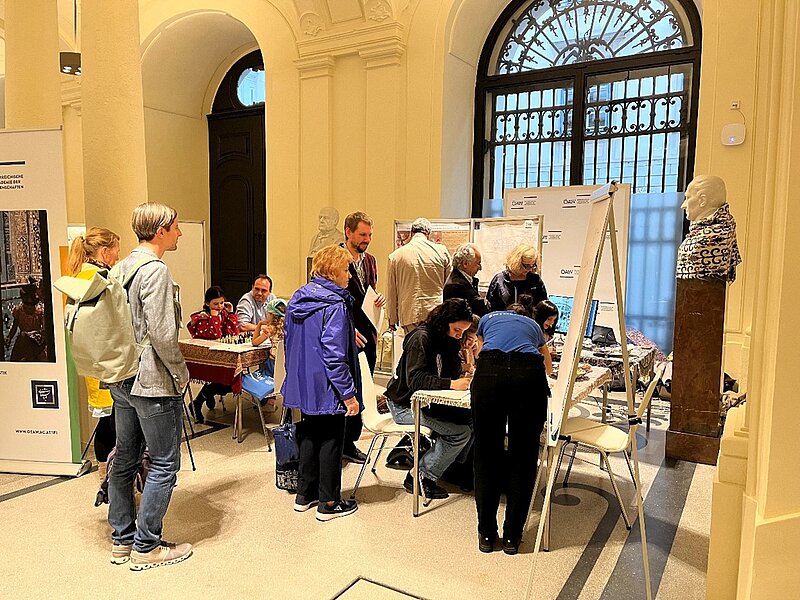
For big events, preparation is key. We spent time on everything from making posters with images from public-domain illuminated manuscripts, to ensuring we had the right number of tables and chairs available, to making laminated chessboards in unusual configurations and working out where to buy about two hundred spare chess-pieces (even then, working out how to represent the camels, giraffes and war engines in Timur’s chess took some creativity!). Translation mattered, too, and we also managed to put together a good team of volunteers from the Institute, which made it possible to talk to more members of the public at once than we might have been able to otherwise.
We had a really successful night at the Lange Nacht der Forschung 2024: discussions on languages and linguistics were happening throughout the evening, visitors competed against each other and against institute members at the chess table until the very last minute of the event, people took pictures of our posters on their phones to check out later, and several happy teenagers learned how to write their names in Arabic, Devanagari and Pahlavi. Finding good hooks to link people’s lives to our research can be a powerful tool for explaining what we do and exploring the Iranian worlds that, across gaps of culture, language and time, we try to translate and understand together.