

Central Asian Manuscripts Conference, Samarkand, May 2024
12.08.2024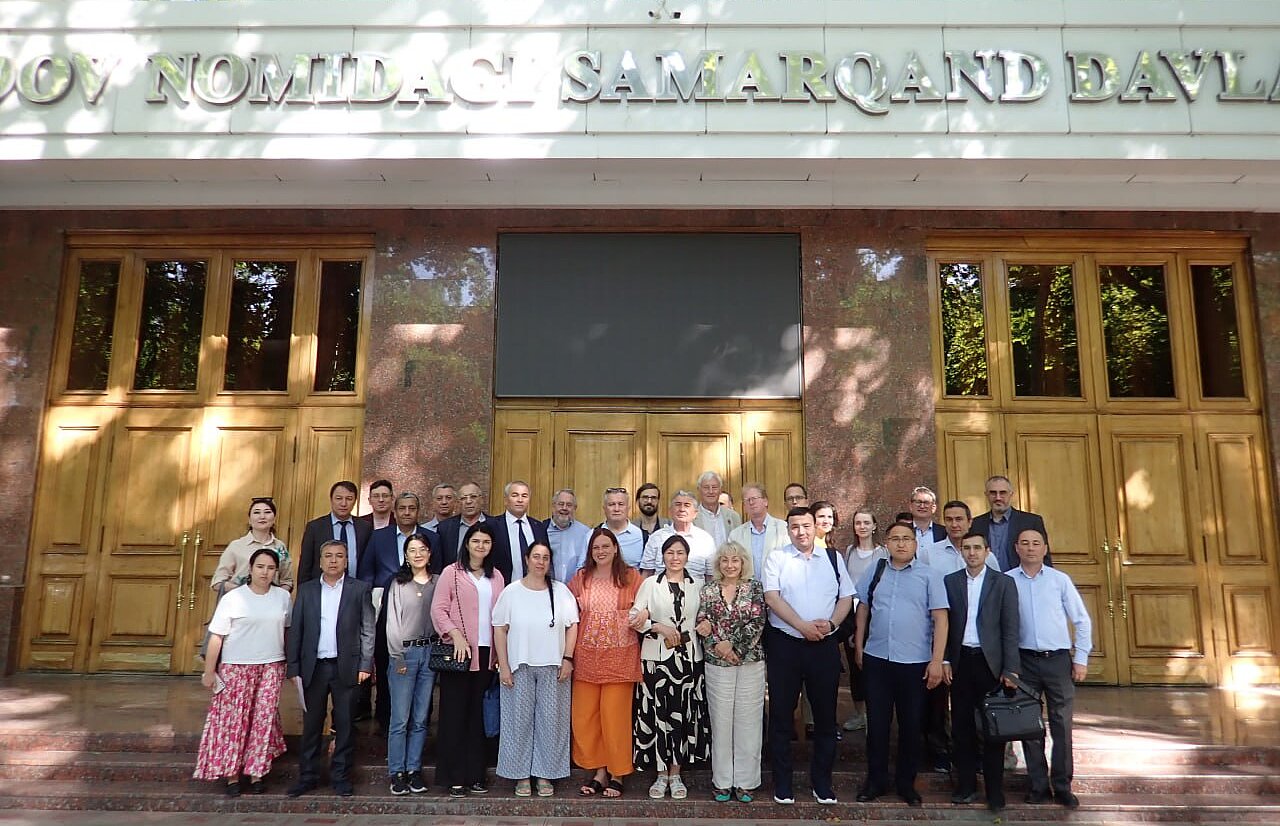
Dr Bruno De Nicola recently organized an international conference as part of his FWF-START project "Nomads' Manuscripts Landscape" (NoMansLand), together with the Bukhari Research Centre in Samarkand and in cooperation with the Institute of Iranian Studies (IfI) of the Austrian Academy of Sciences, the Abu Rayhan Biruni Institute of Oriental Studies in Tashkent, and Samarkand State University. Participants from Europe, the United States, and Uzbekistan gathered in Tashkent and Samarkand for three days of events around the topic of “Central Asian Manuscripts in the Mongol and Timurid Empires.”
In the same vein, Professor Charles Melville from the British Institute of Persian Studies (BIPS) and the University of Cambridge elaborated on how the accessibility of digitized manuscripts brings Central Asian heritage and manuscript collections to a broader audience, also suggesting a joint-publication journal and conducting marketing research to create a higher demand and interest for this field. Subsequently, Dr Nodir R. Karimov from Tashkent State University of Oriental Studies presented its different faculties and how students are educated on the study of manuscripts to be ready for potential collaborations and partnerships. In addition, Dr Firuza Melville from the Shahnamah Project, Pembroke College, offered three concrete suggestions for projects: restoring and documenting Central Asian manuscripts in Cambridge, studying a Shahnamah from the Biruni Institute, and introducing the collection in general to a wider public. Lastly, Dr Sanjar Gulomov highlighted aspects of documents compared to manuscripts, with a particular focus on manuscripts from the Biruni Institute, bringing the focus back to the local context.
These talks revealed the importance of three central aspects when studying manuscripts: institutions, research, and education. They laid the foundation for future joint projects, as showcased in the lively discussion afterwards. Other scholars also came forward to offer comments and suggestions, voicing further aspects such as provenance research, database connections or the necessity of funding. As such, this meeting proved to be a fruitful starting point of exploring new ways of collaboration, with many new ideas to be developed in the time ahead.
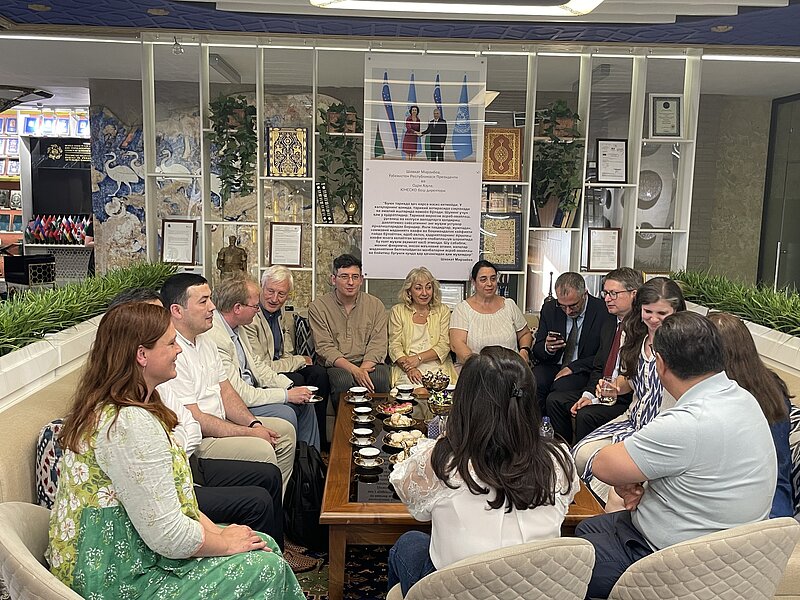
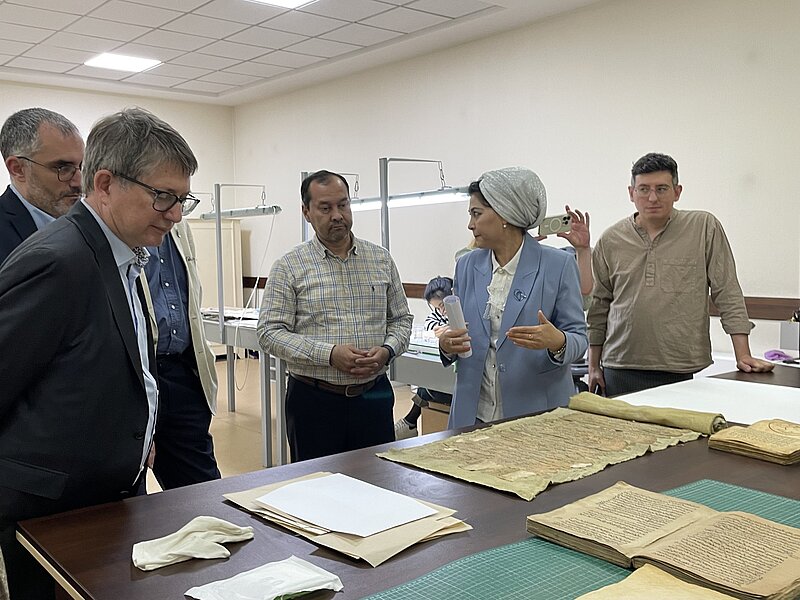
The roundtable was followed by two delightful events. First, the participants were given a guided tour of the institute, including a brief overview of its history, glimpses into the restoration and copying processes undertaken in its labs, and an introduction to the digital tools used for manuscript research. A wonderful selection of manuscripts was displayed in the domed hall, with important texts like the Tafsir ‘Abd al-Qahir, colorful illustrations, and decorative margins. Secondly, the participants had the opportunity to visit the office of the World Society for the Study, Preservation, and Popularization of the Cultural Legacy of Uzbekistan (WOSCU). A scientific briefing was held there and subsequently published on their website. The WOSCU presented their many current projects in the field of preserving cultural heritage, after which stimulating discussions arose to continue and to establish cooperation in the future.
Scholarship and sightseeing in Samarkand
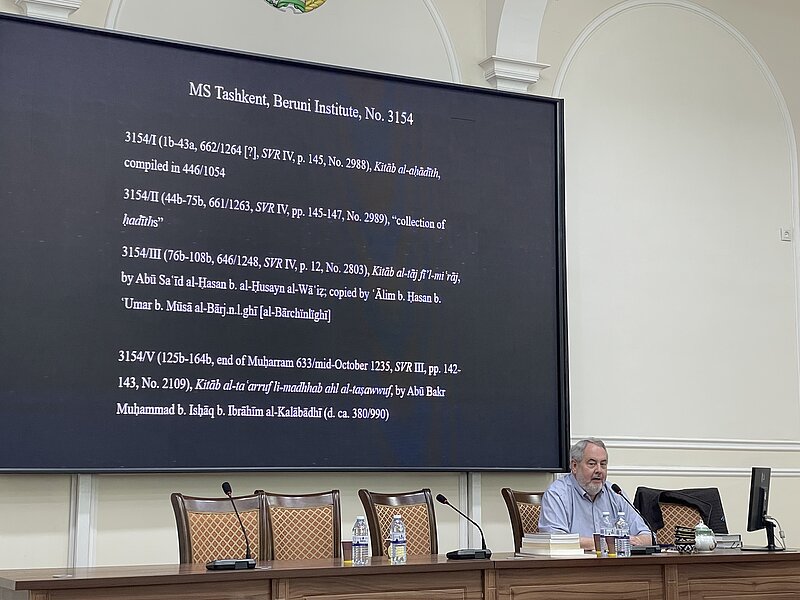
The following day, the conference participants travelled on the Afrasiyob train from Tashkent to Samarkand. There, the State University of Samarkand had organized a delicious welcome lunch reception with traditional foods, followed by a tour through the archaeological museum-exhibition on the premises. In the evening, Professor Devin DeWeese from Indiana University kicked off the conference by delivering an insightful keynote lecture, demonstrating through a network of local intellectual associations how the Mongol era was formative in terms of knowledge transmission. Professor DeWeese brought his audience on a deep dive into manuscripts as venues through which history is conveyed, particularly highlighting the interplay between oral transmission and written manuscripts. This inspired a lively discussion afterwards with many interested auditors from Samarkand.
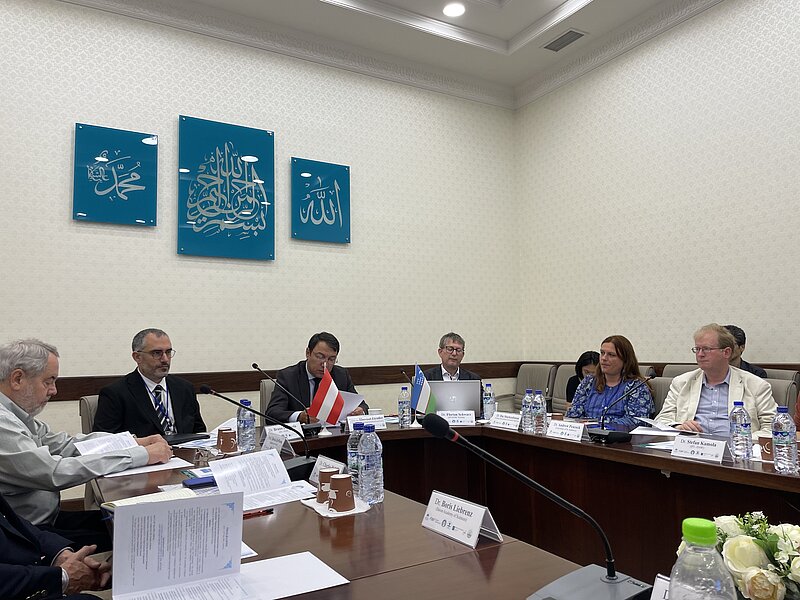
The main conference filled the next two days in the beautiful venue of the Bukhari Research Centre, where exciting lectures were offered on Sufism, historical and epic texts, law and education, and materiality of manuscripts. Further talks focused on libraries and collections, poetry, manuscript production, and the documentation of Central Asian manuscripts. Delectable reception snacks and lunches were served in-between. The lectures were delivered in both English and Uzbek with translators present, transforming the conference into a compelling bilingual event. A publication of the proceedings is forthcoming. At the end, the local organizers invited the participants to leisurely browse through the curated manuscript exhibition at the research center.
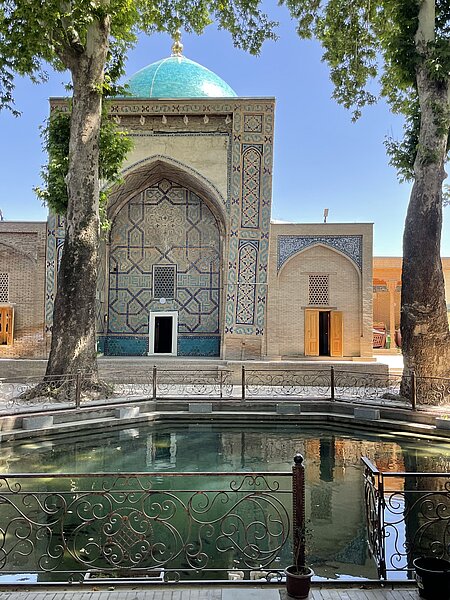
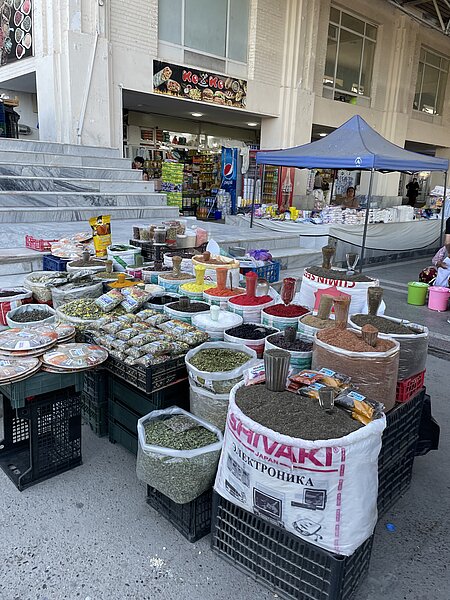
On the very last day, the participants visited key monuments such as the pristine Rukhobod Mausoleum next to the impressive Gur-i Amir, taking them back to a time long past. The massive Registan Square radiated in the sunlight, and glimpses of the unrestored Ishratxona Mausoleum provided insights into the building structure. The tranquil Khodzha Abdu-Darun Mausoleum gave the visitors some repose before they were awed by the monumental Bibi Khanym Mosque. The adjacent bustling Siyob Bazaar with selections of traditional clothes, food, and spices presented a final opportunity to purchase souvenirs of this terrific trip.
The conference proved to be a resounding success, with many new connections made and potential further research to be conducted with like-minded colleagues. The organizing team is looking forward to further collaborations!