

Heritage and Resilience VII+VIII: Oirat-Kalmyk Folk Songs
OIRAT-KALMYK FOLK SONGS. DOCUMENTATION, PUBLICATION AND RESEARCH
Ghilyana Dordzhieva
Mongol-American Cultural Association
Chingis Azydov
Friedrich Schiller University Jena
PROGRAMME | REGISTRATION required by 16 May 2025
23 May 2025, 4 p.m.
Institut für Romanistik, Campus AAKH, ROM 14
Spitalgasse 2, Hof 8
1090 Vienna
Ghilyana Dordzhieva | Mongol-American Cultural Association
Kalmyks' and Western Mongols' Ut Dun/Urtyn Duu Long Songs
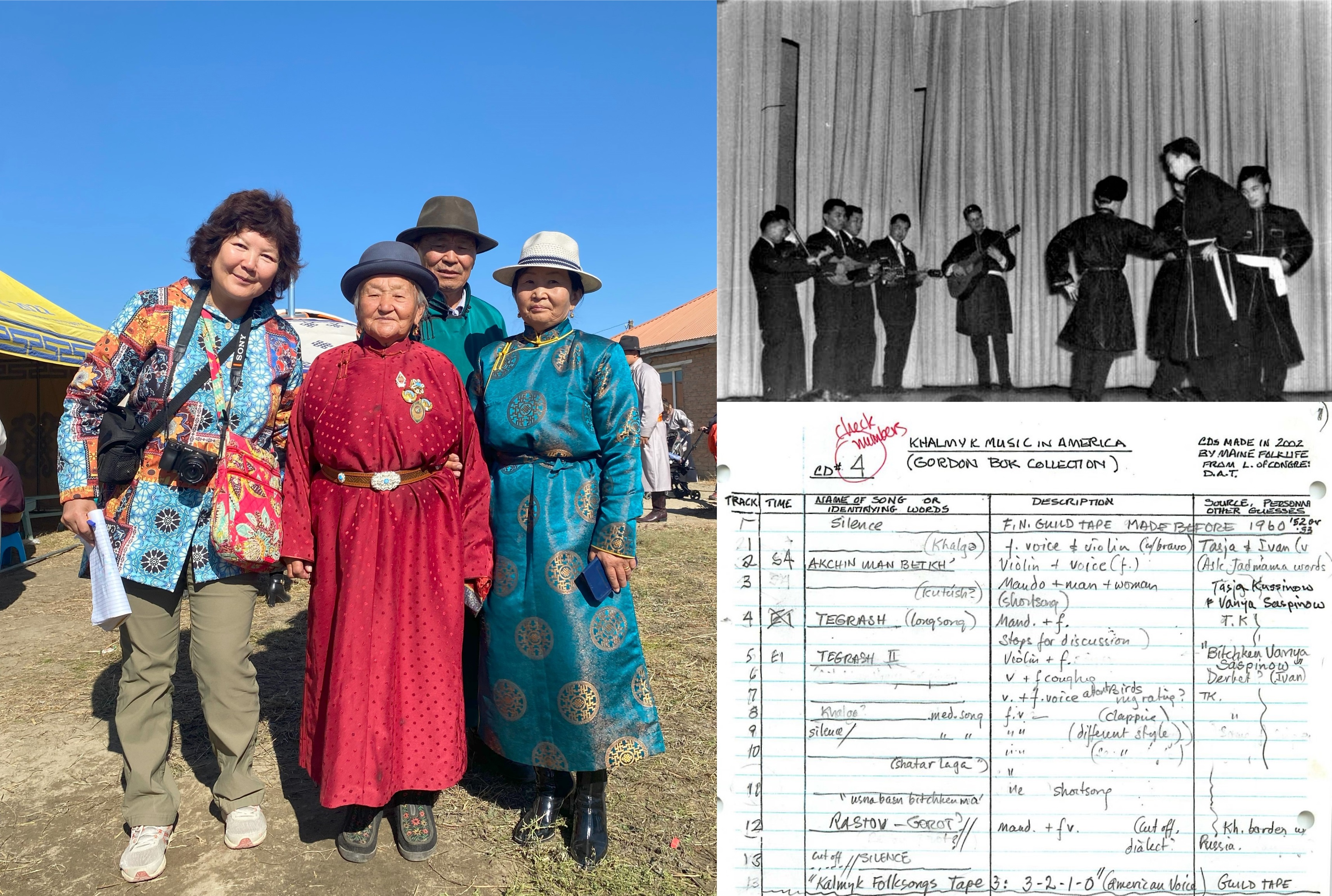
The Western Mongolian regional traditions of ut dun/urtyn duu long songs encompass the musical heritage of the Oirat ethnic groups in the Uvs, Hovd and Bayan-Ölgii provinces of Mongolia, as well as in Inner Mongolia and the Xinjiang Uyghur Autonomous Region of China and the Kalmyk Republic of Russia. This lecture will explore long songs as vital expressions of identity, shared history, collective memory, cultural customs and etiquette. Specific attention will be given to the musical characteristics, particularly the correlation between words and tune, alongside rhythm and temporal structure, which define Mongolian long songs as unique forms. A primary objective is the publication and cataloging of Kalmyk and Oirat ut dun/urtyn duu, ensuring their preservation and accessibility. Effective classification methods for preservation consider the analysis of poetical themes, social functions, ritual contexts, structural and musical features, documentation of melodic types, and their geographical distribution. Integrating these methods will deepen our understanding of long songs, highlighting their cultural, historical and artistic significance.
Chingis Azydov | Friedrich Schiller University Jena
Folk Songs Recorded Among Kalmyk Emigrants to Europe and America
The civil war in Russia caused widespread destruction and claimed many lives, forcing many Kalmyks to flee their homeland for survival. In 1920, some emigrated to Turkey, and later to Europe. After World War II, these Kalmyks, along with a new wave of refugees, ended up in displaced persons camps in Germany, from which they migrated to the United States in 1951-1952. Despite being far from their homeland, the Kalmyks made great efforts to preserve their language and folklore. In the 1960s-70s, American musician Gordon Bok encountered the Kalmyks and their folk music in Philadelphia. A few years later, he gathered a small archive of Kalmyk folk music. His digital collection includes 13 folders with 226 audio recordings of Kalmyk folk songs in various genres, as well as dance melodies played on the mandolin. It features home recordings of Kalmyk immigrants in Philadelphia and New Jersey, as well as recordings made by Gordon Bok himself. The Kalmyks also recorded songs passed down from older relatives. In 1974, Alta Buruschkin recorded a few ut duun (long songs) performed by his grandfather, Sandscha Buruschkin.
Informationen