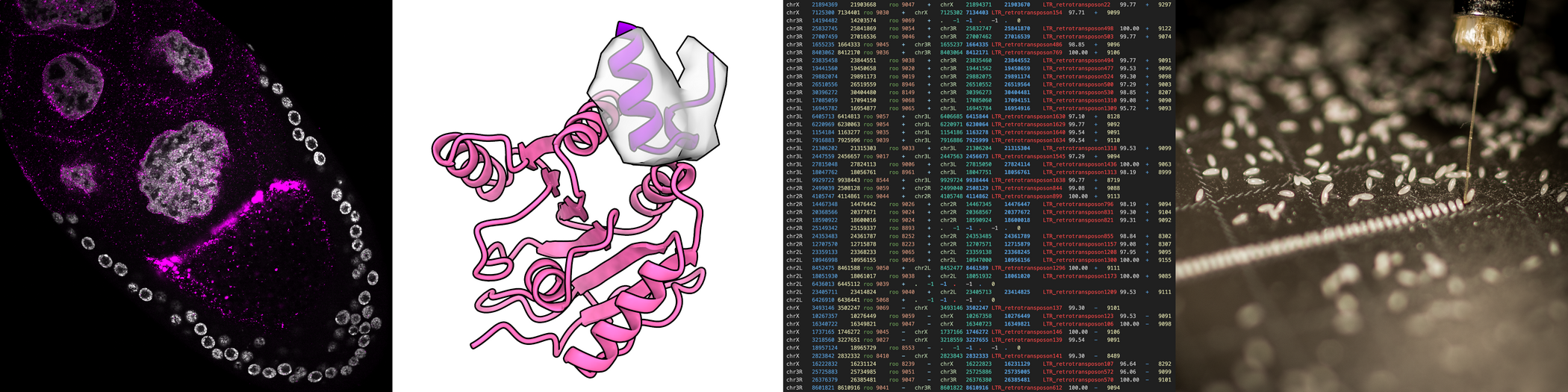
The piRNA pathway is an RNA-based immune system that protects animal germ cells from transposable elements. It relies on PIWI proteins—a distinct subfamily of Argonaute proteins—loaded with small RNAs known as PIWI-interacting RNAs (piRNAs). piRNAs guide PIWI proteins to complementary RNAs, enabling highly specific recognition and silencing of genome invaders. Our lab investigates how this pathway is assembled, how it distinguishes host transcripts from transposons, and how it intersects with chromatin biology to enable heritable silencing. We focus on three major conceptual areas:

A central question in piRNA biology is how cells distinguish their own transcripts (self) from those of invading elements (non-self). This step—selecting specific RNAs as piRNA precursors—defines the specificity and target spectrum of the pathway.
We investigate the molecular logic that guides precursor selection and how this logic adapts when new transposons enter the genome.
By studying these questions, we aim to gain unique insight into how host organisms adapt to the evolving threat posed by transposons.

Besides the cytoplasmic branch of the pathway that degrades transposon transcripts through cleavage, one PIWI-clade protein, Piwi, acts in the nucleus, where it targets nascent transposon transcripts and recruits heterochromatin factors to co-transcriptionally silence the underlying locus.
We study how Piwi couples target RNA recognition to the assembly of a heterochromatin silencing complex. Remarkably, these studies also provide insight into how target RNA recognition is coupled to piRNA biogenesis in the cytoplasm.
We also explore how Piwi defines the fate of its targeted RNAs—ensuring that transposon transcripts are retained and degraded in the nucleus, rather than escaping to the cytoplasm.
piRNAs are encoded at specific genomic loci known as piRNA clusters—heritable repositories of silencing information, conceptually similar to CRISPR arrays in bacteria. In the Drosophila germline, these clusters reside in dense heterochromatic regions, where gene expression is typically repressed.
We are uncovering how the piRNA pathway co-opts the host’s transcriptional machinery to enable piRNA cluster transcription. Central to this process is the HP1 family protein Rhino, which, together with specialized cofactors, forces transcription initiation and elongation within heterochromatin.
By dissecting these molecular adaptations, we reveal how piRNA clusters act as dynamic immune memory elements in the genome and how the transposon–host arms race diversified the gene expression program.
Transposons are highly adaptable genomic elements that must continuously evolve to evade host defense systems and ensure their propagation. In response to selective pressures imposed by silencing pathways such as the piRNA system, they have acquired a range of molecular strategies that optimize their replication, transmission, and persistence within the host genome. Our lab investigates these adaptations from the transposon’s perspective. We study how the structural components and cis-regulatory sequences of LTR retrotransposons co-evolve with different infectivity mechanisms in order to exploit specific features of the host germline environment.

LTR retrotransposons encode capsid-like structures that protect their genomic RNA and mediate intracellular trafficking.
These virus-like particles interact with host factors to localize to specific subcellular destinations, some translocate into nuclei, while others hijack host cellular biology to accumulate in the oocyte pole plasm, where future germline cells will form.
We are investigating the molecular logic of these interactions by combining targeted transposon genetics with cryo-electron tomography (cryo-ET) in collaboration with the group of Sven Klumpe.
Our goal is to understand how capsid structure and dynamics influence host engagement and determine transposon fate within the gonad.

Some LTR retrotransposons have evolved the ability to cross from somatic support cells into neighbouring germ cells, mirroring aspects of retroviral infection.
Surprisingly, we discovered a novel infectivity mechanism that relies on a small transmembrane protein rather than a canonical envelope protein. This strategy enables the direct transfer of retrotransposon particles between cells and opens up new questions about how infectivity evolves in the absence of classical viral machinery.
We are studying how infectivity mechanisms vary across transposon families and how the diverse somatic cell type niches in the gonad influence the evolution of horizontal transmission routes.

Successful transposon replication depends on precisely timed gene expression. We recently uncovered pervasive niche expression of LTR retrotransposons in the Drosophila ovary.
We are dissecting the cis-regulatory architecture of these elements using single-cell technologies, phylogenetic analysis, and synthetic reporter systems.
By examining how promoter and enhancer elements co-evolve with replication strategies, we aim to understand how transposons optimize their transcriptional programs—and how regulatory innovation contributes to their long-term persistence in the genome.

By studying the piRNA pathway, we often uncover new and unexpected biology. Time and again, this small RNA pathway has co-opted variants of highly conserved host proteins for new roles or evolved mechanisms that intersect with the core processes of chromatin regulation, transcription, and RNA export.
These molecular intersections provide us with a powerful entry point into understanding the core gene expression machinery. We believe that studying evolutionary innovations in the piRNA pathway not only reveals how this genome-defense system operates but also sheds new light on how cells manage and interpret their genetic information.
For instance, our recent discovery of a non-canonical export route for piRNA precursors sparked an exciting collaboration with the lab of Clemens Plaschka, in which we uncovered how cells sort and distinguish different RNAs within the nucleus.
In this way, the evolutionary arms race with transposons doesn’t just drive innovation in genome defense, it also provides us unique entry points into studying the inner workings of the cell.


